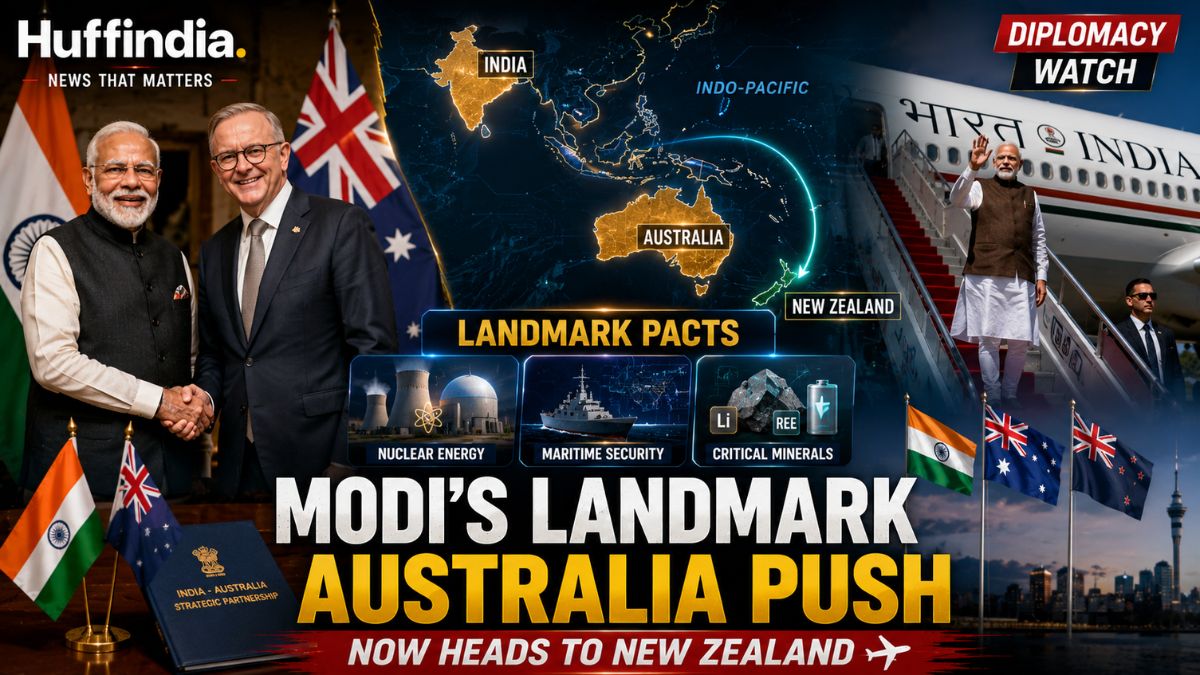



The PM Modi Australia visit concluded on Friday with Prime Minister Narendra Modi leaving for New Zealand after three days of high-level engagements that produced a broad set of outcomes spanning civil nuclear energy, defence, maritime security, critical minerals and economic cooperation.
Modi’s departure marked the end of the Australian leg of his three-nation tour covering Indonesia, Australia and New Zealand. His visit to Australia included the third India-Australia Annual Summit with Prime Minister Anthony Albanese in Melbourne, alongside business and political engagements.
The latest agreements reflect the steady expansion of India-Australia relations beyond trade and diaspora ties into areas increasingly linked with energy security, Indo-Pacific stability and resilient supply chains.
PM Modi Australia Visit Ends With Wide-Ranging Strategic Outcomes
The PM Modi Australia visit produced a substantial list of bilateral outcomes, according to India’s Ministry of External Affairs.
Among the most closely watched developments was cooperation in civil nuclear energy, alongside initiatives related to defence, maritime security and critical minerals. The two sides also advanced engagement across technology, education, investment and other sectors.
The breadth of the outcomes matters because India and Australia have spent recent years deepening their Comprehensive Strategic Partnership. Both are also members of the Quad, alongside Japan and the United States, though their bilateral relationship extends beyond that grouping.
For New Delhi, Australia is important as a major Indo-Pacific partner and a resource-rich economy. For Canberra, India represents a large and growing market as well as an increasingly significant strategic actor.
Civil Nuclear Energy Emerges as a Major Headline
Civil nuclear cooperation was one of the most significant elements of the visit.
Recent reporting said the two countries moved to operationalise arrangements that could facilitate Australian uranium supplies to India for peaceful nuclear-energy purposes under agreed safeguards. The development is strategically important because Australia holds major uranium resources, while India is seeking to expand low-carbon electricity generation and strengthen long-term energy security.
The issue has a long diplomatic history and therefore carries significance beyond a single commercial transaction.
However, the outcome should be reported carefully. Cooperation and supply frameworks do not mean that every commercial, regulatory or logistical step is automatically complete. Actual flows will depend on implementation, contracts and applicable safeguards.
Maritime Security Gains Fresh Momentum
The PM Modi Australia visit also placed strong emphasis on maritime and defence cooperation.
India and Australia share interests across the Indian and Pacific oceans, where secure sea lanes are vital for trade, energy flows and regional connectivity. The bilateral agenda includes maritime domain awareness, defence engagement and wider security coordination.
The strategic logic is clear. Both countries depend heavily on stable maritime routes, while regional security challenges increasingly require information sharing and practical cooperation.
At the same time, the partnership should not be reduced to a single geopolitical rivalry. India and Australia maintain their own foreign-policy priorities, and their cooperation spans trade, education, technology, resources and people-to-people ties in addition to security.
Critical Minerals Partnership Could Shape Future Supply Chains
Critical minerals formed another major pillar of the talks.
These materials are essential for sectors including electric vehicles, batteries, renewable-energy systems, advanced electronics and high-technology manufacturing. Australia possesses substantial mineral resources, while India is seeking to expand domestic manufacturing and reduce vulnerabilities in strategic supply chains.
During the visit, the two sides highlighted work towards deeper critical-minerals cooperation, including the prospect of stronger corridor and investment links.
The opportunity is significant, but execution will be decisive. Mining projects can require years of approvals and capital investment, while processing and refining capacity often determine whether raw resources translate into resilient industrial supply chains.
Trade and Investment Remain Central to the Relationship
Security and energy dominated many headlines, but economic ties remained central.
During the summit, the two leaders discussed efforts to advance a bilateral investment treaty and broader economic cooperation. Business engagements during Modi’s visit also reflected interest in expanding commercial links between Indian and Australian companies.
The existing economic relationship has already been strengthened through the India-Australia Economic Cooperation and Trade Agreement. The next challenge is to widen investment and create more durable commercial partnerships.
Education remains another major bridge, supported by a large Indian-origin community in Australia and extensive student links.z
Also Read | India-Japan Strategic Partnership: PM Modi Welcomes Japanese PM Sanae Takaichi to New Delhi
Why the Australia Visit Matters for India’s Indo-Pacific Strategy
The PM Modi Australia visit fits into a broader pattern of Indian engagement across the Indo-Pacific.
Modi’s itinerary covered Indonesia, Australia and New Zealand from July 6 to 11, according to his official departure statement. That sequence itself highlights India’s effort to strengthen relationships across a region central to trade, maritime connectivity and strategic competition.
India’s approach combines multiple tracks: strategic partnerships, economic ties, energy security, defence cooperation and engagement with regional institutions.
The Australia leg demonstrated how these priorities increasingly overlap. Uranium cooperation connects diplomacy with energy policy. Critical minerals link foreign relations to manufacturing. Maritime security connects defence with trade.
The wider objectives of the three-country diplomatic tour were outlined in the Prime Minister of India’s official departure statement.
Modi Heads to New Zealand for Final Leg
After concluding his engagements in Australia, Modi departed for New Zealand, the final destination of the tour.
The visit follows an invitation from New Zealand Prime Minister Christopher Luxon and builds on the momentum created by Luxon’s India visit in 2025. Official Indian material had earlier confirmed the broader three-country itinerary and the reciprocal diplomatic context.
Attention will now turn to the economic and strategic agenda in New Zealand, including opportunities to deepen bilateral cooperation and strengthen India’s wider Pacific engagement.
Final Words
The conclusion of the PM Modi Australia visit marks a notable phase in India-Australia relations.
The three-day trip produced outcomes across civil nuclear energy, maritime and defence cooperation, critical minerals and economic engagement. Together, these areas show how the relationship is evolving from a traditionally important partnership into a more complex strategic framework.
Yet the real measure of success will come through implementation. Nuclear cooperation will depend on safeguards and commercial arrangements. Critical-minerals partnerships will require viable projects and processing capacity. Maritime cooperation will need sustained institutional engagement.
As Modi heads to New Zealand, the broader message from the tour is clear: India is seeking deeper, more diversified partnerships across the Indo-Pacific, with energy, security, technology and supply-chain resilience increasingly at the centre of its diplomacy.