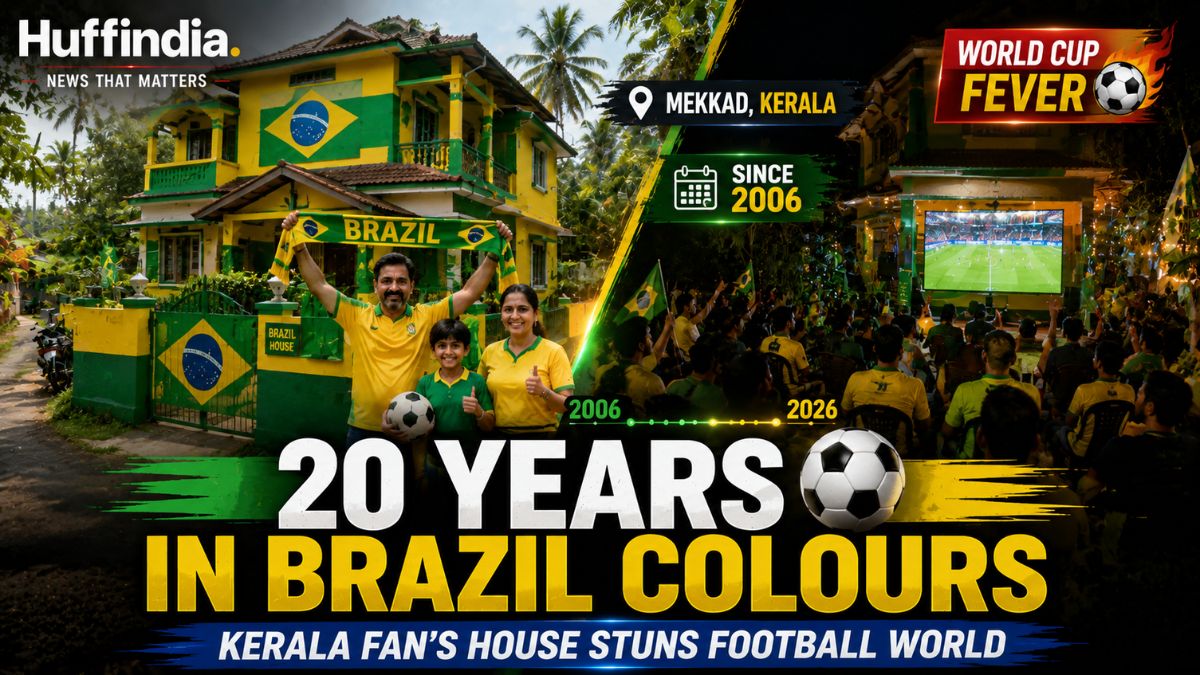



The House of Brazil Kerala is not a temporary World Cup decoration or a short-lived burst of football fever. Tucked away in Mekkad near Nedumbassery, on the outskirts of Kochi, the green-and-yellow home of Brazil supporter Salu Paul has become a striking symbol of fandom that continues long after tournament banners elsewhere are taken down.
Painted in colours associated with the Brazilian flag and national football team, the house stands out immediately from its surroundings. But the story behind it is less about a fresh coat of paint and more about a family’s enduring connection with football.
According to the account provided for this story, the home has carried its Brazil identity since 2006. Recent independent coverage confirms that Salu’s current residence remains extensively decorated in Brazilian colours, with flags, player murals and themed fencing.
House of Brazil Kerala Is More Than World Cup Decoration
The House of Brazil Kerala attracts extra attention whenever the FIFA World Cup arrives, but Salu’s devotion is not limited to tournament season.
That distinction is central to the story.
Across Kerala, football tournaments often transform streets, shops and neighbourhoods. Giant cut-outs appear, flags cross roads and supporters publicly declare loyalty to Brazil, Argentina and other major teams. Much of that decoration is naturally seasonal.
Salu’s house is different because the Brazil identity stays.
Recent reporting by The New Indian Express described the Mekkad home as a Brazil shrine, with yellow and green across the property alongside flags and murals. Salu told the publication that the latest makeover took nearly a month, with additional decoration supported by fellow fan-association members.
Salu Paul’s Brazil Passion Goes Back to His School Days
The story did not begin with the 2026 World Cup.
Salu has said his support for Brazil dates back to his school years. In a recent interview, he recalled admiring Brazilian football figures including Roberto Carlos, Zico and Sócrates and remembered watching matches in a social setting with family, neighbours and relatives.
That history helps explain why the house feels more permanent than a tournament promotion.
For Salu, Brazil fandom has crossed generations of players and multiple World Cups. Teams have changed, stars have retired and football tactics have evolved, but the allegiance has remained.
The current house is also not his first home to carry Brazil colours. Local reporting says his earlier house after marriage was similarly painted in canary yellow, reinforcing that the visual identity predates the latest tournament.
Why Mekkad’s Brazil House Has Drawn Fresh Attention
The 2026 World Cup has brought renewed visibility to the property.
Reuters photographs from June show Salu Paul with his wife Lathi and daughter Nayana outside the Brazil-coloured home in Mekkad. Another recent image report documented supporters arriving to watch a Brazil match on a large screen installed at the residence.
Those scenes show how a private home can also become a community gathering point during major football nights.
The significance is not simply visual. A brightly painted house may attract cameras, but collective viewing gives the place a social role. Friends, relatives, neighbours and supporters can share the tension and celebration of a World Cup match together.
That echoes an older era of football viewing, when fewer households had access to television and major games often became communal events.
Kerala Football Fans Share a Deep Connection With Brazil
The House of Brazil Kerala also fits into a wider football culture for which the state is well known.
Kerala’s enthusiasm for international football becomes especially visible during World Cups. Support is often intensely divided between global football powers, with Brazil and Argentina commanding particularly passionate followings.
In this environment, supporters do more than watch matches. They create fan associations, install flags and cut-outs, organise screenings and turn neighbourhoods into highly visible expressions of sporting loyalty.
Salu’s home represents an unusually permanent version of that culture.
Instead of disappearing after a final whistle, its colours remain part of everyday life. That continuity is what separates the house from many temporary fan displays.
For official tournament updates, fixtures and wider World Cup coverage, readers can follow FIFA’s official World Cup portal.
Also Read | France vs Morocco World Cup: Les Bleus Win 2-0
Family Support Keeps the Tradition Alive
Large-scale fandom inside a family home inevitably depends on more than one person.
Recent reporting highlights the role of Salu’s family and friends in supporting the tradition. He has credited those around him for helping make the scale of decoration possible, while saying that the wider family now supports Brazil as well.
Reuters’ 2026 photograph of Salu alongside his wife and daughter offers a current visual record of that family dimension.
This matters because the home is not presented merely as an individual collection of memorabilia. It is a lived family space that has also developed a public identity among football followers.
Win or Lose, the Colours Are Staying
Perhaps the strongest element of the story is the refusal to make loyalty dependent on results.
Brazil’s World Cup history is unmatched in the men’s competition, but recent tournaments have also brought painful eliminations. Salu specifically recalled the 2022 quarter-final against Croatia, a match Brazil lost on penalties after Neymar had scored in extra time.
Yet defeat has not changed the house.
In his recent interview, Salu made clear that the colours would remain regardless of whether Brazil wins or loses.
That position transforms the property from a celebration of success into something more durable: an expression of identity and long-term sporting attachment.
House of Brazil Kerala Shows Football’s Cultural Reach
There is also a wider story here about how global football travels.
Mekkad is thousands of kilometres from Brazil, yet the visual language of Brazilian football has found a permanent home in Kerala. The connection has been built through televised matches, legendary players, family memories and repeated World Cup experiences.
No formal link is required for that emotional bond to feel real to supporters.
The House of Brazil Kerala demonstrates how international sport can become embedded in local culture, producing traditions that are both global and deeply personal.
Final Words
Salu Paul’s green-and-yellow home may receive its greatest attention during the FIFA World Cup, but its meaning extends well beyond a single tournament.
The property in Mekkad has become a visible record of sustained Brazil fandom, family participation and Kerala’s extraordinary relationship with football. Recent 2026 coverage confirms that the house remains a gathering place and a striking symbol of support as another World Cup unfolds.
For Salu, the central idea appears simple: Brazil’s results may change, players may come and go, and tournaments may end, but the colours stay.
That is why the House of Brazil Kerala is more than a seasonal attraction. It is a two-decade story of loyalty painted directly onto the walls of a family home.