
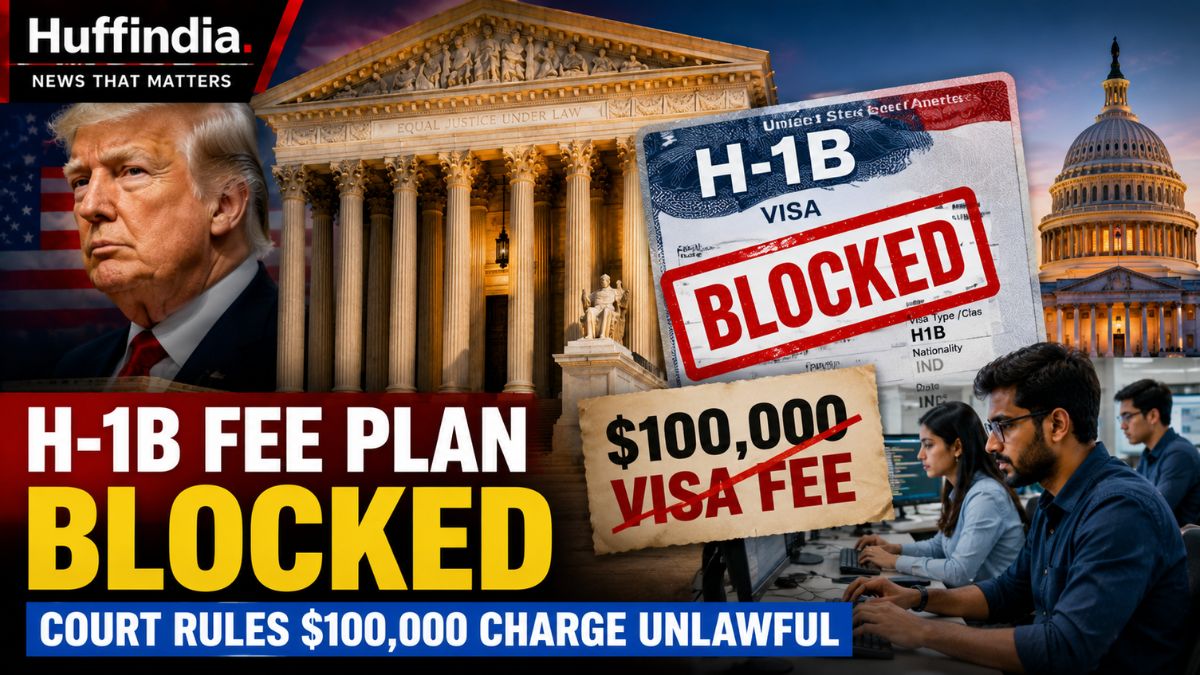



H-1B Visa Fee has become the center of a major legal and political debate in the United States after a federal court ruled that a proposed $100,000 fee on certain H-1B visa applications was unlawful because it lacked approval from Congress.
The ruling represents a significant victory for businesses, technology companies, universities, and skilled foreign workers, including thousands of Indian professionals who rely on the H-1B program to work in the United States.
The decision also marks a setback for former President Donald Trump’s immigration agenda, although legal experts expect the administration and its supporters to challenge the verdict through the appeals process.
H-1B Visa Fee Plan Faces Major Legal Setback
The controversy centers on a proposal that sought to impose a massive $100,000 fee on certain H-1B visa petitions.
Critics argued that the proposed charge would have dramatically increased the cost of hiring foreign professionals and placed a significant burden on employers seeking specialized talent.
The federal court concluded that such a substantial fee could not be imposed without explicit authorization from Congress. The ruling emphasized that executive agencies cannot create major revenue-generating measures without legislative approval.
As a result, the proposed H-1B Visa Fee was declared unlawful.
Why the Court Rejected the Proposal
At the heart of the case was the question of whether immigration authorities had the legal authority to introduce such a significant fee increase.
The court determined that Congress, not administrative agencies, has the power to authorize major financial charges of this scale.
Legal experts note that government agencies generally have authority to establish processing fees linked to administrative costs. However, a fee as large as the proposed $100,000 charge was viewed as exceeding normal regulatory powers.
The ruling reinforces longstanding constitutional principles regarding the separation of powers and congressional oversight of taxation and fees.
Relief for Skilled Foreign Workers
The decision is expected to provide immediate relief to many skilled foreign workers seeking employment opportunities in the United States.
Indian professionals represent one of the largest groups of H-1B visa beneficiaries, particularly in sectors such as information technology, engineering, healthcare, finance, and research.
Many immigration advocates warned that the proposed H-1B Visa Fee could discourage employers from sponsoring foreign talent and reduce opportunities for highly skilled workers.
Business organizations argued that the measure would have created additional labor shortages in industries already struggling to recruit specialized professionals.
Impact on US Businesses and Technology Companies
The ruling is also being welcomed by employers that rely heavily on global talent.
Technology companies, research institutions, consulting firms, and healthcare organizations frequently use the H-1B program to recruit workers with specialized skills that may be difficult to find domestically.
Industry groups argued that a dramatic increase in visa-related costs could make hiring international professionals economically unviable for many businesses.
The court’s decision therefore removes a major source of uncertainty for employers planning future recruitment strategies.
Trump’s Immigration Agenda Faces Another Challenge
The ruling represents another chapter in the long-running debate over immigration policy in the United States.
Supporters of stricter immigration controls have argued that higher visa fees could encourage companies to prioritize domestic hiring and reduce dependence on foreign workers.
Critics, however, contend that such measures risk undermining innovation, economic growth, and America’s ability to attract global talent.
The rejected H-1B Visa Fee proposal became a symbol of broader disagreements regarding the balance between immigration restrictions and economic competitiveness.
What Happens Next?
Legal observers expect the decision to face further scrutiny through the appeals process.
The Trump administration and supporters of the proposal may seek to overturn the ruling in a higher court, arguing that immigration authorities possess broader regulatory authority than the federal court recognized.
If an appeal proceeds, the issue could ultimately become a significant test case regarding executive power and immigration policy.
Until then, the court’s ruling remains a major victory for employers and foreign professionals affected by the proposal.
Why the H-1B Program Matters
The H-1B visa program remains one of the most important pathways for skilled foreign workers seeking employment in the United States.
The program allows American employers to hire professionals in specialty occupations that typically require advanced education or technical expertise.
Many sectors of the US economy, particularly technology and engineering, have relied on H-1B workers for decades.
Supporters argue that the program helps address talent shortages and strengthens America’s global competitiveness, while critics continue to debate its impact on domestic employment.
Global Implications of the Court Decision
The court ruling could have implications beyond the United States.
Countries competing for highly skilled workers closely monitor changes in US immigration policy because such decisions influence global talent mobility.
A more predictable visa environment may help maintain the United States’ attractiveness as a destination for international professionals.
For Indian workers, who account for a substantial share of H-1B visa approvals, the decision may be viewed as a positive development that reduces uncertainty surrounding future employment opportunities.
For official information on H-1B visa regulations and immigration procedures, applicants can visit the U.S. Citizenship and Immigration Services (USCIS) website.
Final Thoughts on the H-1B Visa Fee Ruling
The H-1B Visa Fee ruling marks a significant moment in the ongoing debate over immigration policy, executive authority, and economic competitiveness.
By declaring the proposed $100,000 fee unlawful, the court has provided relief to businesses and skilled foreign workers while reaffirming Congress’s central role in approving major financial measures.
Although the legal battle may continue through appeals, the decision is already being viewed as a major development for employers, immigration advocates, and thousands of professionals seeking opportunities in the United States.
As the case moves forward, the future of the H-1B Visa Fee debate will remain closely watched by policymakers, businesses, and workers around the world.
Also Read: Marco Rubio Iran Deal Talks Continue Despite Fresh U.S. Strikes