
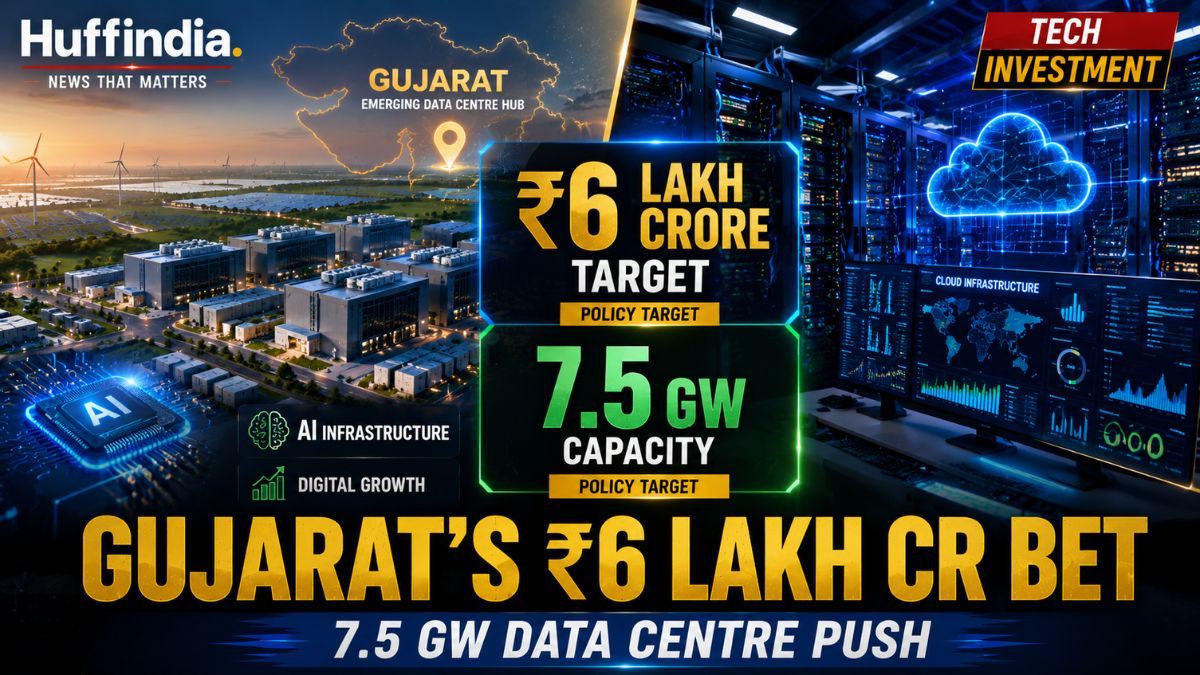



The Gujarat Data Centre Policy has placed the state at the centre of India’s fast-expanding race to build infrastructure for artificial intelligence, cloud computing and large-scale digital services, with an ambitious target of attracting ₹6 lakh crore in investment and creating 7.5 GW of data-centre capacity.
The new policy, launched in Gandhinagar, seeks to position Gujarat as a major destination for hyperscale data centres and AI-linked infrastructure at a time when demand for computing power is rising rapidly.
Chief Minister Bhupendra Patel launched the initiative at the Mahatma Mandir Convention Centre, according to recent reporting. The policy is framed around attracting major investment while strengthening the physical infrastructure needed for India’s increasingly data-intensive economy.
The scale of the target is striking. But it is important to distinguish ambition from achievement: the ₹6 lakh crore figure represents an investment target under the policy, not money that should be described as already invested or guaranteed.
Gujarat Data Centre Policy Targets ₹6 Lakh Crore Investment
The Gujarat Data Centre Policy aims to create a large ecosystem capable of supporting the next generation of digital infrastructure.
At its core are two headline ambitions: attracting investment worth around ₹6 lakh crore and developing approximately 7.5 GW of data-centre capacity.
If realised, such expansion would represent a major increase in the scale of digital infrastructure associated with the state.
The policy is expected to appeal particularly to companies involved in hyperscale computing, cloud services, artificial intelligence and other data-heavy technologies.
Recent reports also point to a package of fiscal and infrastructure-related incentives designed to improve the economics of setting up large facilities in Gujarat.
Why 7.5 GW Data Centre Capacity Matters
The 7.5 GW data centre capacity target is one of the most significant elements of the announcement.
Data-centre capacity is closely linked to the computing infrastructure required to run cloud platforms, enterprise services, digital applications and increasingly demanding AI workloads.
For context, the Union government said in March that India’s total data-centre capacity had risen from about 375 MW in 2020 to around 1,500 MW by 2025. That national figure provides useful context for understanding just how ambitious Gujarat’s stated 7.5 GW target is.
However, readers should avoid treating unlike figures as automatically comparable. Policy targets can span future development periods and may use definitions or project pipelines that differ from estimates of currently operational national capacity.
The key takeaway is simpler: Gujarat is making a very large infrastructure bet on future computing demand.
For broader national context, the Government of India’s official update on data-centre capacity and cooling technologies provides recent figures on the sector’s expansion.
AI Infrastructure Gujarat Pushes Into a New Phase
The rise of generative AI has transformed the global conversation around data centres.
Advanced AI systems require enormous computing resources. Large clusters of specialised chips must process and store huge volumes of information, while cloud platforms need reliable facilities capable of operating continuously.
This is why the AI infrastructure Gujarat strategy could have implications beyond traditional server hosting.
A large data-centre ecosystem can support:
- AI computing workloads
- cloud platforms
- enterprise digital services
- software ecosystems
- fintech infrastructure
- e-commerce operations
- content delivery
- advanced research
Gujarat’s broader technology policy environment already includes efforts to encourage emerging technologies and high-skilled digital activity. The state’s official IT/ITeS policy framework describes goals including advanced technology, modern IT infrastructure and large-scale investment.
Gujarat Data Centre Policy Offers Investor Incentives
The Gujarat Data Centre Policy is not relying on capacity targets alone.
Recent reports indicate that the framework includes financial and operating incentives intended to attract large projects.
Reported provisions include a capital subsidy for eligible investment in the Dholera region, interest support on qualifying term loans, power tariff assistance and reimbursement of electricity duty subject to policy conditions.
These measures matter because data centres are capital-intensive assets.
Developers must consider land, electricity availability, grid connectivity, cooling systems, fibre networks, backup infrastructure, security and long-term operating costs.
For hyperscale projects, even relatively small changes in energy economics or approval timelines can influence location decisions.
Dholera Could Play a Strategic Role
Dholera is expected to be an important part of Gujarat’s digital-infrastructure ambitions.
The region has already been positioned within the state’s broader advanced-industry strategy, and recent policy reporting specifically identifies enhanced support for eligible data-centre investment in the Dholera region.
Its relevance comes from the possibility of planning large infrastructure projects at scale.
Major data centres require more than buildings filled with servers. They depend on reliable electricity, high-capacity connectivity, land availability, cooling strategies and supporting infrastructure.
A planned industrial region may offer advantages when these requirements can be coordinated from the beginning rather than added later.
Still, the success of Dholera or any other proposed cluster will depend on actual project execution, customer demand and the timely delivery of supporting infrastructure.
Also Read | WhatsApp Usernames Coming Soon: Chat Without Sharing Your Phone Number
Sustainability Will Be a Critical Test
The sustainability dimension may become one of the most important tests of Gujarat’s plan.
Data centres can consume substantial amounts of electricity, particularly as AI workloads become more compute-intensive. Cooling can also create water-management challenges depending on technology and local conditions.
The Union government has said the Indian data-centre industry is adopting advanced cooling technologies to minimise water use, while highlighting broader growth in national capacity.
For Gujarat, the central challenge will be whether rapid digital expansion can be aligned with:
- renewable power
- efficient cooling
- responsible water management
- grid reliability
- energy storage
- high-efficiency computing
Sustainability claims will ultimately need to be judged against implementation and measurable project performance rather than policy language alone.
Why Gujarat Is Competing for Hyperscale Projects
The global data-centre market is being reshaped by a convergence of trends.
AI adoption is increasing computing demand. Cloud services continue expanding. Companies are generating more data. Digital payments, streaming, enterprise software and online public services all require resilient infrastructure.
India is therefore becoming an increasingly important market for new data-centre capacity.
Gujarat is seeking to compete by combining industrial infrastructure, policy incentives and a broader technology ecosystem.
The state’s official Global Capability Centre policy also emphasises emerging sectors, research and development, targeted incentives and streamlined governance, illustrating a wider effort to attract technology-intensive activity.
Could the Policy Create New Jobs?
Large data-centre investment can support employment, but job claims require careful interpretation.
Construction phases may generate demand across engineering, electrical systems, civil works and project management. Once operational, facilities need professionals in network management, cybersecurity, cloud operations, cooling systems, power management and physical security.
A wider cluster may also attract supporting businesses and technology services.
However, highly automated data centres do not necessarily create direct permanent employment on the same scale as labour-intensive manufacturing.
For that reason, the strongest long-term employment impact may depend on whether Gujarat can build a broader ecosystem around AI, cloud services, research, software and enterprise technology rather than focusing only on physical server capacity.
Gujarat Data Centre Policy Faces Major Execution Challenges
The ambition is substantial, but execution will determine the outcome.
Developing capacity on the scale envisioned by the Gujarat Data Centre Policy could create pressure across multiple systems.
Key challenges may include reliable power supply, transmission infrastructure, land readiness, fibre connectivity, cooling requirements, water management, environmental compliance and the availability of skilled workers.
There is also intense competition.
Other Indian states are developing their own data-centre strategies and trying to attract AI-ready infrastructure. Gujarat will therefore need to demonstrate not just attractive incentives but consistent implementation and dependable infrastructure.
What the ₹6 Lakh Crore Target Really Means
The headline number deserves careful interpretation.
A target of ₹6 lakh crore signals the scale of Gujarat’s ambition, but it should not be reported as a completed investment inflow.
Policy targets can depend on multiple future factors:
- investor commitments
- project approvals
- financing
- land allocation
- electricity availability
- construction timelines
- market demand
Some announced projects may move quickly, while others may take years or change in scope.
For readers and investors, the most meaningful indicators will be signed commitments, construction starts, commissioned capacity and operational utilisation.
Why This Matters for India’s Digital Economy
The broader significance extends beyond Gujarat.
India’s digital economy is generating increasing demand for domestic computing and storage infrastructure. AI adoption could accelerate that demand further.
The Union government’s March update that national data-centre capacity reached around 1,500 MW by 2025 underlines the sector’s growth trajectory.
If Gujarat succeeds in attracting a substantial share of future investment, it could strengthen India’s domestic infrastructure for cloud computing, AI and other digital services.
But the scale of the ambition also makes responsible energy planning essential.
What Happens Next?
Attention will now turn from policy launch to implementation.
The key questions will include how quickly investors respond, which projects reach financial closure, where capacity is built and how electricity and sustainability requirements are managed.
The Gujarat Data Centre Policy gives the state a clear strategic direction. The next phase will show whether its incentives and infrastructure can translate a headline target into operational capacity.
Progress should therefore be assessed through measurable milestones rather than announcements alone.
Final Words
Gujarat’s new data-centre strategy is one of the state’s biggest bets on the AI-era economy.
The targets — ₹6 lakh crore in investment and 7.5 GW of capacity — are ambitious enough to place the initiative firmly in the national spotlight. The policy also arrives as India’s demand for cloud infrastructure, AI computing and digital services continues to expand.
Yet ambition is only the starting point.
The real test will be execution: attracting credible projects, delivering reliable power and connectivity, managing environmental pressures and ensuring that digital infrastructure creates wider economic value.
If those pieces come together, the Gujarat Data Centre Policy could significantly reshape the state’s role in India’s technology economy. If they do not, the gap between policy targets and operational reality will remain the central question.