
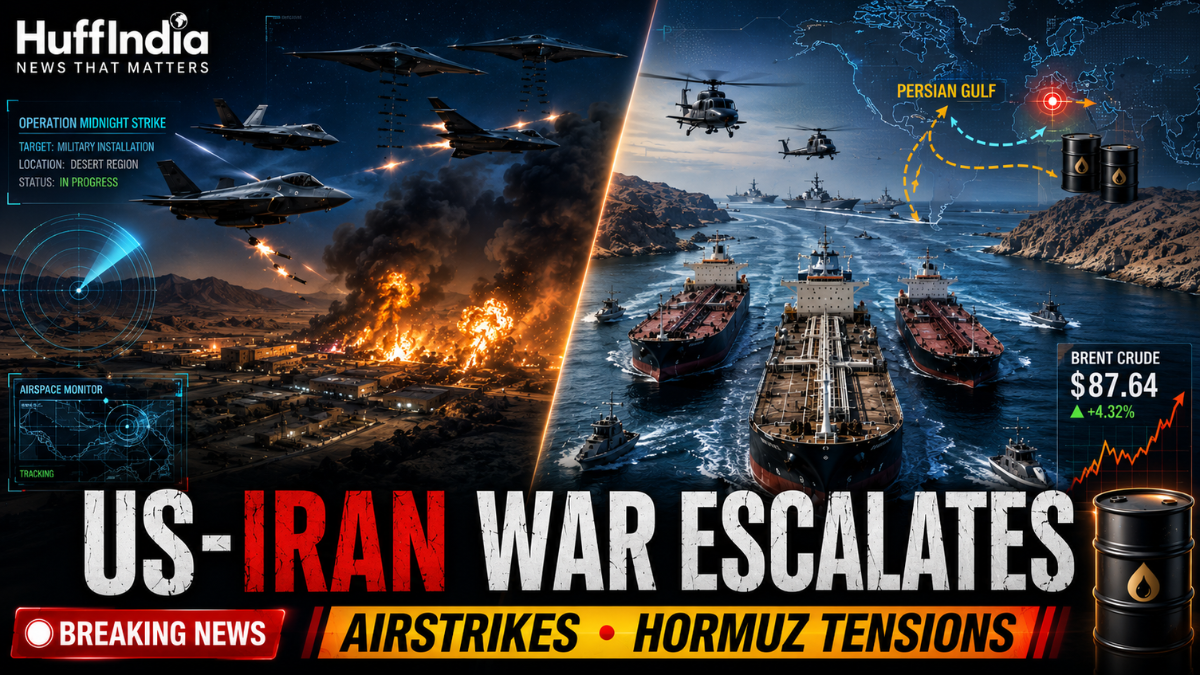



The US-Iran conflict entered a more volatile phase on Wednesday after the United States launched a fresh wave of airstrikes targeting Iranian military infrastructure, while concerns over maritime security intensified around the Strait of Hormuz following reports of attacks involving commercial vessels. The latest developments have heightened fears of a broader regional confrontation and renewed uncertainty in global energy markets.
According to the U.S. military, the strikes targeted command centres, missile facilities, drone infrastructure and coastal defence positions inside Iran. The operation came after recent exchanges of military action between Washington and Tehran, with both sides accusing each other of escalating hostilities.
US-Iran Conflict Intensifies With Fresh Airstrikes
U.S. Central Command said the latest operation involved coordinated strikes on multiple military sites considered part of Iran’s offensive capabilities. American officials described the action as part of efforts to reduce threats against U.S. personnel and regional partners.
Iranian authorities condemned the attacks, calling them a violation of international norms and warning that Tehran reserves the right to respond. State media reported explosions in several areas following the strikes, although independent assessments of the damage were not immediately available.
Reports of Attacks Near the Strait of Hormuz Raise Maritime Concerns
As the military situation intensified, reports emerged of attacks involving commercial vessels operating near the Strait of Hormuz. While some media reports attributed the incidents to Iran’s Islamic Revolutionary Guard Corps (IRGC), officials had not publicly confirmed responsibility at the time of publication, and investigations into the incidents were continuing.
The Strait of Hormuz remains one of the world’s most strategically important maritime chokepoints, with a significant share of global crude oil and liquefied natural gas exports passing through the narrow waterway every day.
Shipping companies have increased security measures and are closely monitoring developments as the conflict evolves.
Global Energy Markets Watch Hormuz Closely
The renewed US-Iran conflict has once again placed global energy markets on alert.
Oil traders are monitoring whether disruptions to commercial shipping could affect crude supplies from the Gulf region. Although vessel traffic has shown signs of gradually resuming, shipping companies continue to assess security risks before entering the Strait of Hormuz.
Analysts note that any prolonged disruption to maritime traffic could influence oil prices, insurance premiums and global supply chains.
International Calls for Restraint
Several governments and international organisations have urged both Washington and Tehran to exercise restraint and avoid further escalation.
Diplomatic efforts aimed at reducing tensions have so far produced limited progress, with both sides maintaining firm public positions regarding recent military actions.
Security analysts warn that continued exchanges could increase the risk of wider regional instability involving neighbouring countries and critical shipping routes.
Also Read | Japan Mayor Maternity Leave Sparks National Debate
Why the Strait of Hormuz Matters
The Strait of Hormuz links the Persian Gulf with the Gulf of Oman and the Arabian Sea. It serves as one of the world’s busiest energy transit corridors, carrying a substantial proportion of internationally traded crude oil and LNG.
Any disruption in the waterway can have immediate consequences for:
- Global oil prices
- Energy supply chains
- Maritime insurance costs
- International shipping schedules
- Financial markets
Because of its strategic importance, military activity in and around the strait is closely watched by governments, energy companies and investors worldwide.
Background information on international maritime safety and global shipping regulations is available on the International Maritime Organization (IMO)
Markets React to Rising Geopolitical Risk
Financial markets have responded cautiously to the latest developments.
Energy stocks, shipping companies and commodity markets remain particularly sensitive to news from the Gulf region. Investors are also monitoring diplomatic statements for signs of either further escalation or renewed negotiations.
Final Takeaway
The US-Iran conflict has entered another critical stage with fresh U.S. airstrikes targeting Iranian military infrastructure and renewed concerns over security in the Strait of Hormuz. While reports of attacks involving commercial vessels have heightened maritime risks, many operational details remain under investigation. As governments continue diplomatic efforts and shipping companies assess security conditions, developments in the Gulf are likely to remain a key focus for global energy markets and international policymakers in the days ahead.