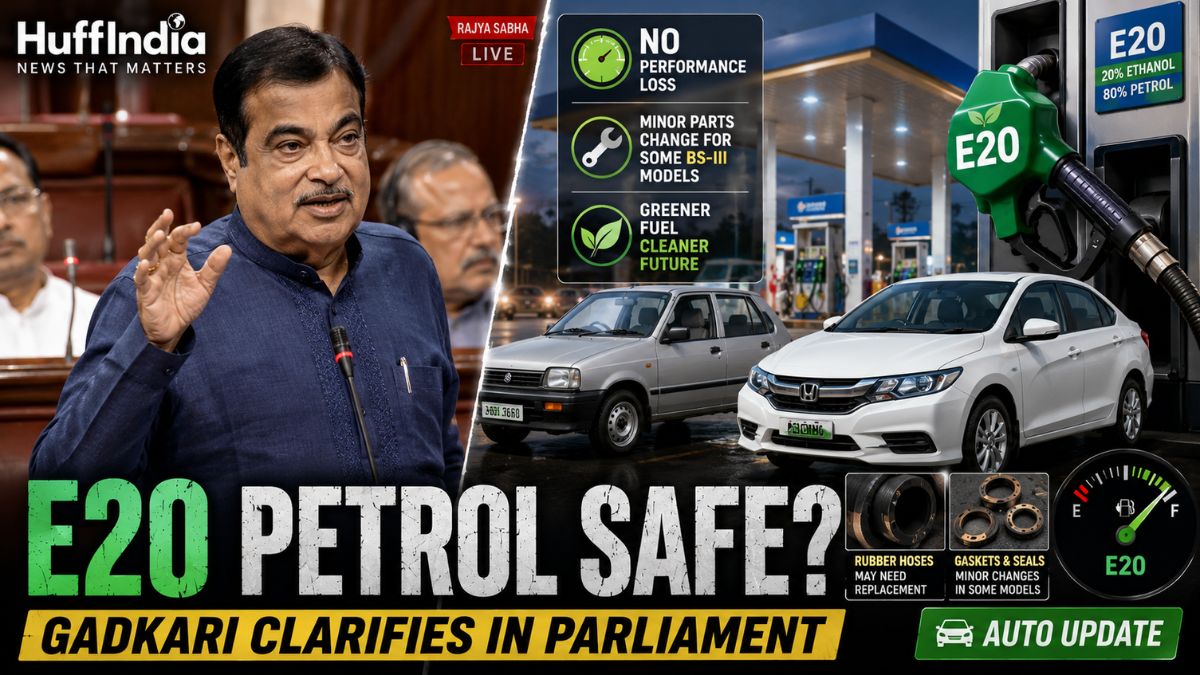



The E20 petrol for older vehicles debate was addressed in Parliament on Wednesday, with Union Minister for Road Transport and Highways Nitin Gadkari stating that vehicles running on 20% ethanol-blended petrol do not experience any significant loss of performance or additional wear and tear. However, he clarified that some older BS-III vehicles manufactured before 2016 may require replacement of certain rubber parts and gaskets to ensure long-term compatibility.
Responding to a question in the Rajya Sabha, Gadkari said studies and testing conducted by automobile manufacturers and government agencies have found that E20 fuel is compatible with most petrol vehicles, while older models may need minor modifications rather than major mechanical changes.
E20 Petrol for Older Vehicles Does Not Affect Performance, Says Gadkari
Addressing concerns raised by vehicle owners, Gadkari informed Parliament that E20 petrol for older vehicles does not lead to noticeable deterioration in engine performance or excessive engine wear under normal operating conditions.
According to the minister, the government has relied on technical evaluations conducted in collaboration with automobile manufacturers before expanding the rollout of E20 fuel across the country. These assessments indicate that vehicles designed for petrol can generally operate on E20 without significant operational issues.
Older BS-III Vehicles May Need Minor Rubber Component Replacement
While emphasising that E20 fuel is broadly compatible, Gadkari noted that BS-III petrol vehicles introduced from April 1, 2005 and manufactured before 2016 may require replacement of specific rubber parts, seals and gaskets.
The reason, officials explained, is that higher ethanol content can affect certain older rubber materials over prolonged use. Replacing these components, where recommended by manufacturers, can help maintain durability and fuel system integrity. The minister did not indicate any requirement for major engine modifications.
Also Read | Fuel | Huffindia
Why India Is Promoting E20 Fuel
The government has been promoting 20% ethanol-blended petrol (E20) as part of its strategy to:
- Reduce dependence on imported crude oil.
- Lower carbon emissions from the transport sector.
- Support India’s ethanol production industry.
- Increase farmers’ income through demand for ethanol feedstocks such as sugarcane and maize.
- Improve long-term energy security.
The rollout of E20 fuel is a key component of India’s broader clean mobility and energy transition initiatives.
Detailed information on India’s ethanol blending programme is available on the Ministry of Petroleum and Natural Gas (MoPNG)
What Vehicle Owners Should Know
Automobile manufacturers have progressively introduced E20-compatible engines in recent years.
For owners of older petrol vehicles, experts recommend:
- Checking the owner’s manual for E20 compatibility.
- Following manufacturer-issued service advisories.
- Replacing ageing rubber hoses or gaskets if advised during servicing.
- Using authorised service centres for inspections where necessary.
Industry experts note that these are preventive maintenance measures rather than evidence of widespread performance issues.
Auto Industry Preparing for Full E20 Transition
Most major automobile manufacturers in India have already introduced or are transitioning to vehicles designed to operate on E20 fuel.
The government has worked closely with manufacturers, oil marketing companies and fuel retailers to expand the nationwide availability of ethanol-blended petrol while ensuring compatibility with the existing vehicle fleet.
Environmental and Economic Benefits
According to the Ministry of Road Transport and Highways, increasing ethanol blending can help reduce greenhouse gas emissions while decreasing India’s reliance on imported fossil fuels.
Officials have also highlighted the potential economic benefits for the agriculture sector through higher domestic ethanol production and greater demand for biofuel feedstocks.
Final Takeaway
The discussion around E20 petrol for older vehicles received fresh clarity after Union Minister Nitin Gadkari told Parliament that ethanol-blended fuel does not cause significant performance loss or excessive wear and tear in most petrol vehicles. While some BS-III vehicles manufactured before 2016 may require replacement of certain rubber parts and gaskets, the government maintains that these are limited compatibility measures rather than major mechanical concerns. As India continues expanding E20 fuel availability nationwide, vehicle owners are encouraged to follow manufacturer guidance to ensure smooth and efficient operation.