
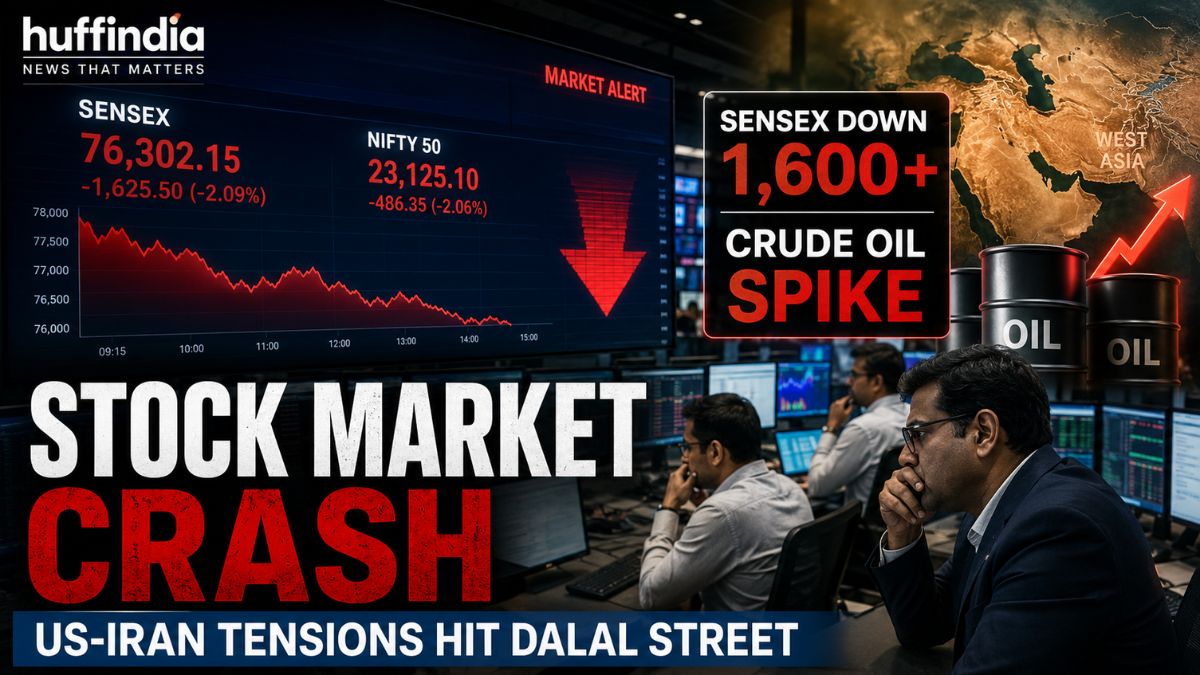



Stock market crash became one of India’s top trending business searches on July 9 after a sharp sell-off on Dalal Street wiped out investor wealth and pushed benchmark indices lower amid renewed concerns over US-Iran tensions and rising crude oil prices.
According to market reports, the Sensex fell sharply on July 8, with several outlets reporting a fall of around 1,677 points. The Nifty also slipped below the 24,000 mark during the sell-off, as investors reacted to geopolitical uncertainty, crude oil volatility and weakness across major sectors.
The Economic Times reported that the Sensex sank 1,680 points and the Nifty closed below 23,900, listing multiple factors behind the market mayhem. Upstox reported that Sensex and Nifty tumbled more than 2%, while market volatility spiked and around ₹9 lakh crore was wiped off the market capitalisation of NSE-listed companies.
The sell-off was linked in several reports to renewed US-Iran tensions after former US President Donald Trump reportedly said the ceasefire with Iran was “over.” Business Today reported that Brent crude spiked more than 6% as the geopolitical situation worsened, adding pressure to Indian equities.
Because markets can change quickly, this article explains what happened, what reports say drove the fall and what investors should watch next. It should be read as market news, not investment advice.
What Triggered the Stock Market Crash?
The stock market crash was triggered by a combination of geopolitical tension, crude oil concerns and broad risk-off sentiment.
Reports said investors turned cautious after renewed uncertainty around the US-Iran situation. The Times of India reported that crude oil moved close to $80 a barrel again after Trump declared the US-Iran ceasefire “over.” Higher crude prices are closely watched in India because the country imports a large share of its oil requirement.
When crude prices rise sharply, investors worry about inflation, the current account deficit, fuel costs, corporate margins and possible pressure on the rupee. These concerns often hit Indian equities, especially in sectors sensitive to fuel prices, input costs and global risk appetite.
The Economic Times said the market fall reflected concerns over US-Iran tensions, rising crude prices, foreign investor selling and global uncertainty. Business Today and other market reports also cited crude oil and geopolitical stress as key reasons behind the sharp fall.
This means the stock market crash was not caused by one isolated domestic factor. It came from a global shock that quickly affected investor sentiment in India.
Also Read | Cupid Share Price Rises After FY27 Revenue Guidance Upgrade
How Much Did Sensex and Nifty Fall?
Reports said the Sensex fell around 1,677 points on July 8, while the Nifty closed below 23,900.
India Infoline reported that the Sensex crashed 1,677 points and the Nifty slipped below 24,000 as US-Iran tensions and soaring crude triggered broad selling. Upstox reported that Sensex and Nifty tumbled over 2%, with volatility rising sharply.
News18 reported that investors lost more than ₹8 lakh crore during the market fall, while Upstox estimated around ₹9 lakh crore was wiped off the market capitalisation of NSE-listed companies.
The exact intraday figures can differ slightly depending on the time of reporting and exchange movement, but the broad picture is consistent: Indian equities saw one of their sharpest recent declines.
For readers tracking the stock market crash, the important point is that the fall was broad-based and not limited to one or two sectors.
For additional background on the sharp fall in Sensex and Nifty and the factors behind the market sell-off, readers can see The Economic Times report on the stock market crash.
Which Sectors Were Hit?
The sell-off affected multiple areas of the market.
Market reports said the pressure was visible across large-cap stocks, financials, IT, consumer names and rate-sensitive sectors. Upstox reported that IndiGo, Jio Financial Services and Maruti Suzuki were among the top movers on the downside on July 8, while ONGC was among the gainers.
Oil-related and energy-sensitive stocks can sometimes react differently during crude spikes. Upstream oil producers may benefit from higher crude prices, while aviation, paints, chemicals, logistics and other fuel-sensitive businesses may face pressure.
Financial stocks also tend to react during major risk-off sessions because foreign investor flows, bond yields, currency movement and liquidity expectations can affect banking and NBFC sentiment.
This is why a stock market crash can quickly spread across indices. Once investor fear rises, selling often becomes broader than the original trigger.
Why Do US-Iran Tensions Matter for India?
US-Iran tensions matter for India because of oil, trade, currency and market confidence.
India depends heavily on imported crude oil. Any disruption in West Asia or fear around the Strait of Hormuz can push crude prices higher. The Strait of Hormuz is one of the world’s most important oil transit routes, and market participants closely track any threat to shipping or energy supply.
Higher crude prices can make imports more expensive for India. That can pressure inflation and the rupee, while also raising concerns about fuel prices and government finances.
Businesses that rely on crude derivatives, imported inputs or fuel-intensive operations may see cost pressure. Consumers may also feel the impact if fuel costs rise over time.
This is why Indian markets react strongly to West Asia tensions even when the immediate conflict is outside India.
What Happened to Crude Oil?
Crude oil prices moved higher after renewed conflict concerns.
Business Today reported that Brent crude spiked more than 6% after Trump declared the Iran ceasefire “over.” The Times of India also reported that oil neared $80 a barrel again after the remarks.
For India, crude oil is a key macroeconomic variable. A sudden rise in crude can affect inflation expectations, import bills and market sentiment.
However, crude prices can be volatile. They may rise sharply on geopolitical fears and then cool if supply fears ease. That is why investors usually track both Brent crude and official updates from West Asia before drawing long-term conclusions.
The stock market crash reflected immediate fear, but future market direction will depend on whether crude remains elevated or stabilises.
What Is GIFT Nifty Indicating for July 9?
After the sharp fall, traders were watching GIFT Nifty for early signals on July 9.
Moneycontrol reported that GIFT Nifty showed recovery after the sharp market fall and signalled a possible positive start for Sensex and Nifty. Another Moneycontrol update said GIFT Nifty was up around 100 points, indicating a better opening after the previous day’s sell-off despite ongoing US-Iran concerns.
GIFT Nifty is often used as an early indicator of Indian market sentiment before domestic trading begins. However, it is only a signal and can change before the market opens.
If global cues worsen, early gains can fade. If crude cools or geopolitical fears ease, markets may recover further.
For now, the market remains sensitive to updates from West Asia, crude oil movement, foreign investor flows and domestic corporate results.
Should Investors Panic?
Investors should not treat a stock market crash as a reason to panic, but they should review risk carefully.
Sharp market falls are unsettling, especially for new investors. However, volatility is part of equity markets. The key is to distinguish between short-term fear and long-term financial planning.
For traders, stop-loss discipline and risk management matter. For long-term investors, asset allocation, emergency funds and portfolio quality are more important than reacting to one trading session.
Investors should avoid making decisions based only on viral posts, panic headlines or unverified market tips. Live prices should be checked on official exchange platforms, and financial decisions should be made according to individual goals and risk capacity.
This article does not recommend buying, selling or holding any stock or mutual fund.
What Should Readers Watch Next?
There are five key factors to watch after the stock market crash.
First, crude oil prices. If Brent crude remains elevated, Indian markets may stay nervous.
Second, US-Iran developments. Any escalation or de-escalation will influence global risk appetite.
Third, foreign institutional investor activity. Heavy FII selling can add pressure to indices.
Fourth, the rupee. Currency weakness can reflect pressure from crude and capital flows.
Fifth, corporate earnings. Q1 results season can help shift attention back to company fundamentals.
Investors should also watch whether the Nifty sustains above key support levels after the fall. Technical levels can influence short-term trading sentiment, but they should not replace fundamental analysis.
Final Thoughts
The stock market crash on Dalal Street reflected a sharp shift in investor sentiment after renewed US-Iran tensions and a jump in crude oil prices. Reports said the Sensex fell around 1,677 points, the Nifty slipped below 24,000 and investor wealth worth several lakh crore rupees was erased during the sell-off.
The safest conclusion is narrow and factual: Indian markets fell sharply because global risk concerns intensified, crude prices rose and investors moved away from risk assets.
For July 9, early GIFT Nifty signals suggested some recovery, but the situation remains fluid. Markets will continue to track West Asia headlines, oil prices, global cues and domestic earnings.