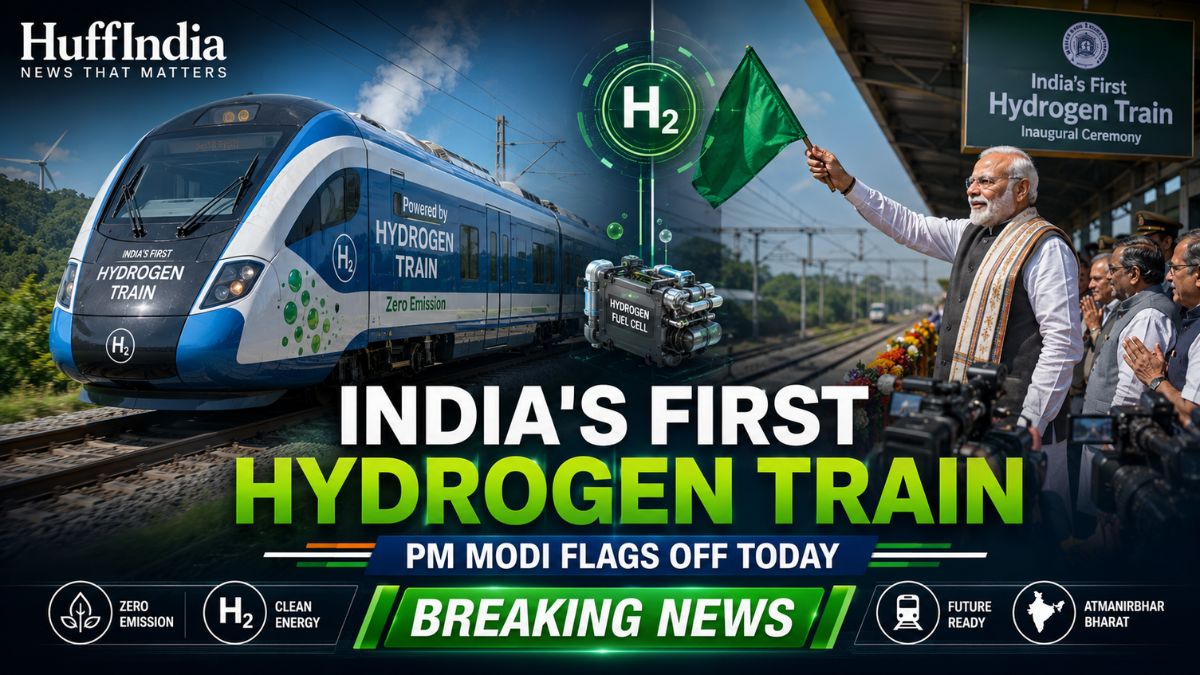



India is set to mark another milestone in its clean transportation journey as Prime Minister Narendra Modi is expected to flag off India’s first hydrogen train today. The project represents a major step towards reducing carbon emissions in the railway sector while promoting green hydrogen as a sustainable fuel for the future.
Developed under Indian Railways’ ambitious green mobility programme, the hydrogen-powered train is expected to showcase how clean energy can be integrated into one of the world’s largest rail networks. The initiative aligns with the National Green Hydrogen Mission and India’s long-term commitment to achieving net-zero emissions.
The launch is expected to draw attention not only because of its environmental significance but also because hydrogen-powered rail technology remains relatively new across the world.
India’s First Hydrogen Train: Route, Speed, Features and How It Runs
The inaugural hydrogen train is expected to operate on the Jind–Sonipat section in Haryana, a route selected by Indian Railways for the pilot project.
The train has been designed to replace conventional diesel-powered services on selected non-electrified routes. Officials believe the technology could eventually be introduced across several regional railway lines if the pilot proves successful.
Expected Route
The hydrogen-powered train will initially serve passengers on the Jind-Sonipat corridor, connecting important towns in Haryana while demonstrating the viability of hydrogen fuel technology in regular passenger operations.
Top Speed
According to Indian Railways, the train is designed to achieve a maximum speed of around 110 km/h, making it suitable for regional passenger services while maintaining operational efficiency.
The performance is expected to be comparable to conventional diesel multiple units currently operating on similar routes.
Passenger Capacity
The hydrogen train is designed to accommodate hundreds of passengers across multiple coaches, offering a travel experience similar to existing passenger trains while significantly reducing emissions.
What Makes the Hydrogen Train Different?
Unlike diesel locomotives, India’s first hydrogen train does not burn fossil fuels to generate power.
Instead, it uses hydrogen fuel cells, which combine hydrogen with oxygen from the atmosphere to produce electricity. That electricity powers electric motors that drive the train.
The only major by-products of this process are:
- Water vapour
- Heat
Since no carbon dioxide is produced during operation, India’s first hydrogen train is considered one of the cleanest alternatives for non-electrified railway routes, supporting Indian Railways’ push towards greener and more sustainable transportation.
How Does a Hydrogen Train Run?
The working principle behind India’s first hydrogen train is relatively straightforward and relies on clean fuel cell technology instead of conventional diesel engines.
Hydrogen gas is stored inside high-pressure tanks installed on the train. The fuel is supplied to a fuel cell, where it reacts chemically with oxygen from the atmosphere.
The fuel cell generates electricity through an electrochemical process rather than combustion.
That electricity powers traction motors, while rechargeable batteries store surplus energy generated during braking. These batteries help improve efficiency during acceleration and reduce overall hydrogen consumption.
This combination of hydrogen fuel cells and battery technology enables India’s first hydrogen train to deliver smooth acceleration, quieter operation and lower maintenance compared to traditional diesel-powered trains, while producing only water vapour as the primary emission.
Why Is Indian Railways Investing in Hydrogen?
Indian Railways has already electrified a significant portion of its network, but several regional and heritage routes continue to depend on diesel locomotives.
Hydrogen trains provide an alternative where full electrification may not be immediately practical.
The key objectives include:
- Reducing greenhouse gas emissions
- Lowering dependence on imported fossil fuels
- Supporting India’s National Green Hydrogen Mission
- Promoting indigenous clean-energy technologies
- Improving air quality near railway corridors
The project is also expected to strengthen India’s position among countries investing in hydrogen-based transportation.
Environmental Benefits
India’s first hydrogen train offer several environmental advantages over diesel locomotives.
Some of the major benefits include:
- Zero tailpipe carbon emissions
- Lower noise pollution
- Reduced particulate matter
- Improved fuel efficiency on suitable routes
- Better sustainability for regional passenger services
If hydrogen is produced using renewable energy sources, the overall carbon footprint becomes even lower, making the technology a promising long-term solution for public transport.
Global Adoption of Hydrogen Trains
Several countries have already introduced hydrogen-powered passenger trains.
Germany became one of the pioneers by deploying commercial hydrogen trains on regional routes. France, Italy, Japan and China have also been testing similar technology as part of their clean transportation strategies.
India’s entry into hydrogen rail technology reflects the country’s growing focus on sustainable infrastructure and energy innovation.
For official announcements and updates, refer to the Ministry of Railways (Government of India):
Challenges Ahead
While hydrogen trains present significant environmental advantages, widespread adoption will depend on several factors.
The biggest challenge remains the development of hydrogen production, storage and refuelling infrastructure.
Hydrogen fuel is currently more expensive than diesel in many markets, and large-scale deployment requires investment in dedicated production facilities and safety systems.
As production costs decline and green hydrogen becomes more widely available, hydrogen-powered rail transport could become increasingly cost-effective.
Also Read | CBSE Third Language Class 9: Supreme Court Questions Policy Before Board Preparation
A Step Towards Greener Railways
The launch of India’s first hydrogen train marks an important chapter in the evolution of Indian Railways. Beyond introducing a new mode of propulsion, the initiative signals the country’s broader commitment to cleaner transportation and reduced emissions.
If the pilot project delivers reliable performance, it could pave the way for hydrogen-powered trains on additional non-electrified routes across India in the coming years.
For passengers, the experience may look similar to any modern regional train. However, behind the scenes, the technology represents a significant shift towards sustainable mobility—one that could shape the future of rail travel in India.