
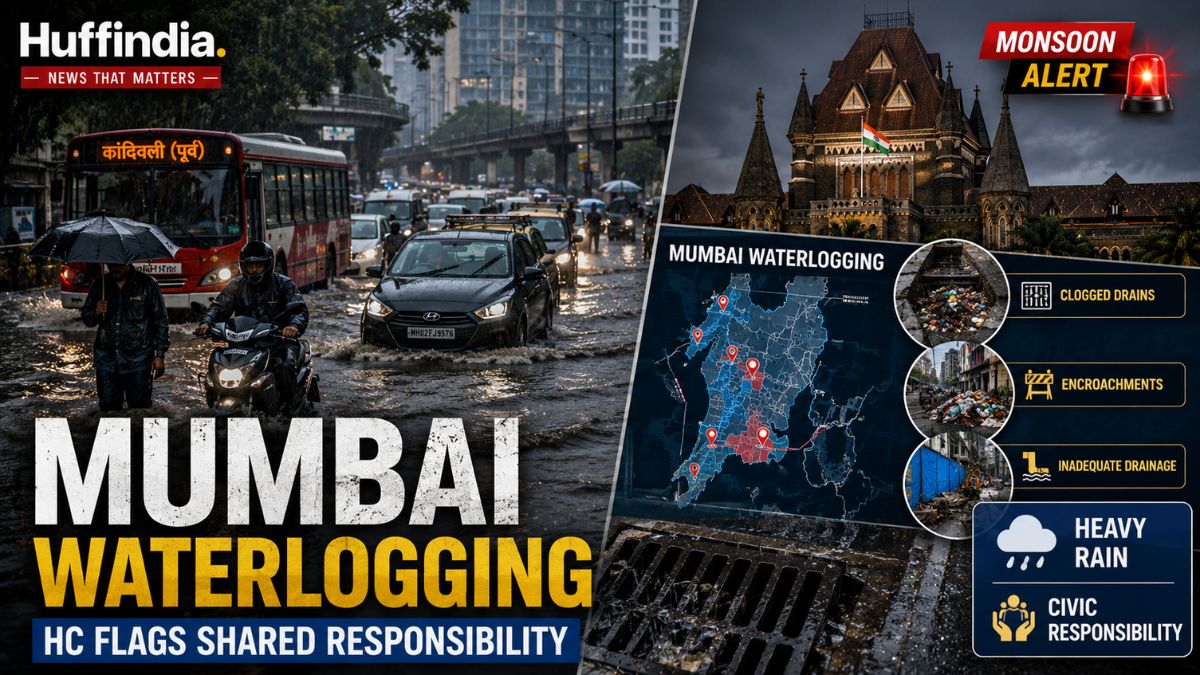



Mumbai waterlogging has returned to the centre of the monsoon debate after the Bombay High Court reportedly said citizens should stop blaming the civic body alone for flooding and recognise how encroachments, blocked drains and misuse of public spaces contribute to the city’s annual crisis.
The remarks came as Mumbai and parts of Maharashtra continued to deal with heavy rain, traffic disruption and public concern over urban flooding. Google Trends showed “severe rainfall alert” and “Bombay High Court” among rising searches, reflecting strong public interest in both the weather situation and the court’s comments.
According to reports by NDTV, Times of India, Bar and Bench, Live Law and The New Indian Express, the Bombay High Court observed that Mumbai’s flooding problem is not only a municipal failure but also a result of public behaviour, encroachments and clogged drainage systems.
Because this is a sensitive civic issue involving public authorities, citizens and court observations, this article separates reported judicial remarks, weather developments and broader urban-planning concerns. The article does not assign legal fault to any individual or group.
What Did the Bombay High Court Say on Mumbai Waterlogging?
The Bombay High Court reportedly said that Mumbai waterlogging should not be blamed only on the Brihanmumbai Municipal Corporation.
According to multiple reports, the court observed that citizens also contribute to the problem by grabbing land, blocking drains and allowing public spaces to be misused. Bar and Bench reported the court as saying that waterlogging is “our own creation,” while NDTV reported that the High Court said people should stop blaming the civic body alone.
Times of India reported that the court referred to encroachments and clogged drains while discussing the city’s repeated monsoon flooding. Hindustan Times reported that the court also referred to how footpaths and public spaces are often taken over by informal activity.
The court’s reported remarks should be understood in context. They do not mean civic authorities have no responsibility. Instead, the observations appear to broaden the discussion by saying the city’s flooding problem involves public behaviour, urban planning, enforcement and civic maintenance.
For additional background on the Bombay High Court’s reported remarks on Mumbai flooding and civic responsibility, readers can see NDTV’s report on the Mumbai waterlogging observations.
Why Is Mumbai Waterlogging a Recurring Issue?
Mumbai waterlogging is a recurring issue because the city combines intense monsoon rainfall with dense construction, old drainage networks, coastal geography and heavy pressure on public infrastructure.
Every monsoon, several low-lying areas experience flooding after heavy rain. Roads slow down, local transport is affected, schools may be shut and emergency services face additional pressure.
The issue becomes more complicated because Mumbai’s drainage system has to deal with rainwater as well as tidal conditions in some areas. If high tide coincides with intense rainfall, drainage becomes slower and water accumulation can worsen.
Encroachments and blocked drains add another layer to the problem. When stormwater drains are clogged with garbage, construction waste or illegal structures, rainwater has fewer pathways to flow out.
This is why Mumbai waterlogging is not only a weather story. It is also a city-planning, civic-governance and public-behaviour story.
Why Did the Court Mention Citizens’ Responsibility?
The court’s reported comments focused on the idea that citizens cannot treat flooding as only a municipal failure while ignoring how public spaces are used.
Reports said the Bombay High Court referred to encroachments, blocked drains and the misuse of land. These issues often reduce the effectiveness of civic infrastructure.
For example, if stormwater drains are built but later blocked by waste or illegal construction, the drainage capacity is reduced. If footpaths, open spaces or natural water channels are occupied, rainwater movement becomes more difficult.
The court’s reported remarks appear to underline a wider point: urban flooding needs both civic action and public cooperation.
This does not remove responsibility from municipal authorities. The BMC and other agencies remain responsible for drainage planning, desilting, road maintenance, flood preparedness and enforcement. But the court’s comments suggest that public participation and compliance are also necessary.
How Did Heavy Rain Add to Public Concern?
Heavy rain in Mumbai has increased public concern because intense monsoon spells can quickly disrupt daily life.
Reports said Mumbai received heavy rainfall over recent days, with traffic jams, water accumulation and temporary disruptions in some areas. The Hindu reported that Mumbai schools and colleges had been shut during an earlier spell as an orange alert remained in place, while later reports said the city got some respite as the alert situation changed.
Times of India reported that Mumbai’s seven-day rainfall had crossed Delhi’s annual average and nearly matched Bengaluru’s yearly total, highlighting the scale of the recent rain spell.
Weather alerts can change quickly, and readers should rely on the India Meteorological Department and local civic authorities for live warnings, school updates, traffic advisories and public-safety instructions.
The Mumbai waterlogging debate gained urgency because the court’s remarks came during a period when citizens were already dealing with the practical impact of rain.
What Role Does the BMC Play?
The Brihanmumbai Municipal Corporation plays a central role in managing Mumbai’s monsoon preparedness.
Its responsibilities include drain cleaning, road maintenance, pumping operations, flood monitoring, disaster-response coordination and public advisories. During heavy rainfall, the BMC also issues updates on waterlogged areas, transport disruptions and local safety measures.
However, civic officials often face structural challenges. Mumbai is densely populated, and infrastructure pressure is high. Some drainage networks are old, while construction and land-use changes have altered water flow in several areas.
This is why criticism of the BMC increases during every monsoon. Citizens expect roads to remain usable and drains to function. At the same time, the court’s reported remarks suggest that enforcement against encroachments and public cooperation are also part of the solution.
A responsible reading of the issue should avoid reducing the problem to a single cause.
Also Read | Pune-Mumbai Expressway Landslide Disrupts Traffic as Heavy Rain Batters Region
What Are the Public Safety Concerns?
Mumbai waterlogging creates several public-safety risks.
Waterlogged roads can hide potholes, open drains or uneven surfaces. Motorists may face vehicle breakdowns, while pedestrians can be exposed to contaminated water and electrical hazards.
Traffic congestion can delay ambulances and emergency response. Flooded railway tracks or roads can disrupt commuting for lakhs of people.
During intense rain, citizens should avoid unnecessary travel, check official alerts, stay away from flooded underpasses and avoid touching electrical poles or open wires.
Residents in low-lying areas should monitor civic advisories and keep emergency contacts available. Parents should follow official school and college announcements rather than relying on viral messages.
These precautions are not a substitute for long-term flood planning, but they can reduce risk during active rain spells.
What Needs to Change Long Term?
The long-term response to Mumbai waterlogging requires coordinated action.
First, drainage systems need regular cleaning and capacity assessment before and during the monsoon.
Second, encroachments on drains, footpaths and natural water channels need consistent enforcement. Selective or temporary action often fails to solve the underlying problem.
Third, urban planning must account for climate change and more intense rainfall events. Cities are increasingly seeing short bursts of heavy rain that overwhelm older systems.
Fourth, waste management needs improvement. Plastic, construction debris and garbage can choke drains and worsen flooding.
Fifth, citizens need reliable, real-time information about flood-prone areas, traffic diversions and weather alerts.
The Bombay High Court’s reported observations may push the public conversation beyond blame and towards shared responsibility.
Why This Story Matters for HuffIndia Readers
This story matters because Mumbai waterlogging is not only a local inconvenience. It is an example of how Indian cities are struggling with monsoon stress, urban expansion and infrastructure pressure.
Many cities face similar problems: drains built for older rainfall patterns, construction over natural water paths, rising vehicle density and weak enforcement against encroachments.
Mumbai’s experience offers a wider lesson for India’s urban future. As rainfall patterns become more intense and cities expand, flood management will require better planning, stricter enforcement and more responsible public behaviour.
The court’s comments are important because they frame flooding as a shared civic problem rather than a one-sided complaint.
Final Thoughts
Mumbai waterlogging has again triggered debate after the Bombay High Court reportedly said citizens should stop blaming the BMC alone and recognise how encroachments, clogged drains and misuse of public spaces contribute to flooding.
The safest conclusion is narrow and factual: heavy rain has renewed public concern over Mumbai flooding, and the court’s reported remarks have broadened the debate from civic failure to shared urban responsibility.
This does not absolve municipal authorities of their duties. Drainage, road maintenance, flood preparedness and enforcement remain essential public responsibilities. But the court’s remarks underline that citizens, businesses and local communities also affect how the city handles monsoon rain.
For now, residents should follow official weather and civic alerts, avoid flooded areas where possible and treat viral rain updates with caution unless confirmed by official sources.