
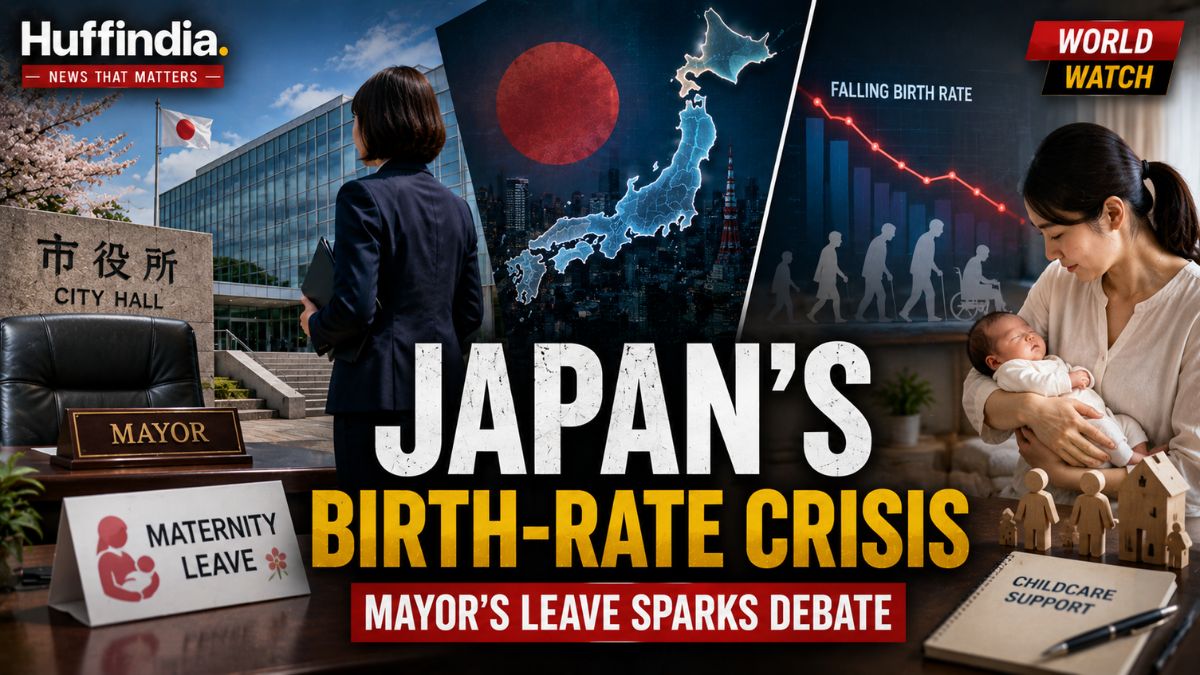



The Japan mayor maternity leave debate has moved into the national spotlight after Shoko Kawata, the mayor of Yawata in Kyoto Prefecture, decided to take time away from official duties around childbirth.
Kawata, 35, has become the focus of a wider argument over whether elected officials should step back from office for maternity leave, how political institutions accommodate pregnancy and childbirth, and what the controversy says about working women in a country grappling with long-term demographic decline.
The case has drawn particular attention because maternity leave available to ordinary employees does not formally apply in the same way to elected mayors. That legal and institutional distinction has turned what might otherwise appear to be a personal decision into a broader debate about public office, representation and workplace expectations.
Japan Mayor Maternity Leave Debate Reaches National Stage
The Japan mayor maternity leave controversy intensified after Kawata announced plans to take leave in connection with the birth of her first child.
Recent reporting identifies her as the first sitting mayor in Japan to take maternity leave, making the case unusual in the country’s political system.
Supporters view the decision as an important test of whether elected institutions can accommodate childbirth without forcing women to choose between political leadership and family life.
Critics have questioned whether a mayor should step away during an elected term, reflecting a wider disagreement over the responsibilities attached to public office.
The debate has therefore moved beyond Kawata herself. It now touches on how political systems should function when elected leaders face childbirth, illness or other major life events.
Who Is Shoko Kawata?
Shoko Kawata became mayor of Yawata in 2023 and was widely reported as Japan’s youngest female mayor at the time.
Before becoming mayor, she studied economics at Kyoto University and worked in public service and politics.
Her political agenda has included childcare and concerns linked to population decline, making the maternity-leave debate particularly significant.
Kawata has also spoken publicly about the scale of the reaction to her decision, indicating that she had not expected it to become such a major controversy.
Her experience has now become part of a much larger national conversation about women, leadership and family responsibilities.
Why the Legal Distinction Matters
One of the most important facts in the case is that elected mayors do not fit neatly within the same maternity-leave system that applies to ordinary employees.
This distinction matters for accurate reporting.
The controversy is not simply about an employee using a standard workplace benefit. It raises questions about how an elected office should continue functioning when the office-holder temporarily steps back around childbirth.
Reports indicate that arrangements have been discussed for the deputy mayor and municipal administration to maintain continuity while Kawata is away.
That operational question is central to the debate because supporters argue that strong institutions should be capable of continuing essential work even when an individual leader is temporarily absent.
Japan Birth-Rate Crisis Adds a Powerful Contradiction
The Japan birth rate crisis gives the controversy a wider national significance.
Japan has struggled for years with population decline, an ageing society and persistently low fertility. Governments have introduced measures intended to support families and encourage child-rearing, yet demographic pressures remain severe.
Against that backdrop, the backlash surrounding a pregnant elected leader taking maternity leave has prompted a difficult question: can a country encourage people to have children while maintaining professional and political structures that make childbirth harder to accommodate?
The Kawata debate does not have a simple answer, but it exposes the tension between demographic policy and workplace culture.
Additional reporting on Kawata’s decision and the institutional questions surrounding maternity leave for an elected mayor is available in The Guardian’s report on Shoko Kawata
Women in Japanese Politics Remain Underrepresented
The controversy also highlights the position of women in Japanese political leadership.
Women remain underrepresented in many levels of Japanese politics, and younger women are particularly uncommon in elected decision-making roles.
That context makes Kawata’s case more than an isolated workplace dispute.
If political institutions lack clear systems for pregnancy, childbirth and parental responsibilities, critics argue that women of childbearing age may face additional barriers to entering or remaining in public office.
Supporters of greater representation say political institutions need structures that allow leaders to manage major life events without creating uncertainty over governance.
Supporters See a Test of Modern Leadership
Those supporting Kawata’s decision argue that public leadership should not require elected officials to abandon family life.
From this perspective, a temporary absence does not automatically mean a collapse in governance if responsibilities are delegated lawfully and administrative systems continue to function.
The case has also encouraged discussion about whether leadership models built around constant personal availability remain realistic in modern institutions.
For supporters, the question is not whether elected officials should avoid responsibility, but whether governments can create continuity systems that recognise childbirth as a foreseeable life event.
Critics Raise Questions About Elected Responsibility
The debate also includes genuine concerns from those who believe elected office carries obligations different from ordinary employment.
Some critics question whether voters should expect a mayor to remain continuously available during a term.
That concern deserves to be represented accurately rather than dismissed. Elected officials hold public authority, and arrangements for temporary absence can raise legitimate questions about accountability, delegation and decision-making.
The central policy issue is therefore how to balance continuity of government with the physical realities of pregnancy and childbirth.
Japan Mayor Maternity Leave Row Exposes a Wider Workplace Challenge
The Japan mayor maternity leave debate reflects broader questions facing working women.
Pregnancy and childbirth can affect career progression, workplace expectations and access to leadership roles. These pressures can become particularly visible when women occupy senior positions traditionally dominated by men.
Kawata’s case has drawn attention precisely because she sits at the intersection of several national challenges: political representation, workplace culture, family policy and demographic decline.
The controversy may therefore outlast the immediate period of her leave.
What Happens Next?
Attention will remain on how Yawata’s administration manages continuity during Kawata’s absence and how the wider political debate develops.
The case could also encourage discussion about whether Japan needs clearer institutional rules for elected officials dealing with childbirth and parental responsibilities.
Any future reform would need to address difficult questions around temporary authority, democratic accountability and continuity of public services.
For now, Kawata’s decision has already achieved something significant: it has forced a national conversation about an issue that Japan’s political system has rarely had to confront so directly.
Also Read | India-Myanmar Security Talks: Myanmar Gives Key Assurance
Final Words
The controversy surrounding Shoko Kawata is about more than one mayor taking maternity leave.
It raises a broader question for Japan: whether institutions can genuinely support childbirth and family life while preserving the responsibilities of elected office.
That question carries added weight in a country struggling with population decline and seeking ways to make raising children more compatible with professional life.
The Japan mayor maternity leave debate is unlikely to resolve every issue surrounding gender, leadership or demographic change. But it has exposed a clear tension between Japan’s concern over falling birth rates and the practical barriers that can confront women when childbirth intersects with positions of power.
How the country responds may shape future discussions about political leadership, workplace expectations and the role of parents in public life.