
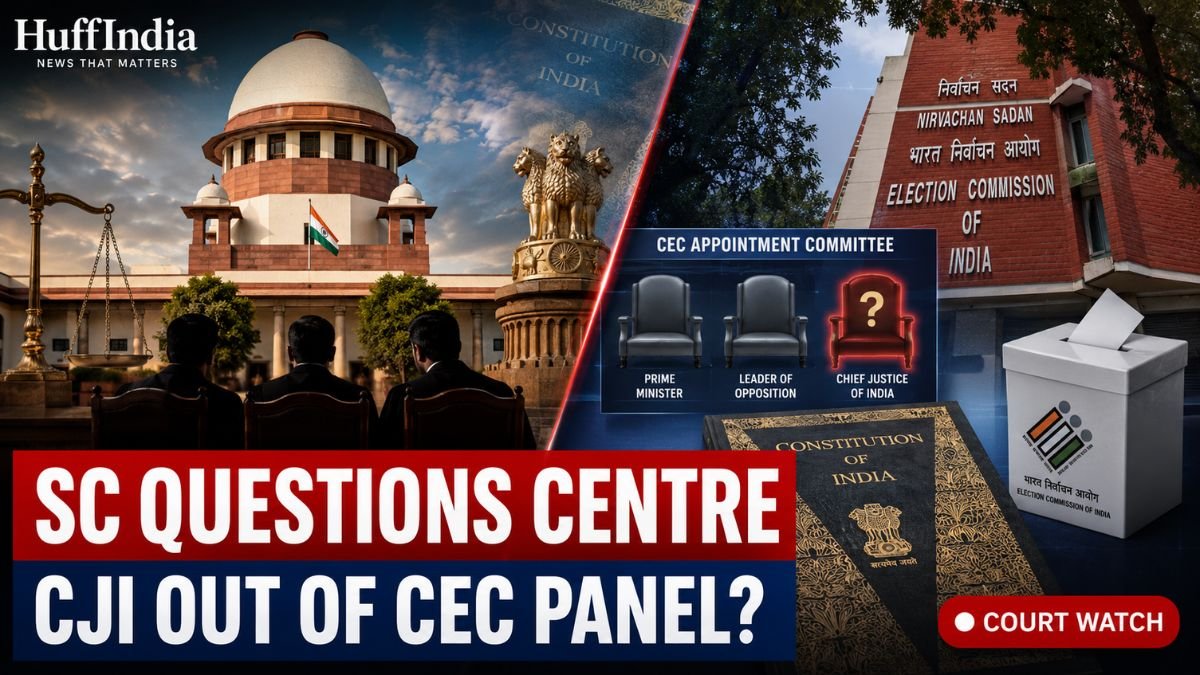



The Supreme Court CEC selection panel issue came under sharp judicial scrutiny on Thursday as the Supreme Court questioned the Union government over the exclusion of the Chief Justice of India (CJI) from the committee responsible for appointing the Chief Election Commissioner (CEC) and Election Commissioners. During the hearing, the Bench emphasised that constitutional institutions must not only function independently but must also inspire public confidence through a transparent appointment process.
A Bench comprising Justices Dipankar Datta and Satish Chandra Sharma heard petitions challenging the constitutional validity of the Chief Election Commissioner and Other Election Commissioners (Appointment, Conditions of Service and Term of Office) Act, 2023, which replaced the CJI with a Union Cabinet Minister on the three-member selection committee.
Supreme Court CEC Selection Panel Hearing Focuses on Institutional Independence
During the hearing, the Bench repeatedly stressed that the Election Commission of India (ECI) must be perceived as an institution that is independent of the executive.
The judges observed that while fairness may exist in the appointment process, it is equally important that the process visibly demonstrates fairness to the public. The court questioned why Parliament chose to remove the Chief Justice from the selection panel after the Supreme Court’s 2023 judgment had included the CJI as an interim member until a law was enacted.
Court Questions Need for Excluding the Chief Justice
The Bench asked the Centre why the selection committee could not include a neutral constitutional authority such as the Chief Justice of India.
During the proceedings, the judges drew comparisons with other high-level appointments, including the selection committee for the CBI Director, where the Chief Justice is represented to reinforce institutional credibility.
The court remarked that democratic institutions should not only be independent in practice but should also appear independent in the eyes of citizens.
What the Current Law Provides
The 2023 Act governing appointments to the Election Commission created a three-member selection committee comprising:
- Prime Minister (Chairperson)
- Leader of the Opposition in the Lok Sabha (or the leader of the largest opposition party)
- A Union Cabinet Minister nominated by the Prime Minister
The law replaced the interim arrangement laid down by the Supreme Court in March 2023, under which the panel consisted of the Prime Minister, the Leader of the Opposition and the Chief Justice of India until Parliament enacted legislation.
Readers can access the full text of the Chief Election Commissioner and Other Election Commissioners (Appointment, Conditions of Service and Term of Office) Act, 2023 on the Legislative Department website
Centre Defends the Existing Framework
The Union government has maintained that the Constitution does not mandate judicial representation in the committee responsible for appointing the Chief Election Commissioner.
In its submissions before the Supreme Court, the Centre argued that including the judiciary in the appointment process is a matter of legislative policy rather than a constitutional requirement. It also contended that the Election Commission’s independence is protected through constitutional safeguards governing tenure and removal from office.
Petitioners Raise Concerns Over Public Confidence
Petitioners challenging the 2023 law argued that excluding the Chief Justice could weaken public confidence in the neutrality of the appointment process.
They submitted that the Election Commission occupies a critical constitutional position responsible for conducting free and fair elections. Therefore, they argued, the appointment mechanism should include an independent constitutional authority to strengthen institutional credibility.
Why the Case Matters
The Supreme Court’s decision will have significant implications for the framework governing appointments to one of India’s most important constitutional bodies.
The Election Commission oversees:
- Lok Sabha elections
- State Assembly elections
- Presidential elections
- Vice-Presidential elections
- Enforcement of the Model Code of Conduct
- Electoral roll supervision
Because of these responsibilities, the method of appointing Election Commissioners has remained the subject of constitutional debate regarding independence and accountability.
Hearing Continues
The Supreme Court has not delivered any final ruling on the constitutional validity of the 2023 Act.
The matter remains under consideration, with further hearings expected after the Centre and petitioners complete their submissions. Until then, the existing statutory appointment process continues to remain in force.
Also Read | Abhijeet Dipke Alleges Student Protesters Are Being Harassed, Warns Movement Could Return
Final Takeaway
The Supreme Court CEC selection panel hearing has once again placed the spotlight on the balance between legislative authority and institutional independence. While the Centre argues that the Constitution does not require the Chief Justice of India to be part of the appointment committee, the Supreme Court has questioned whether excluding a neutral constitutional authority could affect public confidence in the Election Commission. With the constitutional challenge still pending, the final verdict is expected to shape the future framework for appointing India’s Chief Election Commissioner and Election Commissioners.