
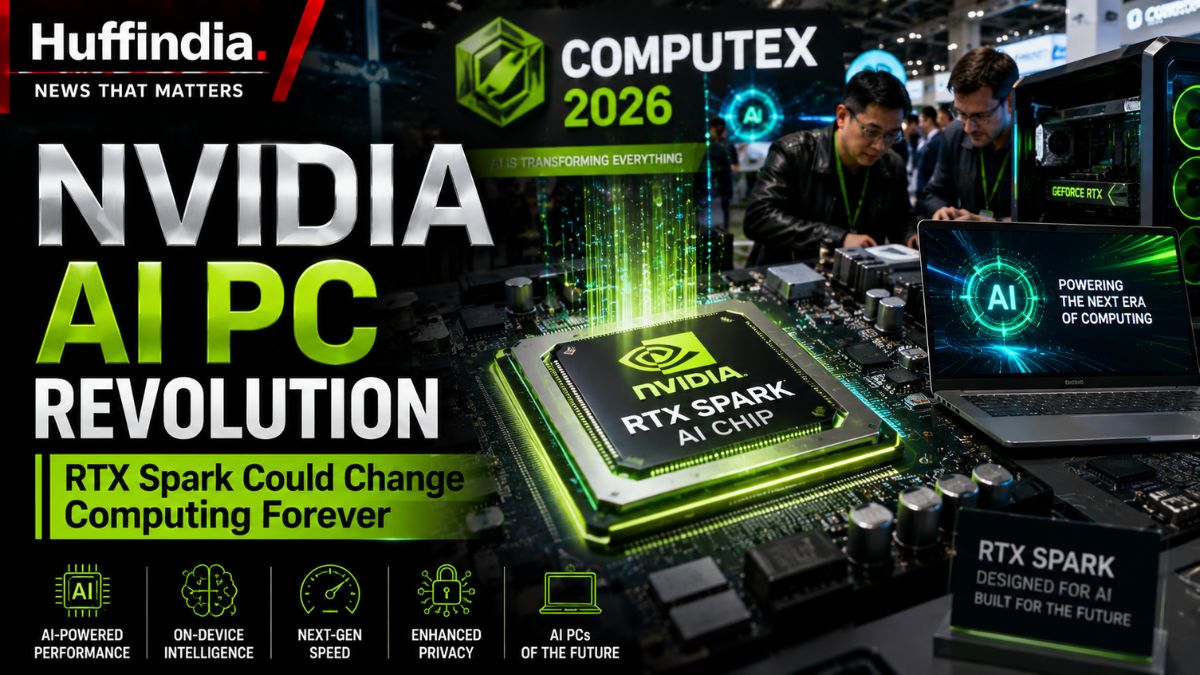



Nvidia RTX Spark AI Chip has emerged as one of the most talked-about technology announcements at Computex 2026, with industry leaders describing it as a breakthrough that could fundamentally reshape the future of personal computing.
As artificial intelligence becomes increasingly integrated into everyday digital experiences, Nvidia’s latest AI-focused processor is being positioned as a major step toward a new generation of intelligent computers capable of running advanced AI applications directly on devices rather than relying solely on cloud computing.
The unveiling has generated significant excitement among hardware manufacturers, software developers, and technology analysts, many of whom believe the industry may be entering a new era of AI-powered personal computing.
Nvidia RTX Spark AI Chip Takes Center Stage at Computex 2026
Computex has long been one of the world’s most important technology exhibitions, and this year’s event was dominated by discussions surrounding artificial intelligence.
Among the major announcements, the Nvidia RTX Spark AI Chip stood out as a key highlight. The company presented the processor as a platform specifically designed to accelerate AI workloads across laptops, desktops, and future computing devices.
Unlike traditional PC processors focused primarily on graphics and general computing tasks, AI-centric chips are engineered to efficiently handle machine learning models, generative AI applications, real-time language processing, and advanced productivity tools.
Industry observers believe this shift represents one of the most significant changes in computing architecture since the rise of mobile computing.
Why Nvidia’s New AI Chip Is Generating Buzz
The excitement surrounding the Nvidia RTX Spark AI Chip stems from its potential to bring advanced artificial intelligence capabilities directly to consumer devices.
Traditionally, many AI services relied heavily on cloud-based infrastructure. However, on-device AI processing offers several advantages:
- Faster response times
- Reduced internet dependency
- Improved privacy
- Enhanced productivity
- Lower latency for AI applications
By enabling AI tasks to run locally, Nvidia aims to make intelligent computing more accessible and efficient for everyday users.
Technology analysts suggest that this capability could transform how consumers interact with personal computers over the next decade.
AI PCs Could Become the New Industry Standard
One of the biggest implications of the AI PC revolution is the possibility that AI-enabled devices may soon become the default computing platform.
Major software companies are increasingly integrating artificial intelligence into operating systems, productivity tools, creative applications, and enterprise software.
As a result, hardware manufacturers are racing to develop processors capable of handling these demanding workloads efficiently.
The Nvidia RTX Spark AI Chip arrives at a time when demand for AI-ready hardware is accelerating across both consumer and business markets.
Industry experts believe future computers will be judged not only by processing speed and graphics performance but also by their ability to run AI-powered applications seamlessly.
What Makes the Nvidia RTX Spark AI Chip Different?
While Nvidia has not positioned the chip as a replacement for traditional CPUs, it is designed to complement existing computing architectures by accelerating AI-specific tasks.
The processor is optimized for:
- Generative AI applications
- Real-time language models
- AI-powered content creation
- Intelligent assistants
- Advanced gaming enhancements
- Productivity automation
This specialized approach reflects the growing recognition that artificial intelligence workloads require dedicated hardware optimization.
Analysts note that AI computing increasingly demands different performance characteristics than conventional computing tasks.
Impact on Windows Laptops and Desktops
The Nvidia RTX Spark AI Chip is expected to play a major role in the next generation of Windows-based computers.
PC manufacturers are already exploring ways to integrate AI functionality into devices ranging from premium laptops to high-performance desktops.
Potential use cases include:
- Real-time translation
- AI-assisted writing tools
- Smart productivity applications
- Personalized computing experiences
- Enhanced cybersecurity systems
- Automated creative workflows
These capabilities could significantly change how users interact with their devices on a daily basis.
Nvidia’s Growing Leadership in Artificial Intelligence
Nvidia has become one of the most influential companies in the AI industry over the past several years.
Its graphics processing units (GPUs) already power many of the world’s leading artificial intelligence systems, including large language models, cloud infrastructure platforms, and enterprise AI solutions.
The launch of the Nvidia RTX Spark AI Chip demonstrates the company’s ambition to extend its AI leadership beyond data centers and into consumer computing.
This strategy aligns with broader industry trends that aim to bring AI capabilities closer to end users.
Challenges Facing the AI PC Revolution
Despite the enthusiasm surrounding AI-powered hardware, several challenges remain.
Developers must create software that fully utilizes AI-specific hardware capabilities. Consumers will also need compelling real-world applications that justify upgrading existing devices.
Additionally, questions regarding privacy, security, energy efficiency, and responsible AI deployment continue to shape discussions across the technology industry.
The success of AI PCs will likely depend on how effectively hardware manufacturers, software developers, and technology companies collaborate to create meaningful user experiences.
What Comes Next?
Industry analysts expect AI-focused computing to remain one of the fastest-growing segments of the technology market over the next several years.
Major technology companies are already investing billions of dollars into AI hardware development, signaling that competition in this space is only beginning.
For official announcements and technical specifications, readers can visit the NVIDIA website.
As AI adoption accelerates, processors such as the Nvidia RTX Spark AI Chip could become central to the next generation of computing innovation.
Final Thoughts on Nvidia RTX Spark AI Chip
The Nvidia RTX Spark AI Chip has quickly become one of the most significant technology announcements of 2026. Its introduction reflects a broader shift toward AI-native computing, where artificial intelligence becomes a core component of everyday digital experiences rather than a separate feature.
While the long-term impact will depend on adoption rates and software development, many industry experts believe Nvidia’s latest innovation could mark the beginning of a major transformation in personal computing.
If those predictions prove accurate, the Nvidia RTX Spark AI Chip may be remembered as a defining milestone in the evolution of AI-powered PCs.
Also Read: AI Search India Trend Reshapes How Users Discover Information Online