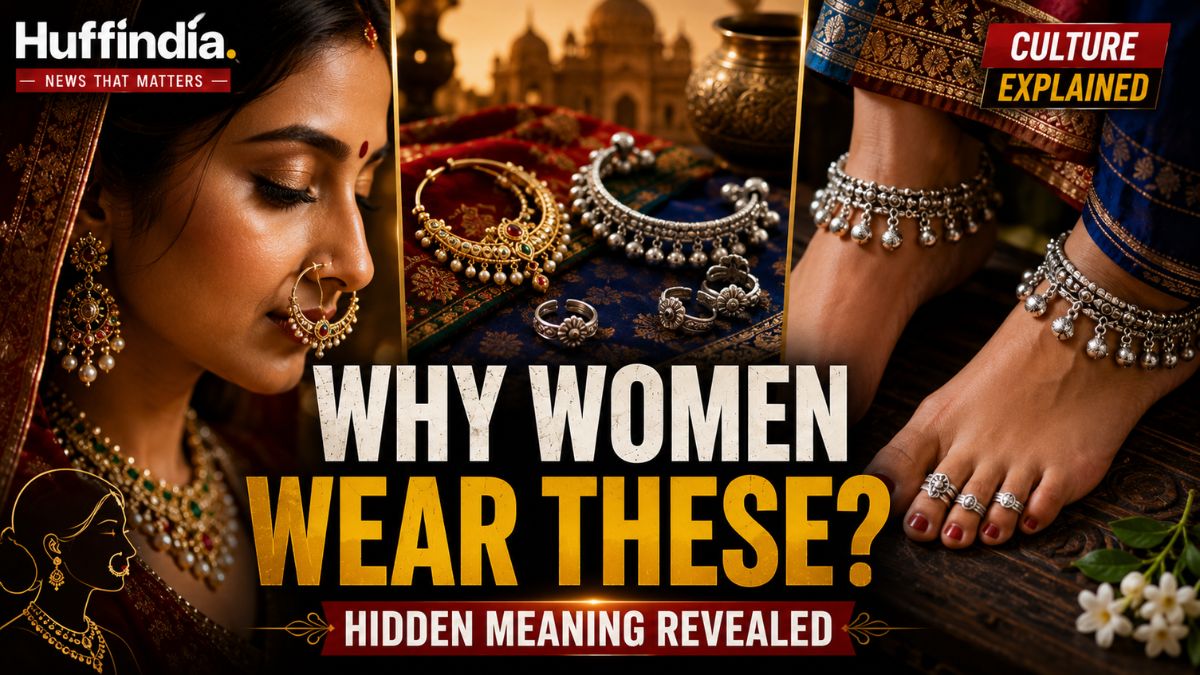



Indian women traditional jewellery is often admired for its beauty, but many ornaments carry meanings that go far beyond fashion. Nose rings, anklets and toe rings have long been connected with identity, marriage, regional customs, aesthetics and family traditions across different parts of India.
Yet there is an important truth behind these age-old practices: India does not have one single explanation for why every woman wears a particular ornament.
Meanings can vary by region, religion, community, family and generation. A nose ring that forms part of bridal identity in one community may be worn purely as fashion in another. Toe rings may signify marriage in many Hindu traditions, while anklets can function as ceremonial jewellery, dance ornaments, heirlooms or everyday adornment.
There are also popular claims that some ornaments improve reproductive health, regulate energy or provide other medical benefits. Such claims should be treated carefully. Cultural belief is not the same as scientifically established medical evidence.
Here is a closer look at what these ornaments have traditionally represented—and where popular explanations may go too far.
Indian Women Traditional Jewellery Reflects More Than Fashion
The story of Indian women traditional jewellery is deeply connected with the country’s cultural diversity.
Jewellery can communicate many things, including:
- marital status
- regional identity
- community tradition
- family heritage
- ceremonial significance
- personal style
- social status
But these meanings are not fixed across India.
The designs of nose ornaments alone vary dramatically between regions and communities. Similarly, anklets may appear as delicate chains, heavy silver ornaments or bell-bearing forms, while toe rings are known by different names in different Indian languages and traditions.
This diversity is why sweeping claims such as “all Indian women wear this for one reason” are misleading.
Why Do Indian Women Wear Nose Rings?
The nose ring meaning in India is especially complex.
Known in many contexts as a nath, nathni or by other regional names, the ornament can be associated with bridal dress, femininity, community identity, family customs and beauty.
In some communities, elaborate nose rings form an important part of wedding attire. In others, small nose pins are worn every day. The preferred design and even the side of the nose may vary according to local practice and personal choice.
Museum-based research into Indian nose-ring collections has highlighted this regional diversity, showing how ornament styles can reflect different cultural and community histories.
This means the Indian nose ring is best understood not as a symbol with one universal definition, but as a family of traditions that have evolved differently across the country.
Also Read | FMGE Result 2026 Declared: Scorecards From July 16, What Candidates Should Know
Are Nose Rings Always a Sign of Marriage?
No.
This is one of the most common oversimplifications surrounding Indian jewellery.
A nose ring may be connected with marriage or bridal identity in certain communities, but many unmarried women also wear nose pins and nose rings for fashion, cultural expression or personal preference.
Modern styling has further changed the picture. Nose jewellery today can move easily between traditional ceremonies, contemporary fashion and individual self-expression.
Therefore, describing every nose ring as a universal marker of marital status would be inaccurate.
The Truth About Nose Piercing and Health Claims
Popular explanations sometimes claim that piercing a particular nostril can reduce menstrual discomfort or ease childbirth because of links to Ayurveda or pressure points.
These ideas circulate widely in lifestyle discussions and family traditions.
However, they should not be presented as proven medical facts without strong clinical evidence.
A cultural belief can be meaningful to the people who practise it while still remaining medically unproven. Responsible reporting should preserve that distinction.
Anyone considering a nose piercing should focus on practical health issues such as hygiene, sterile equipment, professional piercing practices and appropriate aftercare rather than relying on claims of therapeutic benefit.
For evidence-based information on body piercing risks and aftercare, readers can consult Mayo Clinic’s body piercing guidance.
Why Do Indian Women Wear Anklets?
The anklet tradition in India is equally rich and varied.
Often called payal, pajeb and by other regional names, anklets have been part of Indian adornment for generations. They appear in bridal jewellery, classical performance traditions, festive dress and everyday wear.
Some anklets include tiny bells that create a distinctive sound as the wearer moves.
Historically and culturally, that sound has been associated with movement, grace and presence. Bell-bearing ankle ornaments also have a major place in Indian dance traditions, although performance ghungroo have a specific artistic function and should not simply be treated as identical to everyday anklets.
For many families, anklets are also gifted during weddings or important ceremonies and may become treasured heirlooms.
What Does the Sound of an Anklet Mean?
The familiar sound of a payal has accumulated different interpretations.
In some traditional accounts, the sound announced a woman’s presence within a household. In artistic contexts, rhythmic ankle bells are inseparable from movement and performance. In literature and popular culture, anklet sounds often evoke grace, romance or femininity.
But once again, there is no single meaning that applies to every wearer.
Today, many women choose anklets simply because they enjoy the design. Others wear them during festivals, weddings or dance performances. Some preserve them as family jewellery.
The modern anklet can therefore be traditional and fashionable at the same time.
Why Is Silver Commonly Associated With Anklets?
Silver is strongly associated with many Indian anklet traditions.
One commonly repeated cultural explanation is that gold is considered sacred or auspicious in some traditions and therefore may be avoided on the feet. Silver consequently became a widely used material for foot ornaments.
However, practices differ across communities, and modern jewellery does not always follow older conventions.
It is safer to describe this as a traditional cultural explanation rather than a universal religious rule followed by everyone in India.
Why Do Married Women Wear Toe Rings?
The toe ring meaning for married women is among the clearest marital associations in Indian ornament traditions, particularly in many Hindu communities.
Toe rings are commonly known as bichiya in Hindi, metti in Tamil and by other names across Indian languages.
In a number of wedding traditions, the groom places rings on the bride’s toes as part of the marriage ceremony. They are often worn on the second toe of each foot and may continue to serve as a visible symbol of married status.
However, the precise ritual, design and expectation of continued wear vary significantly.
Not every married Indian woman wears toe rings, and not every Indian community follows the same custom.
Toe Rings as Symbols of Marriage and Identity
For many wearers, toe rings represent:
- marriage
- commitment
- continuity of tradition
- family customs
- bridal identity
Their meaning can therefore be compared, cautiously, with other forms of marital jewellery—but without assuming that every community treats them identically.
In modern India, toe rings have also entered mainstream fashion. Contemporary designs may be worn outside traditional marital contexts, demonstrating how jewellery meanings can evolve over time.
Do Toe Rings Improve Reproductive Health?
This is where fact-checking becomes especially important.
A widely repeated claim suggests that wearing a ring on the second toe affects nerves connected with reproductive organs, supports fertility or regulates menstrual cycles. Some versions also claim that silver conducts energy from the earth into the body.
These explanations are popular in cultural and lifestyle content, but they should not be reported as established medical facts.
There is a difference between a traditional belief and a clinically demonstrated health effect.
Toe rings may hold genuine cultural, emotional and marital significance without needing an unverified medical explanation to justify the tradition.
Why These Traditions Have Survived for Generations
The continuing appeal of these ornaments lies partly in their ability to change.
A grandmother’s heavy silver payal may become a family heirloom. A traditional bridal nath may appear only during a wedding ceremony. A minimalist nose pin may become part of everyday urban fashion. A toe ring may remain a marital symbol for one woman and serve as a style accessory for another.
This adaptability has allowed old forms of jewellery to survive even as social expectations change.
Rather than disappearing, many ornaments have acquired additional meanings.
How Modern Indian Women Are Redefining Traditional Jewellery
Today, women increasingly decide for themselves how and why they wear traditional ornaments.
Some embrace them as symbols of cultural continuity. Others reinterpret them through contemporary fashion. Some choose not to wear marital markers at all.
This change does not necessarily erase tradition. Instead, it demonstrates that cultural practices are living systems rather than frozen rules.
Modern jewellery designers have also transformed nose pins, anklets and toe rings into pieces that can be styled with both Indian and Western clothing.
As a result, ornaments once strongly associated with particular ceremonies may now appear in offices, universities, fashion shoots and everyday street style.
The Hidden Meaning Is Diversity, Not One Universal Rule
Perhaps the most important truth is that Indian women traditional jewellery cannot be reduced to a single viral explanation.
India’s enormous diversity means that the same ornament can carry different meanings in different places.
A nose ring can signify bridal heritage, regional identity or personal fashion. An anklet can be ceremonial, musical, inherited or decorative. A toe ring can mark marriage in one context and function as a contemporary accessory in another.
The traditions are real, but their meanings are layered.
Final Words
Nose rings, anklets and toe rings remain among the most recognisable forms of Indian women traditional jewellery, but their significance extends far beyond a simple list of supposed benefits.
They tell stories of marriage, beauty, movement, family, regional identity, craftsmanship and changing ideas of womanhood.
At the same time, responsible discussion requires separating cultural belief from medical evidence. Claims that particular ornaments guarantee reproductive benefits, reduce pain or alter bodily energy should not be presented as scientific fact without reliable evidence.
The deeper truth behind these age-old traditions is not that every ornament has one secret meaning. It is that Indian jewellery has evolved