


India UK FTA vehicle import benefits are moving closer to implementation after New Delhi notified procedures governing how importers can seek preferential tariff treatment for eligible vehicles originating in the United Kingdom.
The move comes ahead of the India–UK Free Trade Agreement taking effect on July 15, 2026, opening a new phase in bilateral trade. For the automobile sector, the agreement is particularly significant because it creates a quota-based route for lower customs duties on qualifying UK-origin passenger vehicles.
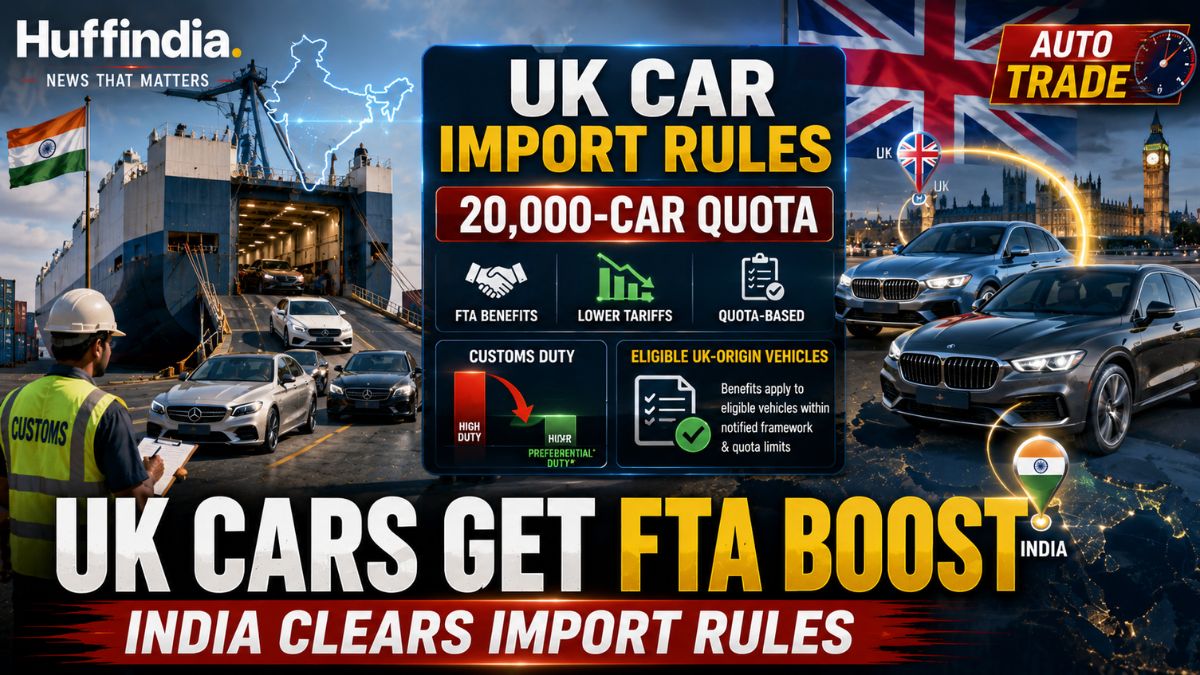
Recent reporting indicates that 20,000 passenger cars across three categories will be covered by the first-year quota framework. However, the concession is not automatic for every British-branded vehicle. Eligibility will depend on origin requirements, vehicle classification, quota availability and compliance with prescribed procedures.
The distinction is important for consumers and importers because the new framework should not be interpreted as a blanket duty cut for all cars associated with the UK.
India UK FTA Vehicle Import Benefits Move Towards July 15 Rollout
The newly notified process provides the operational framework through which India UK FTA vehicle import benefits can be claimed once the trade agreement enters into force.
Qualifying vehicles will need to satisfy the agreement’s rules of origin and relevant documentation requirements. The system is intended to ensure that preferential tariffs are available only to eligible products with sufficient economic connection to the UK.
This matters because modern vehicles often rely on complex global supply chains. Components, electronics, batteries and other systems may be sourced from several countries even when the final vehicle carries a British brand name.
As a result, the country associated with a brand will not necessarily determine tariff eligibility on its own.
First-Year Vehicle Quota Set at 20,000 Units
One of the most important elements of the automotive arrangement is its quota-based structure.
According to recent reports, a total of 20,000 passenger vehicles across three categories will be eligible under the first-year framework. The quota is central to understanding India UK FTA vehicle import benefits because preferential access will be limited rather than unlimited.
For mass-market vehicles with engine capacity of up to 1,500 cc, reports indicate a first-year quota of 5,000 units, with customs duty reduced to 50% from 66% under the applicable framework.
Other vehicle categories are subject to separate tariff and quota provisions. Larger and higher-value imported vehicles are likely to receive particular market attention because India has historically imposed high duties on completely built imported cars.
The actual concession available to any vehicle will therefore depend on its category, origin status and remaining quota availability.
Why British Luxury Cars Are in Focus
The new trade framework has attracted strong interest from the premium automobile market because Britain is home to several globally recognised luxury and high-performance automotive marques.
India UK FTA vehicle import benefits could improve the economics of importing certain qualifying UK-made models into India. Some eligible larger petrol and diesel vehicles may receive significant tariff reductions under the phased framework.
However, lower customs duties should not be confused with guaranteed reductions of the same scale in showroom prices.
Final vehicle prices can still reflect shipping costs, insurance, currency movements, domestic taxes, dealer strategy, model specifications and other commercial factors.
Automakers will ultimately decide whether and to what extent tariff savings are passed on to customers.
Rules of Origin Will Decide Which Cars Qualify
Rules of origin will be among the most important parts of implementation.
A vehicle cannot necessarily claim India UK FTA vehicle import benefits simply because it belongs to a British company or is marketed as a British brand. The product must satisfy the origin criteria specified under the bilateral agreement.
This is particularly relevant in the automobile industry, where manufacturing networks extend across multiple countries.
Importers seeking preferential treatment may need to maintain supporting records and demonstrate compliance with the applicable origin requirements. Such safeguards are designed to enable verification and reduce the risk of improper tariff claims.
For businesses, documentation could therefore become almost as important as the headline duty reduction itself.
What Changes When the FTA Takes Effect on July 15?
The bilateral trade agreement is scheduled to enter into force on July 15, 2026.
For eligible automobile imports, that date marks the beginning of the new preferential framework rather than an immediate transformation of the entire market.
From July 15, India UK FTA vehicle import benefits will enter the implementation phase for qualifying vehicles that meet origin, quota and procedural conditions.
Importers will still need to establish eligibility, complete the required processes and operate within the available quota limits.
The real market impact is therefore likely to emerge gradually as companies assess eligible models, pricing strategies and import volumes.
Could UK-Made Cars Become Cheaper in India?
Potentially, yes, but the answer will vary by model.
Some qualifying UK-origin vehicles could benefit from lower customs duties than under the previous regime. This may give manufacturers greater flexibility when setting prices for selected imported models.
For buyers, the impact of India UK FTA vehicle import benefits will depend heavily on how manufacturers respond to tariff reductions and whether savings are reflected in final retail prices.
A company may pass on a substantial portion of the benefit, retain part of the saving to absorb other costs or revise its wider market strategy. Currency fluctuations could also reduce or amplify the impact.
For that reason, claims that all British cars will suddenly become dramatically cheaper would be misleading.
The more accurate conclusion is that eligible UK-origin vehicles within the quota framework may gain access to preferential tariff treatment.
Also Read | Delhi EV Policy 2026: New Rules, Incentives and EV Targets Explained
India’s Domestic Auto Industry Remains a Key Consideration
India has developed a large automotive manufacturing ecosystem covering passenger vehicles, two-wheelers, components, engineering services and export-oriented production.
Any significant tariff opening must therefore balance consumer choice and international trade commitments with domestic industrial priorities.
The quota system offers one mechanism for managing that balance. Instead of immediately allowing unlimited concessional imports, the framework sets defined volumes and introduces changes within controlled limits.
This approach could give policymakers and the industry time to assess market effects while preserving a degree of protection for local manufacturing.
For deeper context on India’s automotive trade patterns and finished-vehicle imports, readers can consult NITI Aayog’s Trade Watch report.
Why the India–UK FTA Matters Beyond Cars
Vehicles are only one part of a much broader economic agreement.
The trade pact covers goods, services and other areas of commercial cooperation between India and the United Kingdom. Both sides are seeking wider market access and deeper bilateral trade ties.
The automotive provisions have attracted exceptional attention because tariff changes can directly influence high-value purchasing decisions and competitive strategies.
However, the overall success of the FTA will ultimately depend on trade and investment outcomes across multiple sectors rather than vehicle imports alone.
Final Words
The notification of procedures for India UK FTA vehicle import benefits is an important operational step ahead of the July 15 rollout.
The biggest takeaway is that lower tariffs will be conditional and quota-based, not a blanket concession for every UK-branded vehicle. With 20,000 passenger cars reportedly covered across three categories in the first year, the framework could influence parts of India’s imported-car market while keeping initial access controlled.
For consumers, the key question is whether tariff savings translate into meaningful reductions in showroom prices. For automakers and importers, the challenge will be managing origin requirements, documentation, classification and quota availability.
India UK FTA vehicle import benefits may open a new chapter in bilateral automotive trade, but the true impact will become clearer only after implementation begins and eligible vehicles start entering the market under the new framework.