
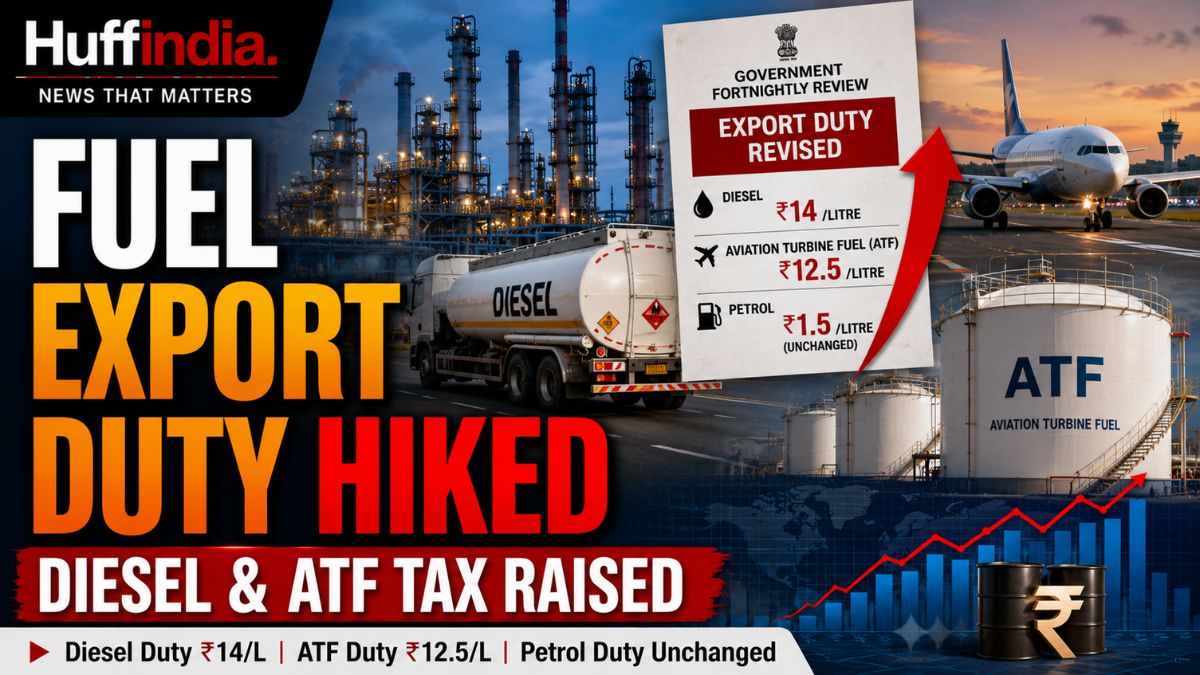



India Fuel Export Duty has been revised upward in the latest fortnightly review, with the government increasing export duties on diesel and aviation turbine fuel (ATF) while leaving the levy on petrol unchanged.
The revised rates, announced late on June 15, will come into effect for the fortnight beginning June 16. Under the new structure, the export duty on diesel has been increased to ₹14 per litre, while the duty on aviation turbine fuel has been raised to ₹12.5 per litre. The export levy on petrol remains unchanged at ₹1.5 per litre.
The move reflects the government’s ongoing effort to balance domestic fuel availability, revenue considerations, and international energy market dynamics.
India Fuel Export Duty Revised in Latest Review
The latest India Fuel Export Duty review resulted in higher taxes on two major petroleum products.
The revised export duty rates are:
- Diesel: ₹14 per litre
- Aviation Turbine Fuel (ATF): ₹12.5 per litre
- Petrol: ₹1.5 per litre (unchanged)
The changes are part of the government’s regular fortnightly review mechanism, which assesses global oil prices, refining margins, and domestic fuel market conditions.
Energy sector observers note that these reviews allow policymakers to respond more quickly to changing international market conditions.
Why the Government Reviews Export Duties
The India Fuel Export Duty framework was introduced to help manage fluctuations in energy markets and ensure adequate domestic fuel availability.
When global prices rise sharply, refiners may find exports more profitable than domestic sales. Export duties can help moderate this trend by reducing incentives to divert large quantities of fuel overseas.
Government officials have consistently stated that the objective is to balance:
- Domestic fuel supply
- Consumer interests
- Export competitiveness
- Energy security
- Revenue generation
The latest increase reflects continued monitoring of these factors.
Diesel Export Duty Sees Significant Increase
Among the changes announced under the revised India Fuel Export Duty structure, diesel experienced the most notable adjustment.
Diesel remains one of India’s most important fuels, widely used in transportation, logistics, agriculture, and industrial operations.
Because diesel demand plays a critical role in economic activity, policymakers often monitor diesel exports closely to ensure domestic requirements are adequately met.
The increase to ₹14 per litre signals a stronger emphasis on balancing export opportunities with domestic considerations.
ATF Export Duty Also Raised
The government also increased the India Fuel Export Duty on aviation turbine fuel.
ATF serves as the primary fuel for commercial aviation operations and is closely linked to trends in global air travel and energy markets.
By raising the export duty to ₹12.5 per litre, authorities appear to be responding to changing market conditions affecting the aviation fuel sector.
Industry analysts will be watching closely to assess the impact on exporters and refiners involved in international fuel trade.
Petrol Duty Remains Unchanged
Unlike diesel and ATF, petrol did not see any changes in the latest India Fuel Export Duty review.
The levy remains at ₹1.5 per litre.
The decision suggests that policymakers currently view petrol market conditions differently from those affecting diesel and aviation fuel exports.
Maintaining the existing rate provides continuity for exporters while allowing the government to focus adjustments on other fuel categories.
Impact on Oil Refiners
The revised India Fuel Export Duty rates are expected to influence India’s refining sector.
Major refiners often export petroleum products to international markets while also serving domestic demand.
Higher export duties can affect:
- Export profitability
- Refining margins
- Trade flows
- Operational planning
- Investment decisions
Industry participants will likely evaluate how the revised rates affect business strategies over the coming weeks.
Global Energy Markets Remain a Key Factor
The India Fuel Export Duty mechanism is closely tied to developments in international energy markets.
Crude oil prices, geopolitical events, refining margins, and fuel demand patterns all play a role in determining policy decisions.
Recent volatility in global energy markets has increased the importance of flexible policy tools that allow governments to respond quickly to changing circumstances.
Analysts believe future duty adjustments will continue to depend heavily on international market conditions.
What the Changes Mean for Consumers
The revised India Fuel Export Duty primarily affects exporters and refiners rather than consumers directly.
However, energy policies can indirectly influence fuel supply dynamics and broader economic conditions.
Experts note that ensuring stable domestic availability remains a key consideration behind export duty decisions.
Consumers and businesses alike benefit from predictable fuel supplies, particularly during periods of international market uncertainty.
What Happens Next?
The revised rates will remain in force for the current review period beginning June 16.
Market participants will now monitor:
- Global crude oil prices
- Refining margins
- Export volumes
- Domestic fuel demand
- Future government reviews
Any significant changes in market conditions could influence subsequent policy decisions.
For official updates on petroleum policies and energy sector developments, readers can visit the Ministry of Petroleum and Natural Gas website.
Final Thoughts on India Fuel Export Duty
The latest India Fuel Export Duty revision highlights the government’s continued focus on managing fuel exports amid evolving global energy conditions. By increasing duties on diesel and aviation turbine fuel while keeping petrol rates unchanged, policymakers are seeking to balance domestic priorities with international market realities.
As global energy markets remain volatile, future reviews of the India Fuel Export Duty structure are likely to remain closely watched by refiners, exporters, investors, and consumers alike. The coming weeks will reveal how the revised rates influence export activity and broader market dynamics.
Also Read: Major Boost for Ethanol Blended Petrol as Government Announces Excise Duty Exemption