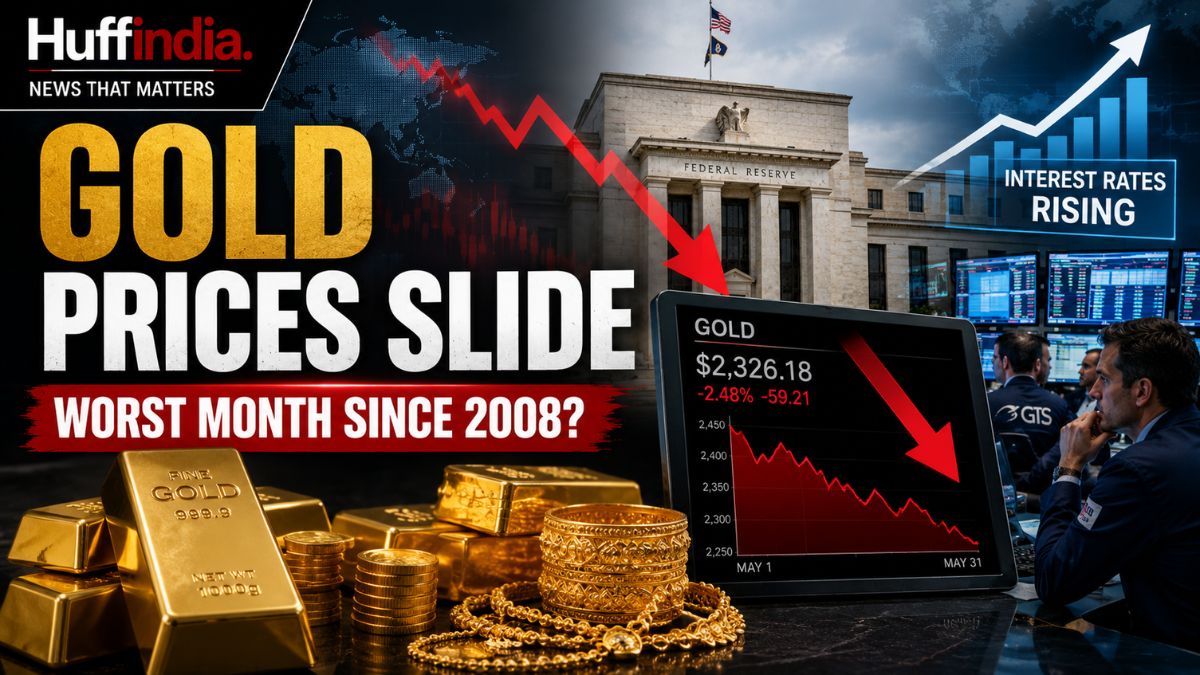



The Gold Price Outlook has turned increasingly bearish as gold prices head towards their steepest monthly decline since the global financial crisis of 2008. Market analysts attribute the sharp fall primarily to growing expectations that the U.S. Federal Reserve could keep interest rates elevated for longer, reducing the appeal of non-yielding assets such as gold.
While geopolitical tensions and global economic uncertainty have traditionally supported gold prices, investors are currently placing greater emphasis on monetary policy signals coming from the Federal Reserve.
Why Gold Prices Are Falling
The biggest factor weighing on the Gold Price Outlook is the market’s expectation that U.S. interest rates may remain higher for an extended period.
Higher interest rates generally strengthen the U.S. dollar and increase returns on fixed-income investments such as government bonds. Since gold does not generate interest or dividends, investors often shift capital toward higher-yielding assets when borrowing costs remain elevated.
As a result, demand for bullion has weakened despite ongoing geopolitical uncertainties.
Safe-Haven Demand Fails to Offset Pressure
Gold has historically been viewed as a safe-haven investment during periods of market volatility and geopolitical conflict.
However, the current Gold Price Outlook suggests that safe-haven buying has not been strong enough to offset concerns over tighter monetary policy.
Analysts note that investors remain cautious as financial markets continue to assess inflation trends, central bank decisions, and global economic growth prospects.
What the Federal Reserve Means for Gold
The U.S. Federal Reserve plays a significant role in determining the direction of global commodity markets.
Recent comments from Fed officials have reinforced expectations that policymakers may keep interest rates elevated until inflation moves closer to their long-term target.
This outlook has strengthened the U.S. dollar and Treasury yields, creating additional headwinds for precious metals.
Market participants will closely monitor upcoming economic data, including inflation and employment reports, for further clues about future interest-rate decisions.
What This Means for Indian Investors
For Indian investors, the current Gold Price Outlook presents both risks and opportunities.
Lower international gold prices can sometimes benefit jewellery buyers, although domestic prices are also influenced by:
- Rupee-dollar exchange rates
- Import duties
- GST
- Local demand
- Global bullion prices
Financial advisers generally recommend viewing gold as a long-term portfolio diversification tool rather than making investment decisions based solely on short-term price movements.
Should Investors Panic?
Market experts believe investors should avoid reacting emotionally to short-term volatility.
The current Gold Price Outlook reflects changing global monetary expectations rather than a fundamental loss of gold’s long-term investment appeal.
Gold continues to serve several important roles in diversified investment portfolios, including:
- Portfolio diversification
- Inflation hedge
- Wealth preservation
- Risk management during market uncertainty
Experts advise investors to review their overall asset allocation instead of making decisions based on one month’s performance.
Key Factors to Watch
The direction of the Gold Price Outlook over the coming weeks will depend on several developments, including:
- U.S. inflation data
- Federal Reserve policy announcements
- Treasury bond yields
- Strength of the U.S. dollar
- Global geopolitical developments
Any significant shift in these factors could influence investor sentiment toward precious metals.
Outlook for the Coming Months
Analysts believe gold prices could remain volatile until markets receive greater clarity regarding future Federal Reserve policy.
If interest-rate expectations soften, gold could regain some lost ground. Conversely, stronger economic data and persistent inflation may continue to support higher bond yields and keep pressure on bullion prices.
Investors are therefore expected to remain focused on upcoming economic indicators before adjusting their long-term investment strategies.
For official market updates and investor information, visit the National Stock Exchange of India (NSE).
Final Thoughts
The current Gold Price Outlook reflects a market balancing two competing forces: the traditional safe-haven appeal of gold and the impact of higher interest-rate expectations. At present, monetary policy is having the stronger influence, placing bullion on course for its weakest monthly performance since 2008.
While short-term volatility may continue, financial experts emphasize that long-term investment decisions should be based on individual financial goals, diversification needs, and risk tolerance rather than temporary market swings.
Also Read | Gold | Huffindia