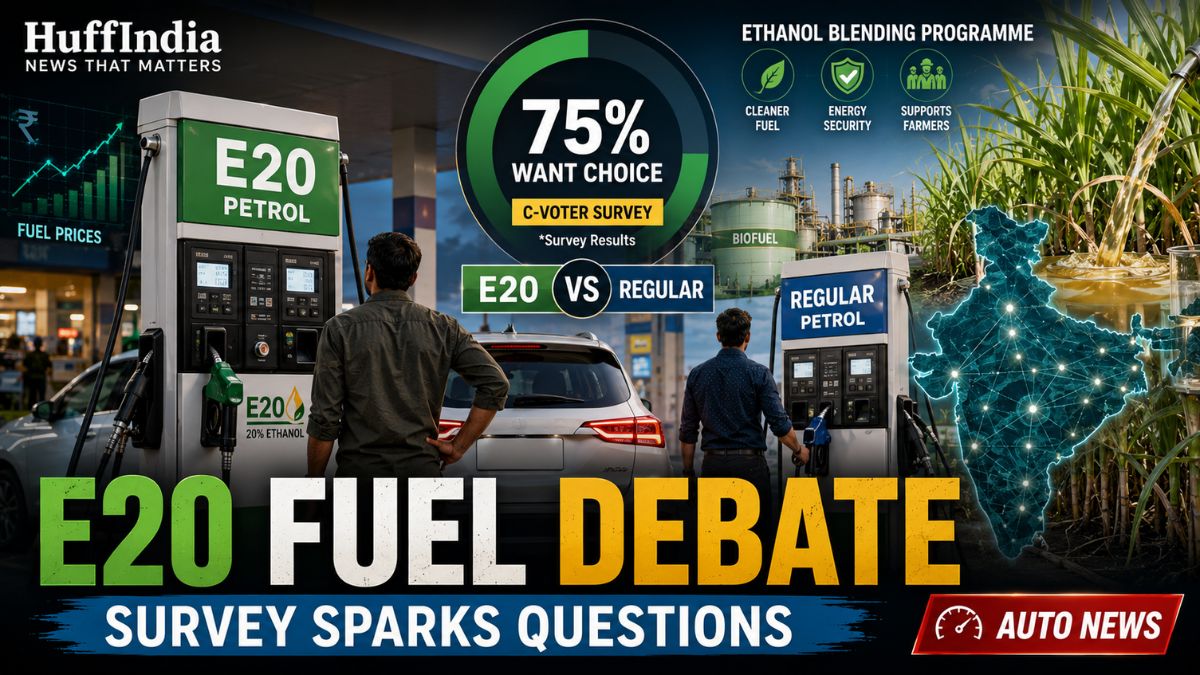



E20 petrol survey findings have sparked fresh discussion over India’s ethanol blending programme after a majority of respondents indicated they would prefer having the option to choose between E20 petrol and conventional fuel. The survey also found that many respondents believe E20 petrol should be sold at a lower price than regular petrol, reflecting concerns about value and consumer choice. According to the published survey, these views were observed across different voter groups, including respondents who support the ruling National Democratic Alliance (NDA). (Survey findings reflect the opinions of respondents and should not be interpreted as official government policy or the views of the wider population.)
India has been steadily expanding ethanol blending in petrol as part of its strategy to reduce crude oil imports, improve energy security and support domestic sugarcane and biofuel production. The government has set ambitious ethanol blending targets over the past few years and has encouraged the rollout of E20-compatible fuel and vehicles.
What Does the E20 Petrol Survey Say?
The E20 petrol survey suggests that consumer preference currently leans towards maintaining flexibility at fuel stations.
According to the reported findings:
- A majority of respondents said they do not support making E20 the only petrol option.
- Around three out of four respondents preferred having a choice between E20 petrol and regular petrol.
- Many respondents felt E20 petrol should be priced lower than conventional fuel if consumers are expected to adopt it.
The findings highlight public opinion at the time the survey was conducted and should be viewed as survey results rather than official policy conclusions.
What Is E20 Petrol?
E20 petrol is fuel that contains 20% ethanol and 80% petrol.
Ethanol is primarily produced from agricultural feedstocks such as sugarcane, maize and other biomass. Blending ethanol with petrol is intended to reduce dependence on imported crude oil while promoting cleaner-burning fuel and supporting India’s biofuel ecosystem.
The Government of India has progressively increased ethanol blending percentages over the past several years as part of the National Biofuel Policy.
Why Is India Promoting Ethanol Blending?
The ethanol blending programme has multiple objectives.
These include:
- Reducing crude oil imports.
- Supporting domestic farmers and ethanol producers.
- Lowering greenhouse gas emissions from the transport sector.
- Improving India’s long-term energy security.
Government officials have repeatedly said that higher ethanol blending can help reduce India’s dependence on imported fossil fuels while strengthening the domestic biofuel industry.
For official information on India’s National Policy on Biofuels, readers can visit the Ministry of New and Renewable Energy (MNRE)
Why Are Some Consumers Seeking Fuel Choice?
The E20 petrol survey indicates that many respondents would like consumers to retain the option of choosing between different fuel types.
Some vehicle owners remain uncertain about compatibility, particularly for older vehicles that were not originally designed for higher ethanol blends.
Others believe that if E20 becomes more widely available, pricing should provide an economic incentive for consumers to adopt it.
Automobile manufacturers have gradually introduced E20-compatible vehicles, while authorities have also issued guidance regarding fuel compatibility for different vehicle models.
Government’s Position on E20
The Government of India continues to support ethanol blending as part of its long-term energy strategy.
Officials have previously stated that expanding ethanol use could reduce foreign exchange expenditure on crude oil imports while contributing to environmental objectives.
At the same time, the government has continued working with automobile manufacturers, oil marketing companies and fuel producers to facilitate the transition toward higher ethanol blends.
No announcement has been made indicating any immediate nationwide withdrawal of regular petrol.
Why Pricing Remains an Important Issue
One of the strongest themes emerging from the E20 petrol survey is pricing.
Many respondents indicated they would expect E20 petrol to cost less than conventional petrol if they are encouraged to switch.
For consumers, fuel prices remain one of the most important factors influencing purchasing decisions. Whether pricing strategies evolve in the future will depend on government policy, global crude oil prices, taxation, ethanol production costs and other economic factors.
Survey Findings Reflect Public Opinion
It is important to distinguish between survey findings and government policy.
Opinion polls provide insight into how respondents feel about a particular issue at a given point in time. However, they do not determine government decisions or necessarily represent the views of the entire population.
Similarly, respondents’ opinions regarding E20 pricing or fuel choice should not be interpreted as confirmed policy changes.
Also Read | Badrinath Donation Theft Case: BKTC Employee Arrested
E20 petrol survey: Final Words
The E20 petrol survey has highlighted an important public conversation around consumer choice, fuel pricing and India’s ethanol blending programme.
While the survey suggests that many respondents prefer retaining the option to choose between E20 and regular petrol, the Government of India continues to promote ethanol blending as part of its broader energy and environmental strategy.
As India expands its biofuel ecosystem, balancing consumer confidence, vehicle compatibility, pricing and long-term sustainability will remain key factors in the country’s transition towards cleaner transport fuels.