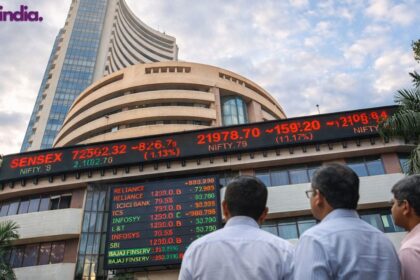
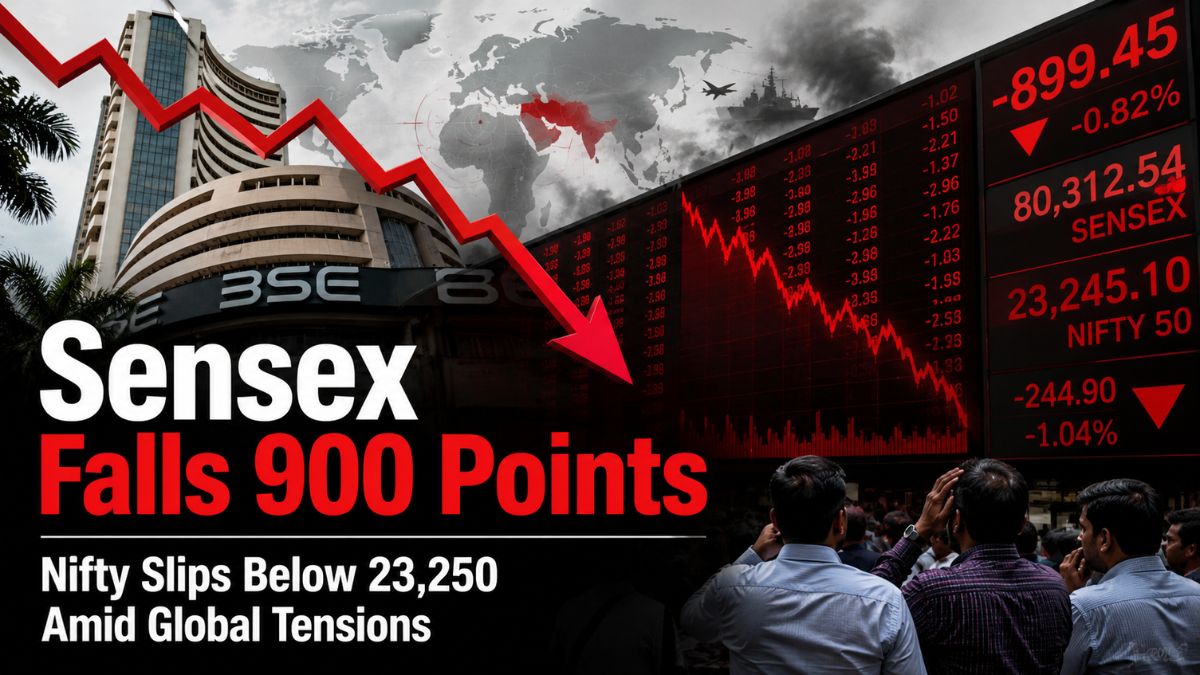



Mumbai, India: Sensex Falls 900 Points as Indian benchmark indices witnessed a sharp sell-off on Wednesday, with the Nifty slipping below the 23,250 mark amid growing concerns over escalating US-Iran tensions, rising crude oil prices, and weak global market sentiment. The decline triggered broad-based selling across sectors, reflecting increased investor caution.
The broad-based decline comes at a time when investors are carefully evaluating multiple risk factors, including developments surrounding the United States and Iran, fluctuating crude oil prices, foreign institutional investor activity, and concerns about the pace of global economic growth.
Sensex and Nifty End Deep in the Red
The Indian stock market decline was visible across sectors as heavy selling pressure emerged in banking, information technology, financial services, and auto stocks. Market participants adopted a cautious approach throughout the trading session, resulting in substantial losses for frontline indices.
The Sensex falls 900 points headline reflects one of the sharper corrections witnessed in recent weeks. Simultaneously, the Nifty below 23250 level signaled weakening market sentiment after the benchmark index failed to hold key support zones.
Analysts noted that investors preferred reducing risk exposure rather than taking fresh positions amid growing uncertainty in global markets.
US-Iran Tensions Add to Market Nervousness
One of the primary factors influencing sentiment has been the rise in geopolitical concerns linked to the Middle East.
The US Iran tensions impact markets narrative has gained prominence as investors fear that any escalation could disrupt energy supplies and create volatility in global commodity markets. Historically, geopolitical conflicts in oil-producing regions have triggered sudden spikes in crude oil prices, increasing inflationary pressures for major economies.
For India, which imports a significant portion of its crude oil requirements, sustained increases in energy prices can affect corporate profitability, inflation expectations, and overall economic growth.
Market experts believe that while the direct economic impact remains uncertain, investors are reacting to the possibility of prolonged instability in the region.
Rising Crude Oil Prices Remain a Key Concern
Energy markets have remained highly sensitive to geopolitical developments.
Any disruption to global oil supply routes could push crude prices higher, increasing costs for businesses and consumers alike. Higher energy prices often lead to inflation concerns, which may influence central bank policy decisions worldwide.
The possibility of elevated inflation has prompted investors to reassess risk assets, contributing to the recent stock market crash today sentiment observed across several global markets.
Indian equities, being closely integrated with global capital flows, often react quickly to such developments.
Foreign Investors Turn Cautious
Another important factor behind the current weakness is investor positioning.
Foreign institutional investors (FIIs) have shown signs of caution in recent sessions as global uncertainty rises. International investors typically reduce exposure to emerging markets during periods of heightened geopolitical risk, leading to capital outflows and increased volatility.
Domestic institutional investors have provided some support to the market, but selling pressure from foreign investors has continued to weigh on benchmark indices.
Analysts say that sustained FII selling can amplify short-term corrections, especially when combined with negative global cues.
Sectoral Performance Highlights Weak Sentiment
The market decline was not limited to a handful of stocks. Several sectors experienced broad-based selling.
Banking stocks, which play a significant role in benchmark indices, came under pressure as investors booked profits after recent gains. Information technology companies also faced weakness due to concerns about global economic growth and potential reductions in corporate technology spending.
Automobile and metal stocks witnessed selling as investors evaluated the potential impact of rising input costs and uncertain demand conditions.
Defensive sectors such as healthcare and consumer staples performed relatively better, reflecting a risk-off approach among market participants.
What Analysts Are Saying
Market strategists believe the current correction should be viewed in the context of broader global developments rather than as a sign of structural weakness in the Indian economy.
India continues to benefit from strong domestic consumption, government-led infrastructure spending, improving manufacturing activity, and resilient corporate earnings growth.
However, analysts caution that near-term volatility may persist if geopolitical tensions intensify or if crude oil prices continue moving higher.
Many experts recommend that long-term investors avoid panic-driven decisions and instead focus on portfolio diversification and disciplined investment strategies.
According to data available on the Bombay Stock Exchange (BSE), benchmark indices remained under pressure throughout the trading session.
Outlook for the Indian Stock Market
Despite the latest Indian stock market decline, several market observers remain constructive on India’s medium- and long-term growth prospects.
The country’s economic fundamentals remain stronger than many peer economies, supported by favorable demographics, digital transformation initiatives, and continued infrastructure investments.
Investors will closely monitor upcoming global developments, movements in crude oil prices, foreign investment trends, and domestic economic data for indications of market direction.
For now, market participants are expected to remain cautious as geopolitical risks and global uncertainty continue to influence sentiment.
While today’s decline has rattled investors, experts suggest that volatility is a natural part of equity markets, particularly during periods of heightened global tension. The coming sessions will likely determine whether the recent sell-off develops into a deeper correction or remains a temporary response to external risk factors.
Also Read: Global Market Crash Alert 2026: Stocks Fall, Oil Prices Surge Amid War Tensions