
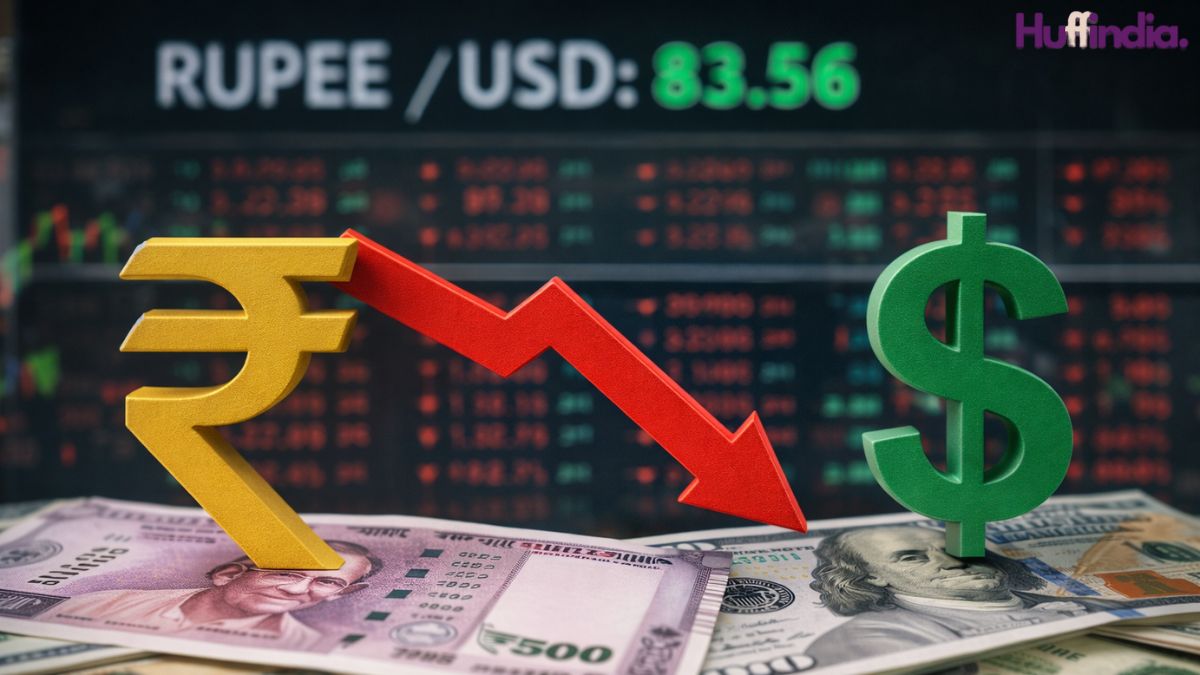



Rupee slips against dollar in early trade as the Indian currency weakened against the US greenback amid cautious global market sentiment. Currency traders said pressure from a strong dollar, volatile crude oil prices, and uncertainty around global interest rate trajectories continued to weigh on the rupee, even as domestic economic fundamentals remained stable.
Rupee Slips Against Dollar Amid Global Uncertainty
At the interbank foreign exchange market, the rupee opened marginally lower as investors remained risk-averse. Market participants attributed the movement to weak global cues, including mixed economic data from major economies and cautious positioning ahead of key central bank signals.
Traders noted that emerging market currencies have broadly faced pressure, with investors preferring safe-haven assets during periods of heightened global uncertainty.
Dollar Strength Pressures Emerging Market Currencies
The US dollar index, which tracks the greenback against a basket of major global currencies, remained firm during Asian trading hours. Analysts said sustained dollar strength has been driven by higher US bond yields and expectations that interest rates may remain elevated for longer.
According to currency experts, the trend where the rupee slips against dollar mirrors broader pressure on emerging market currencies as global capital flows gravitate toward safer assets.
Impact of Crude Oil Prices on the Rupee
Rising crude oil prices added to the rupee’s weakness. As India is one of the world’s largest importers of crude oil, higher prices increase the country’s import bill and can widen the current account deficit, putting downward pressure on the currency.
Market analysts said fluctuations in global oil prices remain a critical factor for the rupee’s near-term movement, especially when combined with global financial uncertainty.
Domestic Factors and RBI’s Role
On the domestic front, traders are closely watching signals from the Reserve Bank of India (RBI). While the central bank has not indicated any change in its broader policy stance, it has historically intervened in the foreign exchange market to smooth excessive volatility.
Economists believe the RBI’s active presence helps maintain stability when the rupee slips against dollar, preventing abrupt or disorderly movements that could impact trade and inflation.
Foreign Fund Flows in Focus
Foreign institutional investor (FII) flows remain another key factor influencing the rupee. Periods of sustained outflows from equity and debt markets tend to put pressure on the currency, while steady inflows provide support.
Market participants said global investors are currently reassessing exposure to emerging markets as they evaluate risks linked to global growth, inflation, and monetary policy.
Outlook for the Rupee
Looking ahead, analysts expect the rupee slips against dollar trend to persist in the near term unless there is greater clarity on global interest rates and economic growth prospects. Near-term movement is likely to be guided by global macroeconomic data, central bank commentary, and crude oil price trends.
Experts also pointed out that India’s strong foreign exchange reserves act as a buffer against sharp currency depreciation, offering confidence to investors and policymakers.
What Investors Should Watch
Investors and businesses will be tracking upcoming global economic indicators, including inflation data from major economies and policy guidance from central banks. Domestically, cues from macroeconomic data releases and RBI commentary will shape currency sentiment.
For now, analysts say the fact that the rupee slips against dollar reflects global risk aversion rather than domestic weakness, underlining the importance of external factors in driving currency movements.
Related: RBI Inflation Outlook Turns Cautious as Central Bank Stresses Price Stability
Related: RBI Interest Rate Policy Signals Caution on Rate Cuts Amid Inflation Risks