
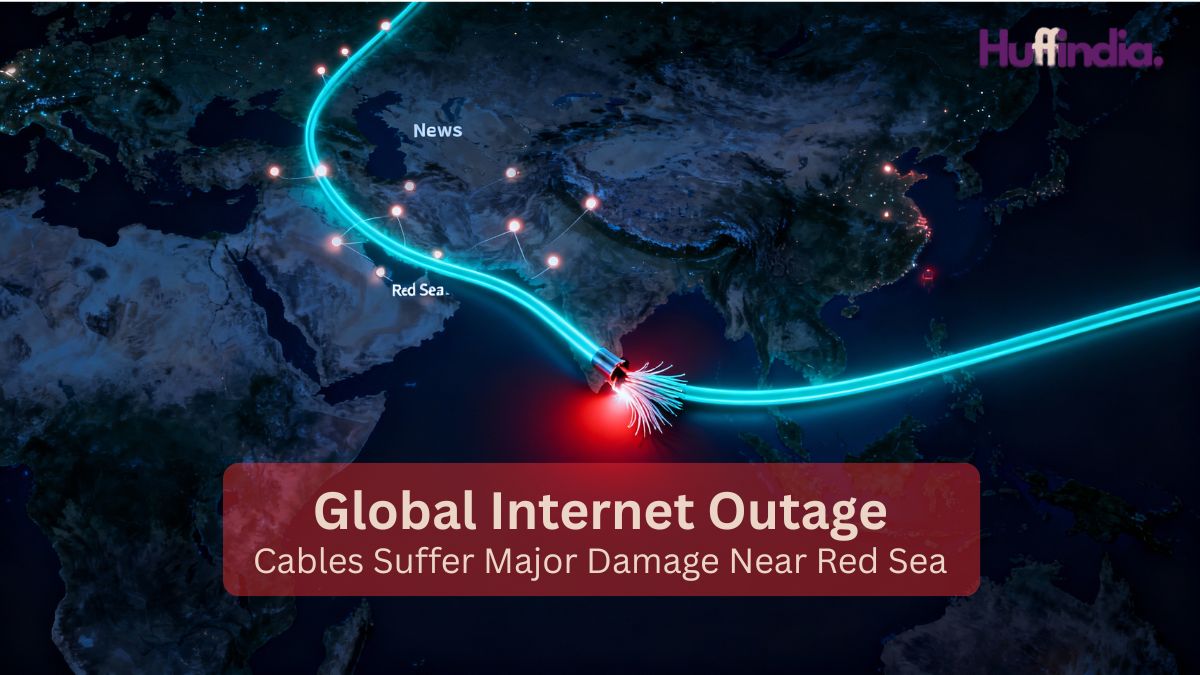



A massive global internet outage continued to disrupt digital communication early Thursday morning as multiple undersea fibre-optic cables suffered significant damage near the Red Sea, one of the world’s most critical and congested data choke points. The incident, which began late Wednesday night, has developed into one of the largest internet disruptions of 2025, affecting millions across India, Southeast Asia, the Middle East, and Europe.
Telecom operators, cybersecurity analysts, and global connectivity watchdogs confirmed that the damage involved at least two major subsea cables, leading to severe latency, slowed traffic routing, and widespread service failures. The outage triggered cascading disruptions across banking, aviation, cloud services, and digital payment networks—highlighting the fragility of global digital infrastructure.
Major Connectivity Collapse Across India and Asia
India is among the worst-hit regions, with major ISPs reporting dramatic speed drops, VPN failures, and UPI payment delays beginning early Wednesday evening. Major cities including Delhi, Mumbai, Bengaluru, Hyderabad, and Chennai recorded connectivity disruptions affecting both individuals and large corporations.
The Department of Telecommunications (DoT) issued an advisory assuring users that traffic was being rerouted through alternative Mediterranean and Atlantic cable systems. However, due to the massive volume of bandwidth India handles on Red Sea routes, normal speeds may not resume immediately.
Cloud-dependent IT companies in Bengaluru reported difficulties accessing corporate servers, while stock traders cited slow data feeds during early market hours. Digital learning platforms and remote working tools such as Zoom, Teams, and Google Meet also showed performance degradation.
According to global telecom monitoring agencies (suggested outbound link anchor text), the affected cables form a core part of Asia-Europe connectivity, carrying over 25% of the region’s transcontinental internet traffic.
Global internet outage: Middle East and Europe Face Widespread Slowdowns
Across the Middle East, countries including Saudi Arabia, UAE, Kuwait, and Egypt reported severe service disruptions impacting mobile data, fibre broadband, and international call routing. Aviation systems at several Gulf airports experienced delays in boarding and verification processes, while digital banking networks temporarily slowed down.
In Europe, the UK, France, Germany, and Italy witnessed disruptions in online banking, cloud-hosted enterprise tools, and global interbank communication flows. According to European cybersecurity councils (outbound link anchor suggestion), several cloud infrastructure clusters relied heavily on impacted routing pathways, resulting in elevated error reports across AWS, Google Cloud, and Microsoft Azure.
How the Incident Happened: Anchor Drag or Sabotage?
Initial investigations suggest a possible anchor drag by commercial vessels, underwater seismic movement, or accidental interference in the strategic Red Sea–Gulf of Aden corridor. However, cybersecurity experts have not dismissed the possibility of targeted sabotage, given rising geopolitical tensions in the region.
Marine cable repair ships have been mobilised but may require 24–48 hours to safely reach the site. Actual repairs could take five to seven days, depending on ocean depth, security clearances, weather, and cable accessibility.
Global Digital Infrastructure Under the Scanner
With 97% of the world’s data travelling through undersea fibre cables, the ongoing outage underscores just how vulnerable global communication networks are. According to international internet governance bodies (outbound link anchor suggestion), more than 250 submarine cables form the backbone of the internet—any disruption can bring economies to a standstill.
Digital payments, fintech platforms, OTT streaming services, and cloud-based enterprise tools globally continue to face intermittent failures.
What’s Next?
Telecom operators expect partial stabilisation through rerouting efforts, but users may continue facing slow speeds and packet drops throughout the day. Governments in India, Singapore, UAE, and the UK are coordinating with international cable authorities to accelerate repairs.
The global internet outage remains the top trending issue worldwide this morning, with millions seeking updates as digital dependence hits an unprecedented high.
Related: Meta Phoenix AR Glasses Delay Shocks Tech Industry: Why the Next-Gen AR Launch Is Now Pushed to 2027