
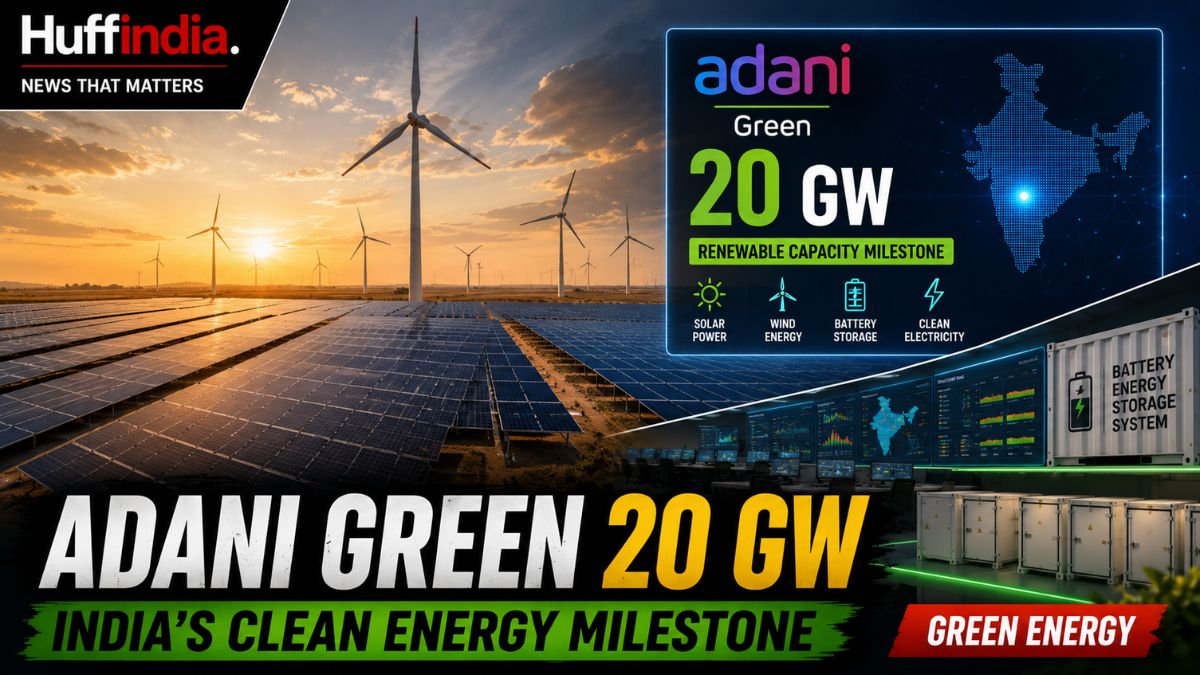



Adani Green 20 GW milestone has placed India’s renewable energy expansion back in focus after Adani Green Energy Limited said it crossed 20 gigawatts of operational renewable energy capacity, becoming the first renewable energy company in India to reach the mark.
The company announced the development on July 1, 2026, saying its operational portfolio now represents about 14% of India’s utility-scale solar installations and about 12% of India’s utility solar and wind capacity. The figures were disclosed in a company media release and were later reported by multiple business and energy publications.
According to Adani Green Energy, the company generates more than 52 billion units of clean electricity annually. The company said this is equivalent to nearly 3% of India’s electricity consumption.
Because the announcement comes from the company, the exact claims should be read as company-disclosed data unless independently verified through official sector databases or regulatory filings. Still, the Adani Green 20 GW update is significant because it shows how quickly India’s large renewable-energy developers are scaling capacity as the country pushes towards its clean-energy targets.
What Is the Adani Green 20 GW Milestone?
The Adani Green 20 GW milestone refers to the company crossing 20 gigawatts of operational renewable energy capacity.
Operational capacity means power projects that have been commissioned and are capable of generating electricity, not merely projects that are planned or under construction.
Adani Green Energy said the milestone was achieved largely through greenfield development. In the energy sector, greenfield development generally refers to building new projects from the ground up rather than only acquiring existing assets.
The company said its operating portfolio includes solar, wind and hybrid renewable-energy projects. It also highlighted battery energy storage as part of its clean-power strategy.
This milestone matters because renewable energy is no longer a small add-on to India’s power system. Large solar and wind portfolios are becoming central to electricity planning, grid management and corporate energy procurement.
Why Does This Matter for India’s Renewable Energy Sector?
The Adani Green 20 GW milestone matters because India is trying to expand clean power while also meeting rising electricity demand.
India’s power needs are increasing due to urbanisation, industrial growth, household consumption, cooling demand and electrification of transport. At the same time, the country has committed to expanding non-fossil energy capacity and reducing the emissions intensity of its economy.
In that context, large renewable-energy developers play a major role. Utility-scale solar and wind projects can add capacity faster than many traditional power projects, although they also require land, transmission lines, storage systems and grid-balancing support.
Adani Green Energy’s 20 GW operating base shows the scale at which private-sector renewable projects are now being developed in India.
However, the milestone should not be seen as the completion of India’s energy transition. Renewable generation still depends on sunlight, wind availability, storage, transmission capacity and demand patterns. The next challenge is not just building capacity but integrating it reliably into the grid.
What Did Adani Green Energy Say?
In its official statement, Adani Green Energy said it had surpassed 20 GW of operational renewable energy capacity.
The company said this made it India’s first renewable energy company to reach the mark. It also said the capacity was built in record time, predominantly through greenfield development.
Adani Green Energy said the portfolio generates more than 52 billion units of clean electricity annually. It also said this represents nearly 3% of India’s electricity consumption.
The company further stated that its operational capacity equals around 14% of India’s utility-scale solar installations and around 12% of India’s utility solar and wind capacity.
These are company-reported claims. For a responsible news report, they should be attributed clearly to Adani Green Energy rather than presented as independent government certification.
For additional background on the company’s operational capacity milestone and clean-energy claims, readers can see Adani Green Energy’s official media release on crossing 20 GW renewable capacity.
Why Is Khavda Important in This Story?
Khavda in Kutch, Gujarat, is central to the Adani Green 20 GW story.
Adani Green Energy described Khavda as the centrepiece of its next phase of growth and the site of what it calls the world’s largest renewable energy plant. The company said the project is spread across 538 square kilometres of barren land and has a planned capacity of 30 GW.
According to the company’s release, Adani Green Energy has already commissioned 9.5 GW of solar capacity at Khavda, representing more than 30% of the project’s planned capacity.
Khavda has become one of India’s most closely watched renewable-energy zones because of its size, location and role in utility-scale solar and wind development.
Large projects like Khavda can help add capacity quickly, but they also come with execution challenges. These include transmission readiness, land management, environmental safeguards, water use, local infrastructure and grid integration.
That is why the Adani Green 20 GW update is not only a company-growth story. It is also part of a wider conversation about how India builds, connects and manages very large renewable-energy clusters.
What Role Does Battery Storage Play?
Battery energy storage is becoming increasingly important as renewable power grows.
Solar power is strongest during daylight hours, while wind generation can vary by season and location. Electricity demand, however, often peaks at different times. Storage can help bridge this gap by storing renewable power when generation is high and releasing it when needed.
Adani Green Energy said it already has 3.55 GWh of battery energy storage systems operational. The company also said it plans to add 10 GWh of battery storage in FY27 and expand its portfolio to 50 GWh over the next five years.
These are company-stated plans and should be tracked through future project updates, regulatory disclosures and commissioning data.
The battery-storage element is important because India’s renewable transition cannot rely only on adding solar panels and wind turbines. The grid also needs flexibility, storage, transmission upgrades and demand-management systems.
If battery storage scales successfully, it could make renewable power more reliable and more useful during evening or peak-demand hours.
How Does This Fit Into India’s Clean-Energy Goals?
The Adani Green 20 GW milestone fits into India’s larger clean-energy ambitions.
India has been expanding solar, wind, hydro, bioenergy and other non-fossil power capacity over the past decade. The Ministry of New and Renewable Energy regularly publishes physical achievement and capacity data for the sector, while the Central Electricity Authority tracks broader electricity-system statistics.
India’s energy transition is being shaped by several parallel forces: government policy, private investment, falling solar costs, rising electricity demand, climate commitments and the need for cleaner urban air.
Private companies such as Adani Green Energy, Tata Power Renewable Energy, ReNew, ACME Solar and others are competing to build large renewable portfolios.
The milestone shows that India’s clean-energy market has moved into a scale phase. But it also increases the importance of transparency, environmental safeguards, financial discipline and grid planning.
What Are the Key Risks and Questions?
The Adani Green 20 GW milestone is positive for renewable capacity expansion, but several questions remain.
The first is grid integration. Large renewable projects need transmission lines and balancing mechanisms so that generated power can reach demand centres.
The second is storage. Battery energy storage can improve reliability, but it requires capital, technology choices, safety standards and long-term cost reductions.
The third is land and local impact. Utility-scale renewable projects require large areas, which makes land-use planning and local stakeholder engagement important.
The fourth is financial execution. Renewable-energy developers often work with long project pipelines, debt financing and power purchase agreements. Investors and policymakers will watch whether capacity additions remain commercially sustainable.
The fifth is climate resilience. Renewable assets themselves can be exposed to extreme heat, storms, floods and other climate-related risks. As India builds more green infrastructure, protecting that infrastructure from climate damage will become more important.
Why Should Readers Care?
Readers should care about the Adani Green 20 GW milestone because renewable-energy growth affects electricity prices, grid reliability, jobs, air quality and India’s climate pathway.
Clean-power expansion can reduce dependence on fossil fuels over time, but it must be supported by infrastructure and regulation. If renewable projects are built without enough transmission or storage, their full benefit may not be realised.
For consumers, large renewable projects can influence the future electricity mix. For businesses, they can support green power procurement and sustainability targets. For policymakers, they raise questions about planning, permitting and grid readiness.
For investors, the milestone may attract attention to listed renewable-energy companies, but this article should not be treated as investment advice. Stock decisions require separate analysis of valuation, debt, project execution, regulatory risk and financial results.
The safest way to understand the Adani Green 20 GW milestone is as an energy-sector development, not as a recommendation to buy or sell any security.
Also Read | Adani Airport Expansion 2025: $15 Billion Plan to Transform India’s Aviation
Final Thoughts
The Adani Green 20 GW milestone marks a notable point in India’s renewable-energy expansion. The company says it has crossed 20 GW of operational renewable capacity, generates more than 52 billion units of clean electricity annually and now represents a meaningful share of India’s utility-scale solar and solar-wind capacity.
The development matters because India’s clean-energy transition depends on large-scale renewable capacity, stronger battery storage, better transmission and reliable project execution.
At the same time, the broader conclusion should remain measured. Adani Green Energy’s milestone is significant, but India’s transition will depend on many companies, public-sector planning, grid upgrades, storage economics, environmental safeguards and long-term policy consistency.
For now, the Adani Green 20 GW update shows that India’s renewable sector is scaling fast. The next test is whether that scale can be converted into reliable, affordable and sustainable clean power.