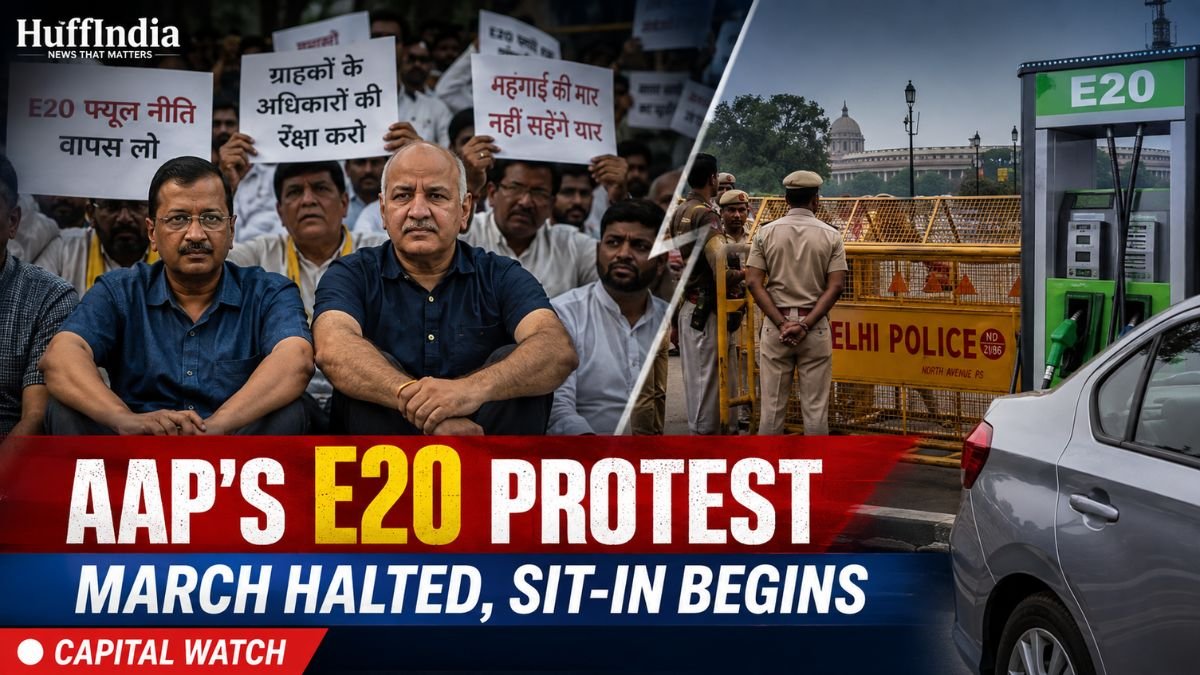



The AAP protest against E20 petrol policy intensified in New Delhi on Tuesday after party leaders Arvind Kejriwal and Manish Sisodia staged a sit-in demonstration when their march towards Prime Minister Narendra Modi’s official residence was stopped by police. The protest was organised to oppose the Centre’s E20 petrol policy, with Aam Aadmi Party leaders alleging that the move would impose additional financial burdens on vehicle owners and consumers.
Police prevented the protesters from proceeding towards the high-security zone surrounding the Prime Minister’s residence, following which senior AAP leaders and supporters sat on the road in protest. The demonstration remained peaceful, with heavy police deployment in the area to maintain law and order.
AAP Protest Against E20 Petrol Policy Ends in Sit-In Near High-Security Zone
The AAP protest against E20 petrol policy began with party workers and senior leaders marching through central Delhi towards the Prime Minister’s residence.
However, Delhi Police erected barricades near the restricted security zone and stopped the procession before it could reach its destination. Following the police action, Arvind Kejriwal and Manish Sisodia, accompanied by party workers, staged a sit-in at the protest site while raising slogans against the government’s ethanol-blending policy.
Traffic movement in parts of central Delhi was affected for a brief period before police diverted vehicles to alternate routes.
Official information on E20-compatible vehicles and fuel initiatives is available through the Society of Indian Automobile Manufacturers (SIAM)
What Is the Protest About?
The protest centres on the Union government’s push to increase the use of E20 petrol, a fuel blend containing 20% ethanol and 80% petrol.
AAP leaders have questioned the policy’s implementation, alleging that it could increase costs for consumers and affect owners of older vehicles. During the protest, party representatives demanded greater clarity on vehicle compatibility, compensation mechanisms and consumer safeguards.
The Union government, however, has consistently maintained that E20 fuel is part of India’s long-term strategy to reduce dependence on imported crude oil, lower emissions and support domestic ethanol production. Union Road Transport and Highways Minister Nitin Gadkari has previously informed Parliament that most newer vehicles are compatible with E20 fuel, while certain older vehicles may require replacement of some rubber components and gaskets.
Heavy Police Deployment During the March
Security arrangements were tightened in central Delhi as the protest approached the vicinity of the Prime Minister’s residence.
Police personnel, barricades and rapid response teams were deployed to prevent protesters from entering the high-security area. Authorities stated that security restrictions around the Prime Minister’s residence remain in force irrespective of the organisation leading a protest.
There were no immediate reports of major violence during the demonstration at the time of publication.
Political Exchanges Continue
The AAP protest against E20 petrol policy marks the latest political confrontation between the Aam Aadmi Party and the Bharatiya Janata Party-led Centre.
AAP leaders argued that the government should address consumer concerns before expanding the use of E20 fuel nationwide. They also called for broader public consultation on issues relating to fuel compatibility and vehicle maintenance.
The Centre has maintained that the ethanol blending programme forms an important part of India’s energy security strategy and has repeatedly highlighted its environmental and economic benefits.
Why E20 Fuel Matters
The E20 programme is a key component of India’s ethanol blending roadmap.
According to the government, increasing ethanol blending can:
- Reduce crude oil imports.
- Lower carbon emissions.
- Support India’s sugar and agriculture sectors.
- Improve energy security.
- Promote cleaner transportation.
At the same time, automobile manufacturers and policymakers have advised owners of older vehicles to follow manufacturer recommendations regarding fuel compatibility.
Also Read | Fuel | Huffindia
Final Takeaway
The AAP protest against E20 petrol policy added fresh political attention to the debate over India’s ethanol blending programme after Arvind Kejriwal and Manish Sisodia staged a sit-in when police stopped their march towards the Prime Minister’s residence. While the opposition continues to question aspects of the policy and its impact on consumers, the Centre maintains that E20 fuel is an important step towards cleaner mobility and greater energy independence. As discussions continue, the issue is likely to remain part of the broader political and policy debate surrounding India’s transition to alternative fuels.