
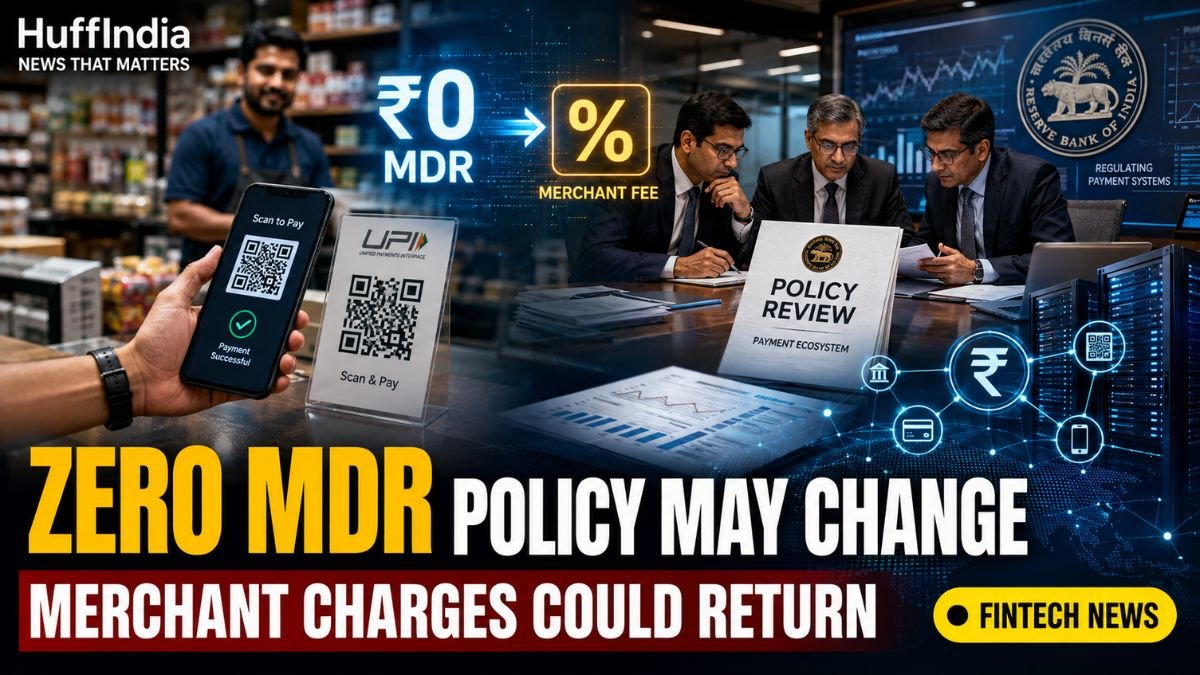
India’s long-standing Zero MDR policy for digital payments could be headed for a major policy shift, with the Centre considering amendments to the Payment and Settlement Systems Act that may allow the return of Merchant Discount Rate (MDR) on selected digital transactions. According to industry executives and government officials familiar with the discussions, the proposal is aimed at creating a sustainable revenue model for banks and payment service providers that have been operating under a zero-fee regime for UPI merchant transactions.
The proposal is still under consideration and has not yet been approved. If implemented, the move would represent one of the biggest changes to India’s digital payments ecosystem since the government removed MDR on UPI and RuPay debit card transactions to accelerate cashless payments.
Zero MDR Policy Under Review as Government Examines New Payment Framework
The proposed amendment does not mean that consumers will start paying for UPI transactions.
Instead, discussions are centred on allowing a merchant discount rate for certain categories of merchants, particularly larger businesses, while continuing to protect peer-to-peer transfers and small merchants from additional charges. Industry sources say the proposal is intended to improve the financial sustainability of India’s rapidly expanding digital payments infrastructure.
Merchant Discount Rate (MDR) is the fee paid by merchants to banks and payment service providers for processing digital transactions. Under the current Zero MDR policy, merchants accepting UPI and RuPay debit card payments generally do not bear this charge.
Readers can learn more about India’s digital payments ecosystem and UPI through the National Payments Corporation of India (NPCI)
Why Is the Government Considering the Change?
UPI has grown into one of the world’s largest real-time payment systems, processing billions of transactions every month.
However, banks, payment aggregators and fintech firms have argued that maintaining the infrastructure, cybersecurity systems and technological upgrades required to support such scale involves significant costs. Industry bodies have repeatedly sought a review of the Zero MDR policy, saying a limited MDR on large merchants would create a more sustainable business model without affecting small businesses or individual users.
Large Merchants May Be the Focus
According to reports, the government’s discussions are focused on introducing MDR only for large merchants, rather than for neighbourhood shops or individual users.
Earlier reports suggested that:
- Small merchants may continue under the zero-MDR regime.
- Peer-to-peer UPI transfers are expected to remain free.
- Large businesses accepting high-value UPI payments could become eligible for MDR.
- The exact rate and turnover thresholds remain under discussion.
No final decision has been announced, and the government has not issued detailed draft rules specifying the categories that could be covered.
What Could It Mean for Consumers?
At present, there is no proposal indicating that consumers would directly pay charges for making UPI payments.
If MDR is reintroduced only for merchants, businesses would decide how to absorb those costs as part of their operating expenses. Analysts note that some merchants may choose to absorb the fee, while others could factor payment processing costs into broader pricing decisions, depending on market competition and commercial practices.
Any eventual impact on consumers would therefore depend on business decisions rather than the policy itself.
Industry Sees Opportunity for Long-Term Sustainability
Banks and payment companies have long argued that India’s digital payments ecosystem requires a sustainable revenue model.
Supporters of MDR say a modest fee on large commercial transactions could:
- Strengthen payment infrastructure.
- Improve cybersecurity investments.
- Support innovation by fintech companies.
- Reduce dependence on government incentives.
- Ensure long-term growth of the UPI ecosystem.
Critics, however, caution that policymakers will need to ensure any new framework does not slow the adoption of digital payments that has accelerated under the existing zero-fee system.
Payment Bill Signals Broader Policy Evolution
The proposed legislative changes form part of a broader effort to modernise India’s payments regulatory framework.
Officials say the updated law aims to address emerging technologies, strengthen oversight and create a more future-ready payments ecosystem as digital transactions continue to expand across sectors. The MDR proposal is one element of that wider reform exercise and remains subject to government approval.
Also Read | Meta, Anthropic, Google, OpenAI to Meet Trump Officials Over AI Safety Testing Framework
Final Takeaway
The review of the Zero MDR policy marks a potentially significant moment for India’s digital payments landscape. While the Centre is examining whether merchant charges should return for certain categories of businesses, discussions indicate that consumers and small merchants are likely to remain protected if changes are introduced. With no final decision announced yet, the proposed amendments are expected to remain closely watched by banks, fintech companies, merchants and millions of UPI users across the country as India continues refining one of the world’s largest digital payment ecosystems.