
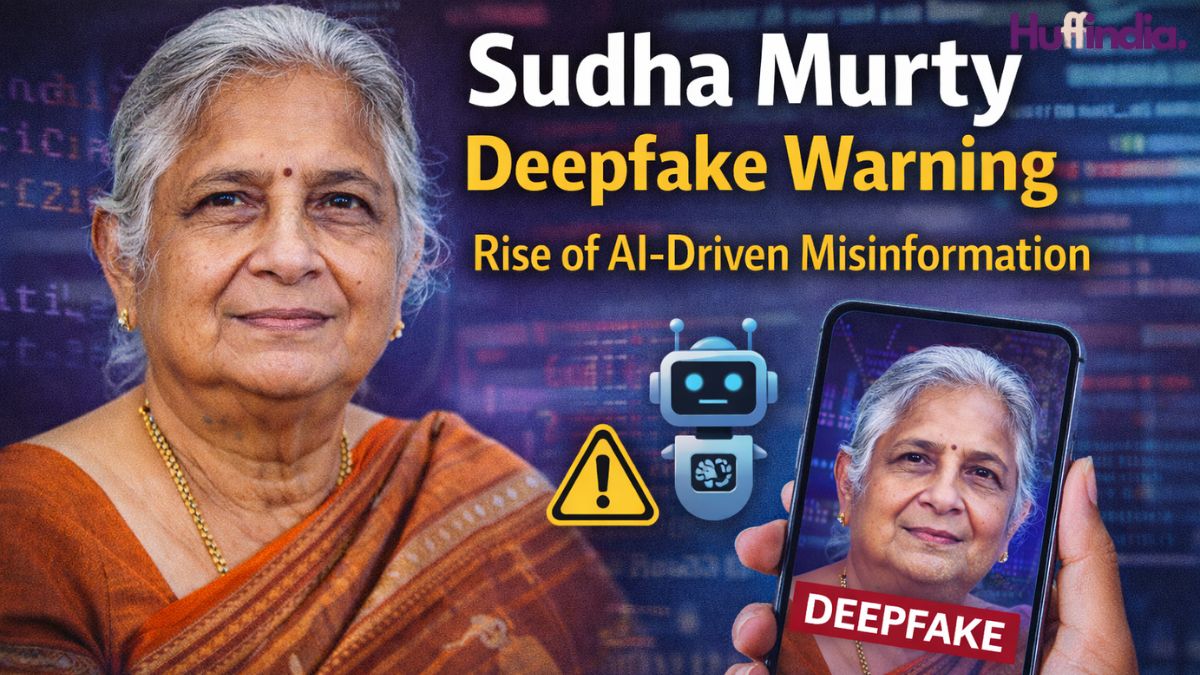



Sudha Murty deepfake warning has drawn national attention after the author, philanthropist, and Rajya Sabha member cautioned the public against AI-generated videos falsely portraying her without consent. Murty said such deepfake content is being circulated online and could mislead people, highlighting the growing dangers of artificial intelligence being misused for misinformation.
Her warning comes at a time when deepfake videos are spreading rapidly across social media platforms, often appearing realistic enough to deceive even careful viewers. Technology experts say Murty’s statement underscores how vulnerable public trust has become in the age of synthetic media.
What Prompted the Sudha Murty Deepfake Warning
According to media reports, Sudha Murty became aware of AI-generated videos using her likeness and voice that she had no role in creating. She publicly clarified that these videos were fake and urged people not to believe or share them without verification.
The Sudha Murty deepfake warning resonated widely because of her reputation as a credible public figure known for integrity and social work. Experts say deepfakes involving trusted personalities are particularly dangerous, as they exploit familiarity to spread false narratives.
Understanding Deepfake Technology
Deepfakes are created using advanced artificial intelligence techniques such as deep learning and neural networks. These systems analyse real images, videos, and audio to generate synthetic content that closely mimics real people.
While the technology has legitimate uses in cinema, education, and accessibility tools, its misuse has become a major concern. The Sudha Murty deepfake warning highlights how easily such tools can be weaponised to spread misinformation, scams, or political manipulation.
Why AI-Driven Misinformation Is a Growing Threat
Cybersecurity experts warn that AI-driven misinformation is becoming harder to detect as technology improves. Fake videos can now convincingly replicate facial expressions, voice tone, and body language.
In India, authorities have observed an increase in fake endorsements, manipulated interviews, and fraudulent videos involving public figures. The Sudha Murty deepfake warning has renewed calls for stronger safeguards, platform accountability, and public awareness.
According to guidance issued by the Ministry of Electronics and Information Technology (MeitY), the misuse of deepfake technology poses serious risks to public trust, online safety, and democratic discourse, prompting the government to call for stronger platform accountability and public awareness.
How Deepfakes Can Harm Society
The impact of deepfake videos goes beyond individual reputations. Experts say they can:
- Spread false information at scale
- Influence public opinion and elections
- Enable financial fraud and scams
- Undermine trust in genuine video evidence
Legal analysts warn that once public trust in visual media erodes, it becomes harder to distinguish truth from manipulation.
How to Identify Potential Deepfake Videos
Following the Sudha Murty deepfake warning, digital safety experts have advised users to be cautious and look for warning signs such as:
- Slight mismatches between lip movement and audio
- Unnatural facial expressions or blinking
- Blurred edges around the face
- Videos shared without credible sources
Verifying content through trusted news organisations before sharing is strongly recommended.
Government and Policy Response
The government has acknowledged the growing risks posed by deepfakes and AI-driven misinformation. Officials have indicated that existing IT rules and cyber laws may be reviewed to address emerging threats from synthetic media.
Legal experts say clearer regulations, combined with platform responsibility and user education, will be essential to tackle the problem effectively.
A Call for Digital Awareness
The Sudha Murty deepfake warning serves as a reminder that technology literacy is now a public necessity. Experts stress that awareness, skepticism, and responsible sharing are critical in preventing the spread of misinformation.
As artificial intelligence continues to evolve, citizens are urged to stay informed, question suspicious content, and report fake videos to platforms and authorities.
Related: AI Regulation in India Gains Urgency as Government Considers New Guardrails
Related: Discovering Exciting News: How Google Discover Chooses News