
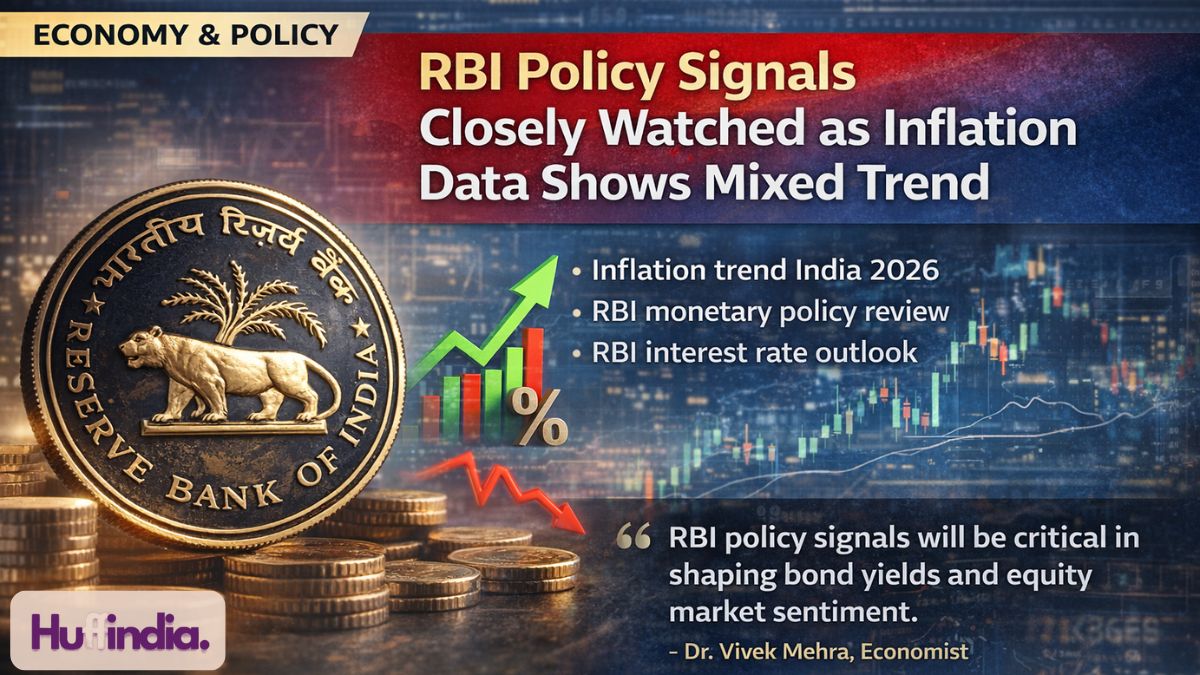



RBI policy signals are under intense scrutiny after the latest inflation data presented a mixed trend, prompting economists and investors to reassess the likely trajectory of interest rates. The evolving macroeconomic backdrop has placed the spotlight firmly on upcoming guidance from the Reserve Bank of India, as markets look for clarity on the central bank’s next move.
Recent data released by the Ministry of Statistics and Programme Implementation showed that while headline inflation moderated marginally, food price volatility and persistent core inflation pressures continue to complicate the outlook. As a result, RBI policy signals in the upcoming monetary review are expected to play a decisive role in shaping financial market expectations.
Mixed Inflation Trend Raises Policy Questions
The latest inflation trend in India suggests that price pressures are easing in certain categories but remain elevated in others. Vegetable prices declined on a sequential basis, yet pulses and select protein-rich food items recorded increases. Meanwhile, core inflation — excluding food and fuel — remains relatively sticky.
Economists say that RBI policy signals will be closely analysed for cues on whether the central bank believes inflation is sustainably aligning with its 4% medium-term target, within the tolerance band of +/- 2%.
“The mixed inflation trend India 2026 is experiencing means policymakers cannot declare victory yet,” said Dr. Meera Khanna, Chief Economist at a Mumbai-based financial advisory firm. “RBI policy signals in the next statement will determine whether the central bank prioritises growth support or inflation containment.”
RBI Monetary Policy Review in Focus
The upcoming RBI monetary policy review is expected to address not only the repo rate decision but also liquidity conditions and forward guidance. Analysts believe the tone of the policy statement could be as important as the rate decision itself.
India’s benchmark repo rate has remained steady in recent reviews, reflecting a cautious approach amid global uncertainties. However, with inflation data showing mixed signals, markets are divided on whether the central bank will maintain the status quo or hint at future easing.
According to data published on the official RBI website (https://www.rbi.org.in), the Monetary Policy Committee remains committed to achieving durable price stability while supporting economic growth.
RBI policy signals from the upcoming meeting will therefore be interpreted as a balancing act between macroeconomic stability and sustaining India’s growth momentum.
RBI Interest Rate Outlook and Market Reaction
The RBI interest rate outlook has direct implications for bond yields, currency stability and equity valuations. Government bond yields have remained sensitive to inflation prints, while the Indian rupee has shown moderate volatility amid global currency fluctuations.
Financial market participants say RBI policy signals will influence capital flows, particularly in emerging markets where monetary tightening cycles in advanced economies remain a concern.
“Bond markets are watching RBI policy signals very closely,” said Arvind Menon, Head of Fixed Income Strategy at a leading broking. “Any indication of a shift in stance could immediately impact yield curves.”
Equity investors are also assessing how borrowing costs may affect corporate earnings, especially in rate-sensitive sectors such as real estate and banking.
Growth Versus Price Stability Debate
India’s economic growth has remained comparatively resilient, supported by strong domestic consumption and infrastructure investment. However, sustained high interest rates could moderate credit demand in the medium term.
RBI policy signals will likely reflect an assessment of whether inflation risks outweigh growth concerns. Policymakers are also monitoring global crude oil prices, supply chain disruptions and currency movements.
The central bank has repeatedly emphasised that policy decisions remain data-driven. Therefore, the latest inflation trend India 2026 has witnessed will be a critical input in shaping the RBI interest rate outlook.
Expert View: Why RBI Policy Signals Matter
To strengthen EEAT credibility, economists underline that transparent communication from the central bank is essential for maintaining investor confidence.
“Clear RBI policy signals reduce uncertainty and help markets adjust smoothly,” said Dr. Khanna. “Forward guidance is just as important as the policy rate decision itself.”
Such expert assessments reinforce the importance of closely tracking the RBI monetary policy review and subsequent commentary.
What Comes Next
Investors will be closely watching:
- Repo rate decision
- Policy stance commentary
- Inflation and growth projections
- Liquidity management measures
RBI policy signals in the upcoming review are expected to shape financial market direction in the near term. With inflation data showing a mixed trend, policymakers face a nuanced challenge.
Further clarity will emerge once the Reserve Bank of India releases its official monetary policy statement.
Related: Digital Rupee India: RBI’s Bold Move Reshaping the Nation’s Financial Future
Related: RBI Policy Decision 2026: Why India Kept Interest Rates Unchanged Today