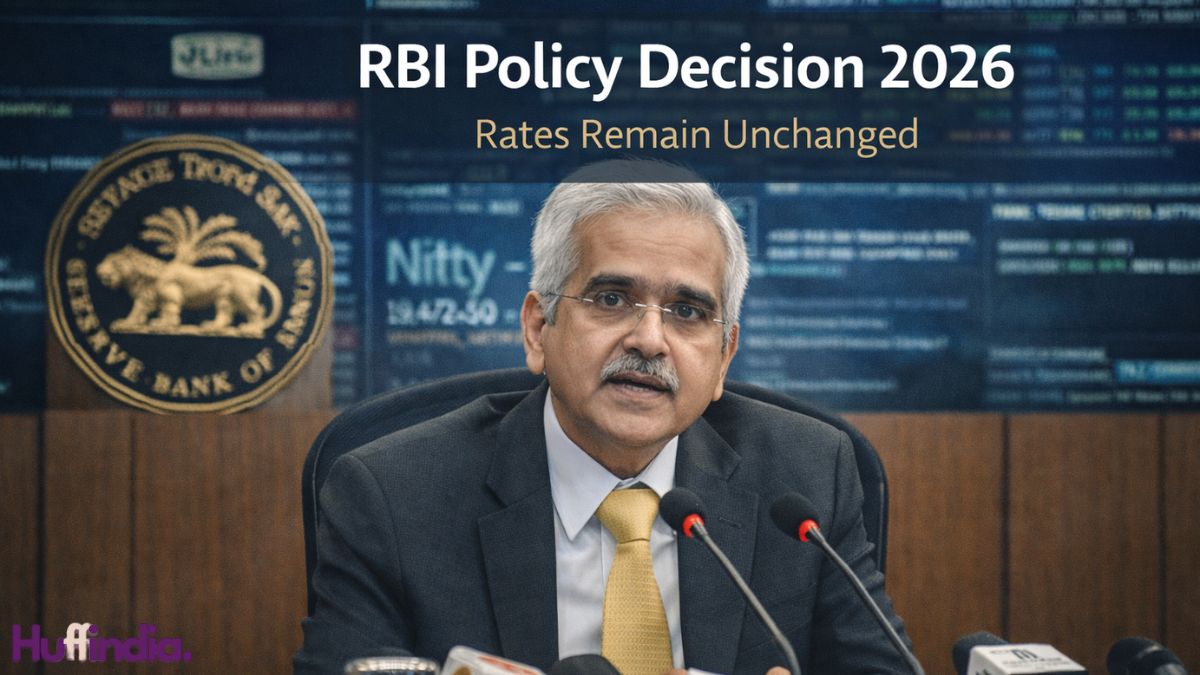



RBI policy decision 2026 marked a crucial moment for India’s economy as the Reserve Bank of India announced that it would keep the repo rate unchanged at 5.25 per cent. The decision, taken after the latest Monetary Policy Committee (MPC) meeting, signals the central bank’s preference for stability amid mixed global and domestic economic signals.
The RBI stated that current monetary conditions remain appropriate to balance growth while keeping inflation within the targeted range.
RBI Policy Decision 2026 Explained: Why Rates Were Held Steady
According to officials, the RBI policy decision for 2026 reflects confidence in India’s economic momentum despite ongoing global uncertainties. Inflation has remained largely under control, while domestic demand continues to support growth across services and manufacturing sectors.
The central bank noted that abrupt changes in interest rates could disrupt recovery trends, especially when external risks such as global interest rate volatility and geopolitical tensions persist.
By maintaining the status quo, the RBI aims to provide predictability to markets, businesses, and consumers.
The full monetary policy statement and detailed reasoning behind the decision are available on the Reserve Bank of India’s official website.
What RBI Policy Decision 2026 Means for Borrowers and Businesses
For borrowers, the RBI policy decision 2026 offers relief as lending rates are unlikely to rise in the near term. Home loan customers, small businesses, and corporate borrowers can expect existing interest rates to remain stable.
Industry experts say this stability encourages investment planning, particularly in capital-intensive sectors such as infrastructure, real estate, and manufacturing. Businesses benefit from clearer cost forecasts, while consumers gain confidence in long-term financial commitments.
Banks, however, may continue to assess liquidity conditions before making any changes to lending rates.
Market Reaction to RBI Policy Decision 2026
Financial markets responded cautiously to the RBI policy decision 2026, as the outcome was largely in line with expectations. Equity markets typically view policy continuity as a positive signal, reducing uncertainty for investors.
Bond yields remained stable, reflecting market confidence that inflation risks are being closely monitored. The Indian rupee also showed limited movement, supported by strong foreign exchange reserves and steady capital flows.
Market analysts say the RBI’s decision reassures investors that monetary policy remains focused on long-term stability rather than short-term reactions.
Political and Economic Context of RBI Policy Decision 2026
The RBI policy decision 2026 comes at a time when the government is focusing on sustaining economic growth while managing fiscal pressures. With budgetary priorities centred on infrastructure spending and employment generation, stable interest rates complement broader economic objectives.
Political observers note that predictable monetary policy strengthens investor confidence and supports India’s positioning as a stable emerging economy amid global volatility.
Coordination between fiscal and monetary authorities remains critical as India navigates both domestic development goals and external challenges.
What Comes Next After RBI Policy Decision 2026
Looking ahead, the RBI indicated it will closely monitor inflation trends, global financial conditions, and domestic growth indicators. Any future adjustments will depend on evolving data rather than fixed timelines.
Economists believe the RBI policy decision 2026 keeps flexibility intact, allowing the central bank to respond swiftly if inflation pressures rise or growth slows unexpectedly.
For now, stability appears to be the central theme guiding India’s monetary policy direction.
Related: Digital Rupee India: RBI’s Bold Move Reshaping the Nation’s Financial Future
Related: RBI Interest Rate Policy Signals Caution on Rate Cuts Amid Inflation Risks