
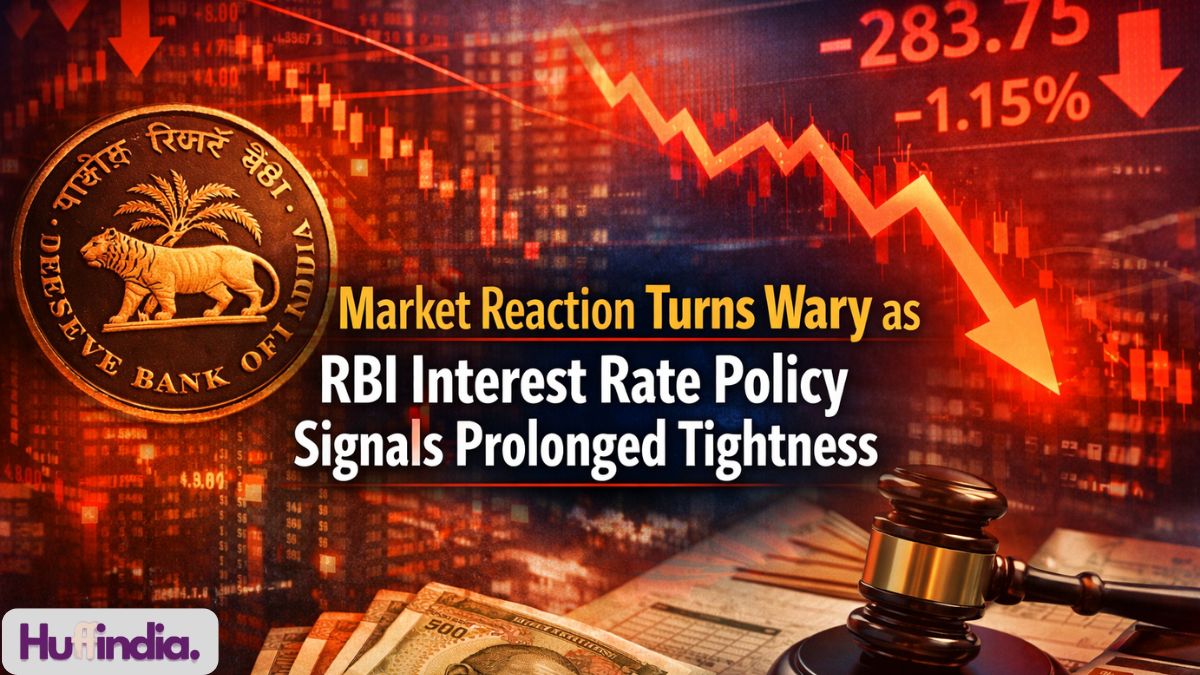



RBI interest rate policy remains firmly focused on inflation control as the Reserve Bank of India signalled a cautious stance on future rate cuts, even as India’s economic growth shows relative stability.
In its latest monetary policy commentary, the RBI said inflation risks continue to outweigh the case for immediate easing, driven by volatile food prices, global commodity uncertainty, and lingering geopolitical risks. The central bank reiterated that maintaining price stability remains its foremost priority.
Inflation Pressures Still a Concern
As stated in the Reserve Bank of India’s latest monetary policy statement, the central bank has reaffirmed that preserving price stability remains its primary mandate and that any adjustment to the interest rate policy will depend on clear, sustained evidence of inflation easing across key sectors.
Officials emphasised that RBI interest rate policy decisions will remain data-dependent and cautious, especially after sustained efforts to anchor inflation expectations.
“Any premature easing could reverse the gains achieved in inflation management,” an RBI official said, underlining the central bank’s conservative approach.
Economists note that food inflation continues to disproportionately impact lower-income households, making inflation control both an economic and social priority.
Growth Outlook Stable but Uneven
India’s GDP growth trajectory remains resilient, supported by strong government capital expenditure, steady services sector expansion, and improving urban consumption. However, the RBI acknowledged that growth momentum is uneven across sectors.
Rural demand has yet to fully recover, while export-oriented industries face pressure from weak global demand and tighter financial conditions abroad. Manufacturing activity has shown gradual improvement, but capacity utilisation remains below optimal levels.
The RBI said the interest rate policy framework aims to strike a balance—supporting growth without compromising long-term macroeconomic stability.
Market Reaction to RBI Interest Rate Policy
Financial markets responded with caution following the latest signals from the central bank, as the RBI interest rate policy continued to prioritise inflation control over near-term growth stimulus. Government bond yields edged higher, reflecting a reassessment of expectations around the timing and pace of potential rate cuts.
Equity markets remained largely range-bound through the session, with investors weighing the impact of sustained higher interest rates on corporate earnings, borrowing costs, and overall liquidity conditions. Rate-sensitive sectors, including real estate and automobiles, saw subdued trading activity amid uncertainty over the policy outlook.
Banking and financial stocks delivered mixed performance. While prolonged higher rates under the RBI interest rate policy could help lenders protect net interest margins, analysts cautioned that elevated borrowing costs may temper credit demand, particularly from retail and small business borrowers.
Market participants now largely expect any meaningful policy easing to be deferred to the latter half of the year, contingent on a clear and sustained decline in inflation. Until then, investors are likely to remain focused on incoming inflation data and policy guidance, with monetary conditions expected to stay tight in the near term.
What It Means for Borrowers and Businesses
For borrowers, the RBI’s cautious interest rate policy suggests lending rates are likely to remain elevated in the near term. Home loan, auto loan, and MSME borrowers may not see immediate relief unless inflation softens decisively.
However, economists argue that maintaining higher rates for longer could strengthen financial stability, reduce volatility, and create conditions for sustainable growth in the medium term.
Corporate borrowers may continue to face higher financing costs, prompting a focus on balance sheet discipline and efficient capital allocation.
A Delicate Policy Balancing Act
As global economic uncertainty persists, the RBI faces a complex challenge—managing domestic inflation risks while supporting growth in a volatile external environment. Policymakers have stressed that credibility in inflation control remains essential to long-term economic resilience.
The coming months will be critical, with RBI interest rate policy closely tied to inflation trends, monsoon outcomes, and global financial developments.
If inflation pressures ease sustainably, the central bank may gain room to recalibrate policy. Until then, caution is expected to remain the guiding principle.
Related: RBI Repo Rate Decision: Central Bank Holds Rates Amid Inflation and Growth Concerns
Related: RBI Inflation Outlook Turns Cautious as Central Bank Stresses Price Stability