
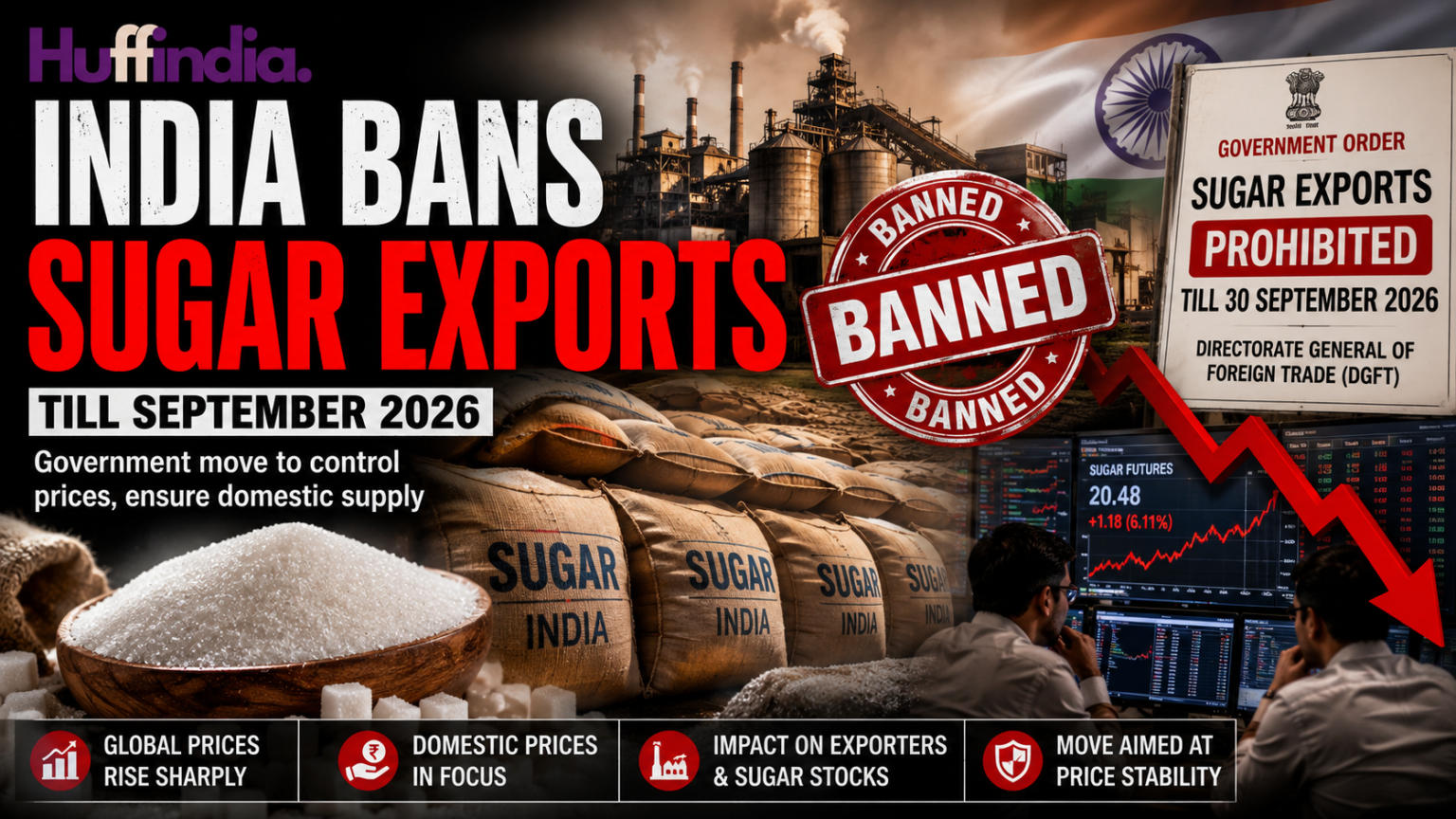



The government has announced an immediate India sugar export ban till September 30, 2026, in a major move aimed at controlling domestic sugar prices and protecting local supplies.
According to official notifications issued by the Directorate General of Foreign Trade (DGFT), exports of raw, white, and refined sugar have now been shifted from the “restricted” category to the “prohibited” category with immediate effect.
The latest decision comes amid concerns that domestic sugar production could remain below consumption levels for the second consecutive year.
Industry analysts say the sudden sugar exports banned announcement is expected to significantly impact global sugar markets, commodity traders, and Indian sugar companies.
Why Government Imposed Sugar Export Ban
Officials say the decision was taken to stabilize sugar prices India and ensure sufficient local availability during a period of rising supply concerns.
Experts believe multiple factors contributed to the move, including:
- Weak sugarcane yields in key producing regions
- Concerns around monsoon conditions
- Inflation management
- Rising domestic demand
- Global commodity volatility
India is currently the world’s second-largest sugar producer and one of the largest sugar exporters globally after Brazil.
The latest India sugar export ban is expected to reduce overseas shipments significantly over the coming months.
According to Reuters, the decision pushed global sugar futures higher shortly after the announcement.
DGFT Sugar Export Policy Shift Explained
The updated DGFT sugar export policy notification clarified that exports will remain prohibited until September 30, 2026, or until further government orders.
However, the government has allowed limited exemptions in specific cases, including:
- Shipments already loaded before the notification
- Vessels already berthed or anchored at ports
- Certain quota commitments to the European Union and United States
Industry observers say the sudden policy reversal could create complications for exporters and commodity traders who had already signed international contracts.
The latest DGFT sugar export policy change also marks a significant shift from earlier government expectations that India would produce surplus sugar this season.
Sugar Market News Impacts Global Commodity Prices
The latest sugar market news has already triggered reactions across global commodity exchanges.
Market analysts say international sugar prices rose sharply after India announced export restrictions because the country remains one of the world’s largest sugar suppliers.
Experts believe competing exporters including Brazil and Thailand could benefit from increased demand in Asian and African markets.
The latest sugar market news is also affecting:
- Commodity traders
- Food manufacturers
- Beverage companies
- Global supply chains
Analysts say international buyers may now face tighter sugar availability and higher import costs over the coming months.
Sugar Stocks Under Pressure After Announcement
The government’s decision has also impacted investor sentiment across India’s sugar sector.
Several sugar company stocks reportedly witnessed declines after the announcement due to concerns around reduced export opportunities.
Industry observers say companies dependent on overseas shipments could face short-term pressure if export restrictions remain in place for an extended period.
According to market reports, investors are now closely tracking:
- Domestic sugar inventory levels
- Monsoon forecasts
- Future production estimates
- Government policy signals
The broader reaction to the India sugar export ban reflects how commodity policy decisions can quickly influence financial markets and investor confidence.
Production Concerns Continue Rising
Industry experts say India’s sugar production outlook remains under pressure due to weaker sugarcane yields in several major producing states.
Concerns around possible El Niño-related weather disruptions and monsoon uncertainty are also contributing to supply worries.
Analysts believe maintaining domestic availability has become a major priority for policymakers amid broader inflation concerns.
The latest sugar prices India discussions are also linked to rising food inflation sensitivity ahead of the festive season.
Experts say future policy decisions could depend heavily on:
- Monsoon performance
- Crop output
- Domestic demand trends
- Inflation levels
India’s Role in Global Sugar Market Remains Significant
India’s position as one of the world’s largest sugar producers means any policy change can influence international commodity markets significantly.
Industry experts say India’s export restrictions may reshape global sugar trade flows over the coming months.
According to DGFT notifications and multiple business reports, the government continues prioritizing domestic supply stability and price management.
The latest sugar exports banned decision is expected to remain one of the most closely watched commodity policy developments in India this month.
Final Takeaway
The government’s decision to impose an India sugar export ban till September highlights growing concerns around domestic supply stability and rising commodity prices.
As global markets react to the policy shift, the move is likely to influence sugar prices, trade flows, and commodity market sentiment in both India and international markets.
While the government aims to protect domestic consumers and control inflation, industry experts believe the broader impact on exporters and global sugar markets will continue unfolding over the coming months.
Also read: Electricity Bill New Rule 2026: Power Tariff Changes and Impact Explained