

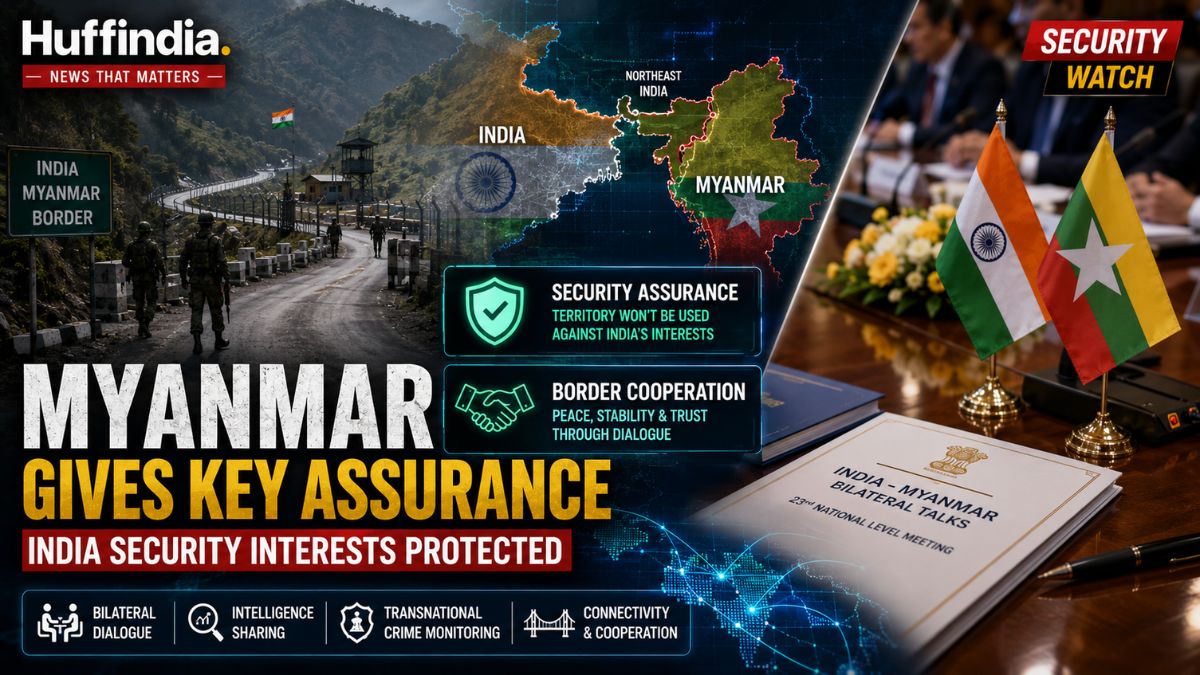
India-Myanmar security talks have produced a significant assurance from Myanmar, with the neighbouring country stating that its territory would not be permitted to be used against India’s security interests.
The development came at the conclusion of the 23rd National Level Meeting between India and Myanmar, held in New Delhi on July 7 and 8. According to the official statement issued after the talks, both sides reviewed bilateral security cooperation and discussed the situation along their shared border.
The meeting comes at a time when border stability, transnational crime and security coordination remain important concerns for both countries.
India-Myanmar Security Talks Focus on Shared Border Challenges
The latest India-Myanmar security talks covered a broad range of issues affecting the two neighbouring countries.
According to the official account of the meeting, both sides held comprehensive and constructive discussions on bilateral security cooperation and reviewed progress under existing dialogue mechanisms.
A central message from the talks was the importance of preventing sovereign territory from being misused for activities harmful to the other country’s security interests.
Myanmar’s assurance that its territory would not be permitted to be used against India’s security interests therefore emerged as one of the meeting’s most closely watched outcomes.
The statement is significant because India and Myanmar share a long and strategically important land border touching several northeastern states.
Myanmar Security Assurance Emerges as Key Outcome
The Myanmar security assurance was framed within a broader commitment by both sides to prevent misuse of sovereign territory.
The official statement said the two countries underscored the importance of ensuring that territory is not used for activities inimical to their respective security interests.
For India, developments across the Myanmar border carry particular importance because security conditions can have implications for border communities and the wider Northeast.
The assurance, however, should be understood as a diplomatic commitment announced after bilateral talks. Its practical significance will depend on sustained coordination, information exchange and implementation on the ground.
India-Myanmar Border Security Remains a Major Priority
The India Myanmar border security discussion also focused on maintaining peace, stability and security in the border region.
India’s Ministry of Home Affairs identifies the India-Myanmar land boundary as extending about 1,643 km and running along Arunachal Pradesh, Nagaland, Manipur and Mizoram.
This geography makes bilateral cooperation especially important. Difficult terrain, remote border areas and cross-border criminal networks can complicate enforcement and coordination.
The latest meeting therefore went beyond a single assurance and addressed broader mechanisms required to manage shared challenges.
Official information on India’s border-management framework is available through the Ministry of Home Affairs Border Management-I Division.
Intelligence Sharing and Operational Coordination in Focus
Another important element of the talks was the push for stronger intelligence sharing and operational coordination.
The two sides discussed enhancing cooperation to deal with common security challenges, including transnational crimes.
Such cooperation can be important when criminal activity crosses national borders and requires agencies on both sides to exchange timely information.
Capacity-building initiatives were also part of the broader security conversation, reflecting an effort to strengthen institutional cooperation rather than rely only on isolated interventions.
Transnational Crime Features in Bilateral Discussions
The talks also addressed cross-border and transnational criminal activity.
For neighbouring countries with a long and complex frontier, security concerns may involve multiple dimensions, including illegal trafficking networks and other organised cross-border activities.
The official outcome indicates that India and Myanmar intend to continue working through bilateral mechanisms to address these shared concerns.
A sustained framework for communication can be particularly important when security conditions evolve quickly and require coordinated responses.
India-Myanmar Security Talks Also Cover Connectivity Projects
The meeting was not limited to immediate security concerns.
Both sides also highlighted the importance of working closely towards the completion of major connectivity initiatives, including the Kaladan Multi-Modal Transit Transport Project and the India-Myanmar-Thailand Trilateral Highway.
These projects have wider strategic and economic significance because they are intended to improve regional connectivity and strengthen links between India and Southeast Asia.
Progress on connectivity, however, is closely linked with stable operating conditions and effective coordination between participating countries.
Who Led the 23rd National Level Meeting?
The Indian delegation was led by Govind Mohan, Secretary in India’s Ministry of Home Affairs.
The Myanmar delegation was led by Major General Min Thu, Deputy Minister in Myanmar’s Ministry of Home Affairs.
The two-day meeting reaffirmed the importance of the longstanding relationship between the neighbouring countries and their stated commitment to further strengthening cooperation.
The National Level Meeting mechanism provides a formal platform for discussing security issues and reviewing progress under bilateral arrangements.
Also Read | India-Japan Strategic Partnership: PM Modi Welcomes Japanese PM Sanae Takaichi to New Delhi
Why the Myanmar Assurance Matters for India
The assurance matters because India’s relationship with Myanmar intersects with several strategic priorities.
These include border management, security in the Northeast, action against transnational criminal networks and regional connectivity.
At the same time, a formal assurance should not be interpreted as evidence that every security challenge has been resolved. The effectiveness of the commitment will depend on continued engagement, operational cooperation and developments along the border.
That distinction is important in assessing the outcome without overstating what a diplomatic statement can achieve on its own.
What Happens Next?
Following the 23rd National Level Meeting, attention is likely to turn towards how the commitments announced in New Delhi are implemented.
Future cooperation may involve continued intelligence exchange, stronger operational coordination, capacity-building measures and regular dialogue on emerging border concerns.
The latest India-Myanmar security talks show that both sides are seeking to preserve formal channels of engagement on issues that directly affect security and regional stability.
Final Words
Myanmar’s assurance that its territory would not be permitted to be used against India’s security interests is a notable outcome of the latest bilateral meeting.
The broader significance of the talks lies in the emphasis on border stability, intelligence sharing, operational coordination, transnational crime and strategic connectivity.
For India, sustained cooperation with Myanmar remains important because developments across the shared frontier can have direct implications for the Northeast and wider regional security. The next test will be whether the commitments made during the meeting translate into durable and effective cooperation on the ground.