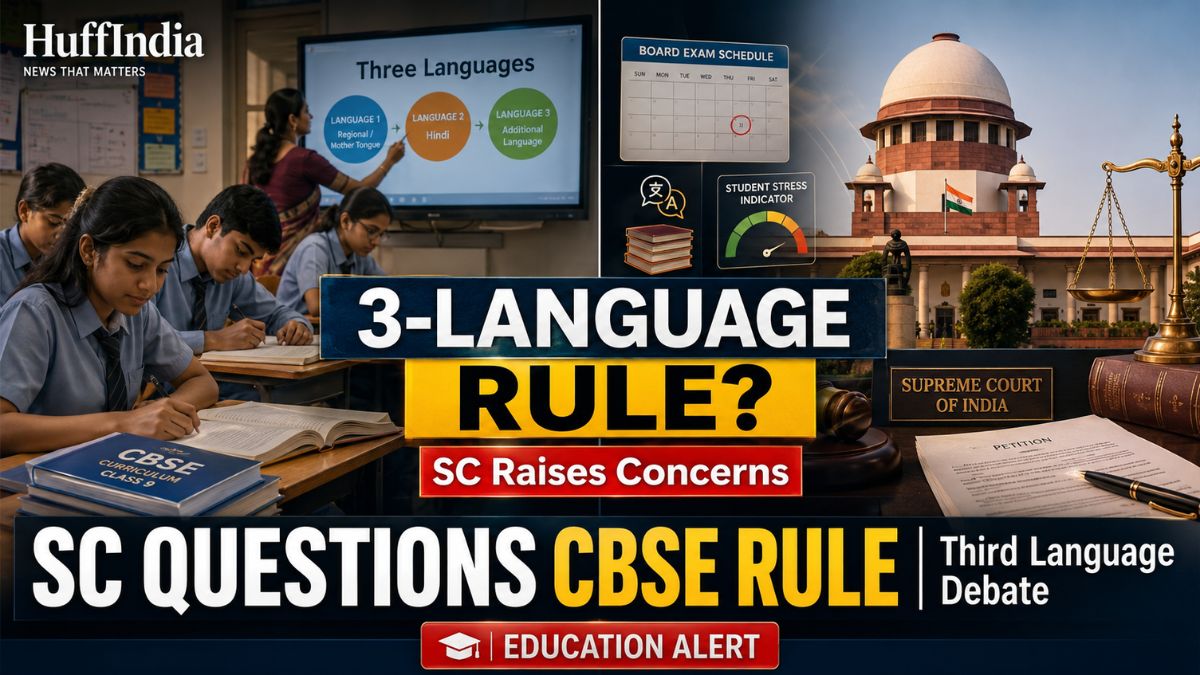



CBSE third language Class 9 policy came under judicial scrutiny on Thursday after the Supreme Court observed that introducing a compulsory third language from Class 9 under the National Education Policy (NEP) could place additional pressure on students as they begin preparing for their Class 10 board examinations.
During the hearing, the Bench remarked that the timing of introducing a new language requirement may increase students’ stress levels. The observations were made while hearing a matter related to the Central Board of Secondary Education’s (CBSE) implementation of the three-language framework. The case remains under consideration, and the Supreme Court has not delivered a final verdict on the policy.
CBSE Third Language Class 9 Policy Under Review
The CBSE third language Class 9 requirement forms part of the board’s implementation of the National Education Policy (NEP) 2020.
Under the revised framework, students are required to study three languages from Class 9 onwards. However, CBSE has clarified that there will be no separate Class 10 Board examination for the third language (R3).
The policy is intended to align school education with the broader objectives of the National Education Policy.
What the Supreme Court Observed
During the hearing, the Supreme Court observed that introducing a third language in Class 9 could increase academic pressure because students typically begin preparing for their board examinations during this stage.
The Bench questioned whether adding another compulsory subject at this point might place an additional burden on students.
These remarks were made during court proceedings and should not be interpreted as the Court’s final decision on the legality or validity of the policy.
CBSE Clarifies No Board Examination for Third Language
CBSE has stated that although students must study a third language under the new framework, there will be no separate Board examination for the third language in Class 10.
The clarification was issued to address concerns regarding examination pressure and assessment requirements.
Students will continue to study the language as part of the curriculum, but the evaluation process differs from that of other Board examination subjects.
National Education Policy and the Three-Language Formula
The CBSE third language Class 9 requirement is linked to the National Education Policy (NEP) 2020, which encourages multilingual learning while allowing flexibility in language choices.
The policy seeks to promote linguistic diversity and strengthen language learning among students.
Its implementation, however, has generated debate in some quarters regarding curriculum load, practical challenges and the timing of introducing additional language requirements.
Also Read | NTA Telegram Ban: Chief Defends Move Ahead of June 21 Re-NEET Exam
Education Experts Hold Differing Views
Education specialists have expressed varying opinions on multilingual education.
Some argue that learning additional languages can improve cognitive development and communication skills, while others believe curriculum changes should be implemented without placing excessive academic pressure on students.
The Supreme Court’s observations add another perspective to the ongoing discussion but do not constitute a final legal determination.
What Happens Next?
The CBSE third language Class 9 matter will continue before the Supreme Court, where further arguments and submissions are expected.
Any future directions or changes to the policy will depend on the Court’s final judgment or subsequent orders.
Until then, the existing framework remains subject to the applicable CBSE guidelines and judicial proceedings.
Readers can access official circulars and curriculum updates on the Central Board of Secondary Education (CBSE) website.
Final Words
The CBSE third language Class 9 policy has become the focus of judicial discussion after the Supreme Court questioned whether introducing an additional compulsory language at the beginning of board examination preparation could increase stress for students.
While the Court’s observations have attracted attention, no final ruling has been delivered, and the matter remains pending. Students, parents and schools are expected to watch future proceedings closely for any further developments.