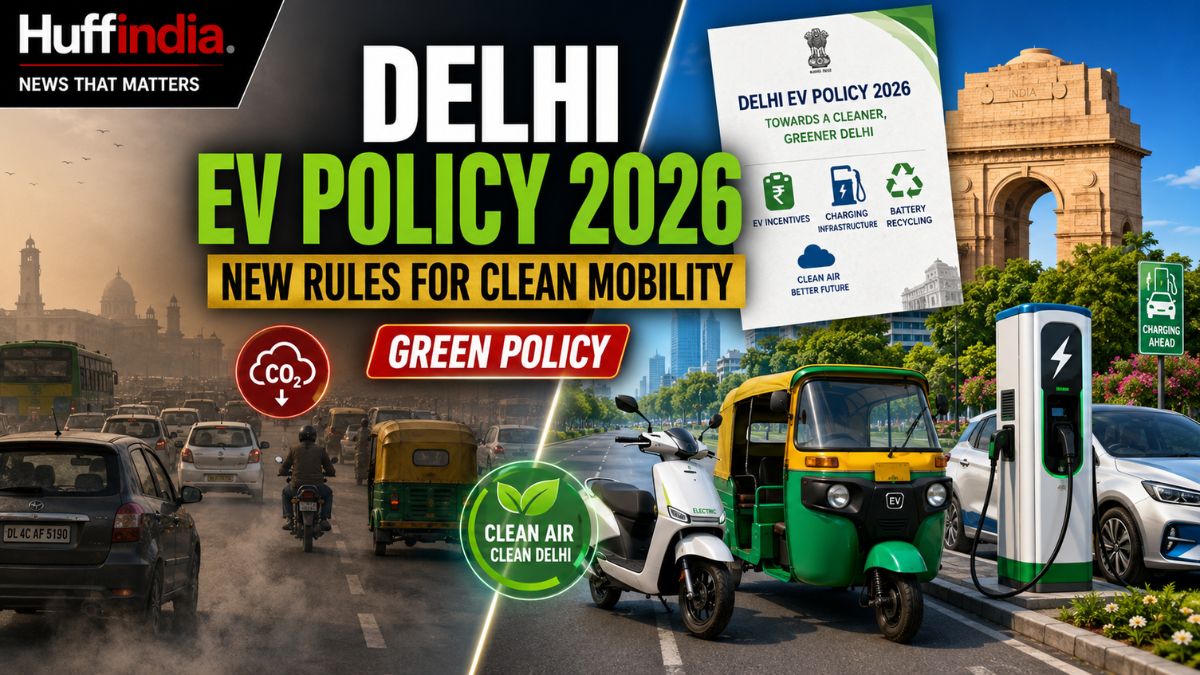



Delhi EV Policy 2026 has brought electric mobility back into the centre of India’s clean-transport debate after the National Capital Territory notified a new four-year framework aimed at reducing vehicular pollution, expanding charging infrastructure and accelerating the shift away from conventional fuel vehicles.
The policy was notified by the Government of the National Capital Territory of Delhi through an official gazette notification dated June 30, 2026, and came into effect from July 1, 2026. It builds on Delhi’s earlier electric vehicle push and sets out a combination of purchase incentives, scrapping benefits, charging-network measures and electrification mandates.
According to the official notification, Delhi EV Policy 2026 draws support from the constitutional right to clean air and from provisions of the Motor Vehicles Act. The policy states that vehicular emissions remain a major contributor to Delhi’s poor air quality, making transport electrification a central part of the capital’s environmental strategy.
Because Delhi’s air pollution problem is complex and includes dust, industrial emissions, construction activity, weather conditions and seasonal factors, this article treats the policy as a transport and sustainability measure rather than a complete solution to the city’s pollution crisis.
What Is Delhi EV Policy 2026?
Delhi EV Policy 2026 is the capital’s updated electric vehicle policy for the 2026–2030 period.
The official notification says the policy aims to accelerate adoption of electric vehicles across major vehicle segments, support public and private charging infrastructure, build a stronger EV supply chain and improve air quality by reducing dependence on internal combustion engine vehicles.
The policy applies from the date of notification and includes provisions for incentives, charging and battery swapping infrastructure, battery recycling, registration mandates and government-fleet transition.
The New Indian Express described the policy as Delhi’s updated blueprint for electric mobility and reported that one of its key targets is to move towards at least 30% electric vehicle share in the capital by 2030.
The central idea behind Delhi EV Policy 2026 is clear: make electric vehicles easier to buy, easier to charge and increasingly necessary in selected high-use vehicle categories.
For additional background on the official rules, incentives and implementation framework, readers can see the Delhi government’s official EV Policy 2026 notification.
Why Has Delhi Introduced a New EV Policy?
The government’s stated reason is air pollution.
The official notification says Delhi is committed to curbing air pollution and promoting clean mobility through targeted incentives, infrastructure development and regulatory measures. It also cites a Commission for Air Quality Management report, saying vehicular emissions were identified as the largest contributor to air pollution in Delhi-NCR during winter.
The policy specifically notes that two-wheelers make up a large share of Delhi’s vehicle stock. It also says three-wheelers, commercial cars and N1 category goods vehicles have high daily use and mileage, making their electrification important for reducing urban emissions.
This does not mean electric vehicles alone can solve Delhi’s air-quality crisis. Experts and media reports have repeatedly noted that Delhi’s pollution problem has multiple causes. However, reducing tailpipe emissions from high-use vehicle categories can still be an important part of a broader clean-air strategy.
That is why Delhi EV Policy 2026 focuses heavily on two-wheelers, autos, goods carriers, school buses, delivery fleets and public charging infrastructure.
What Incentives Are Offered for Electric Two-Wheelers?
Delhi EV Policy 2026 provides purchase incentives for electric two-wheelers, subject to eligibility conditions.
According to the official notification, the ex-showroom price of the electric two-wheeler should not exceed ₹2.25 lakh. The policy provides a year-wise incentive structure for electric two-wheelers.
In the first year from the date of notification, the incentive is ₹10,000 per kWh, up to a maximum of ₹30,000. In the second year, it drops to ₹6,600 per kWh, up to ₹20,000. In the third year, it becomes ₹3,300 per kWh, up to ₹10,000.
The policy says the incentive applies to both plug-in and battery-swapping electric two-wheeler models.
This phased incentive structure shows that the government wants to encourage early adoption while gradually reducing subsidy support over time.
Also Read | 5 Indian Cars from the 90s We Wish Would Make a Comeback
What Are the Benefits for Electric Autos and Goods Vehicles?
Delhi EV Policy 2026 also covers electric three-wheeler auto-rickshaws and electric four-wheeler goods vehicles.
For electric three-wheeler auto-rickshaws in the L5M category, the official notification provides incentives of ₹50,000 in the first year, ₹40,000 in the second year and ₹30,000 in the third year.
The policy says the incentive will apply to the replacement of old CNG auto-rickshaws or purchase of new electric auto-rickshaws, within the overall limit fixed for autos in Delhi.
For electric four-wheeler goods vehicles in the N1 category, incentives vary by vehicle weight and year. The policy provides higher incentives for N1 vehicles above 1.75-ton gross vehicle weight and lower incentives for those up to 1.75 tons.
These provisions are significant because commercial vehicles generally travel more kilometres per day than private vehicles. Electrifying high-use commercial vehicles can potentially reduce tailpipe emissions more efficiently than focusing only on private cars.
What Scrapping Incentives Are Included?
Delhi EV Policy 2026 includes scrapping incentives to encourage replacement of older polluting vehicles.
According to the official notification, a scrapping incentive of ₹10,000 is available for electric two-wheelers when a Delhi-registered BS-IV or older two-wheeler is scrapped and a new eligible electric vehicle is purchased within six months of receiving the Certificate of Deposit from an authorised scrapping facility.
For electric three-wheelers, the scrapping incentive is ₹25,000. For electric cars with an ex-showroom price not exceeding ₹30 lakh, the scrapping incentive is ₹1,00,000, limited to the first 1,00,000 eligible applicants under the policy. Electric N1 goods carriers are eligible for a scrapping incentive of ₹50,000.
The policy also provides a ₹15,000 scrapping incentive for Gramin Sewa vehicles under specified replacement conditions.
These incentives are designed to link EV adoption with removal of older vehicles from the road, rather than simply adding new vehicles to the existing fleet.
What About Road Tax and Registration Fees?
The policy provides important tax and fee exemptions for electric vehicles.
Delhi EV Policy 2026 says all eligible electric vehicles purchased and registered in Delhi during the policy period will receive 100% exemption from road tax throughout the life of the vehicle and registration fees at the time of vehicle registration, subject to specific conditions.
For electric cars with an ex-showroom price below or equal to ₹30 lakh, the policy grants 100% exemption from road tax and registration fees until March 31, 2030.
However, electric cars priced above ₹30 lakh are not granted road tax and registration fee exemption under the policy.
This structure indicates that the government is trying to focus benefits on mass adoption and relatively more affordable EV segments rather than premium electric cars.
What Are the Major Electrification Mandates?
One of the most important parts of Delhi EV Policy 2026 is its registration mandate for selected vehicle categories.
The official notification states that from January 1, 2027, only electric three-wheelers in the L5 category will be permitted for new registration in Delhi.
From January 1, 2027, only electric N1 goods carriers will be permitted for new registration in the capital.
For two-wheelers, the policy says that from April 1, 2028, only electric two-wheelers will be permitted for new registration in Delhi.
The policy also sets targets for school buses. Schools in Delhi are expected to reach a minimum electric share of 10% of their bus fleet by the end of the second year from notification, 20% by the end of the third year and 30% by March 31, 2030.
These mandates make Delhi EV Policy 2026 more than a subsidy scheme. It is also a regulatory roadmap for gradually shifting key vehicle segments towards electric mobility.
How Will Charging Infrastructure Be Expanded?
Charging infrastructure is a central part of the policy.
The notification says Delhi Transco Limited will act as the nodal agency for planning, coordination and implementation of public EV charging and battery swapping infrastructure in Delhi.
Delhi Transco is expected to aggregate demand, identify locations, plan grid readiness and develop standard operating procedures for charging and swapping infrastructure.
The policy also proposes a single-window facility for charge-point operators and battery-swapping operators to enable faster approvals and connections.
Resident welfare associations, group housing societies, private entities and real estate developers are encouraged to facilitate community and private EV charging infrastructure.
This is important because EV adoption depends not only on vehicle cost but also on charging convenience. Without reliable charging access, especially for apartment residents, commercial fleets and delivery workers, policy targets may be difficult to achieve.
What Does the Policy Say About Battery Recycling?
Delhi EV Policy 2026 also addresses battery recycling and waste management.
The notification says the Environment Department must ensure compliance with Battery Waste Management Rules, including Extended Producer Responsibility requirements.
The Delhi Pollution Control Committee is expected to facilitate battery collection centres across Delhi under a public-private partnership model in collaboration with authorised recyclers.
The policy also calls for standard operating procedures for safe collection, storage, transport and transfer of waste batteries to authorised recyclers or producer responsibility organisations.
This is an important sustainability safeguard. Electric vehicles reduce tailpipe emissions, but battery waste, recycling, mineral sourcing and end-of-life handling remain key environmental concerns.
By including battery traceability and recycling, the policy attempts to address part of the life-cycle impact of EV adoption.
What Are the Main Challenges?
The biggest challenge for Delhi EV Policy 2026 will be implementation.
The policy sets ambitious targets, but the transition depends on vehicle affordability, charging availability, grid readiness, financing, service networks and consumer confidence.
Commercial operators may need affordable loans and predictable operating costs before replacing existing vehicles. Two-wheeler buyers will compare electric models with petrol alternatives on upfront cost, range, battery life and after-sales support.
Charging infrastructure will also need to grow quickly. Public chargers, community charging points and battery-swapping stations must be reliable, accessible and affordable.
There may also be pushback from some transport groups, especially where mandates affect livelihoods or require faster replacement of existing vehicles. Any such concerns should be assessed through official consultations, policy clarifications and ground-level implementation data.
Final Thoughts
Delhi EV Policy 2026 marks a major step in the capital’s attempt to use electric mobility as part of its clean-air strategy. The policy offers purchase incentives, scrapping benefits, road-tax exemptions, charging-infrastructure measures and registration mandates for important vehicle categories.
The safest factual conclusion is that Delhi has moved from encouraging EV adoption to setting a clearer regulatory pathway for it. The policy’s success will depend not only on its written targets but also on execution, financing, charging access and public acceptance.
Electric vehicles will not solve Delhi’s air pollution problem alone. But Delhi EV Policy 2026 shows that the government is treating transport emissions as a major part of the solution, especially in high-use vehicle categories such as two-wheelers, autos, goods carriers and school buses.