
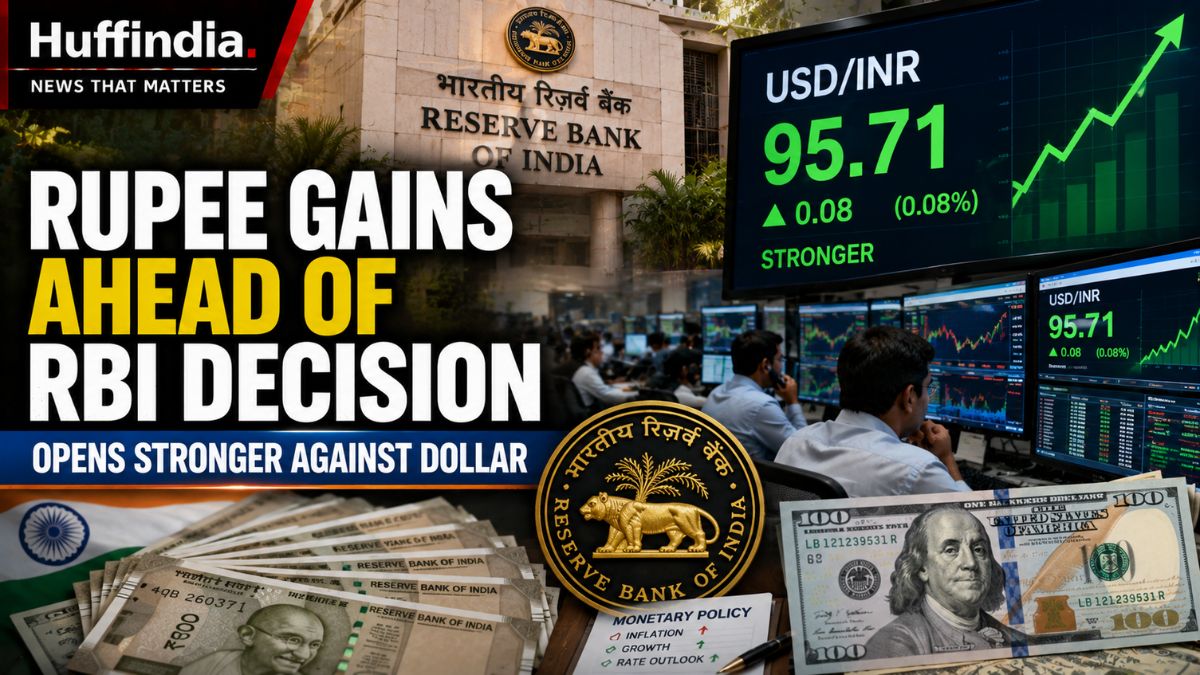



Rupee Against Dollar opened eight paise stronger at 95.71 on Friday as investors closely monitored the Reserve Bank of India’s (RBI) monetary policy decision and awaited potential measures aimed at supporting the currency and attracting foreign capital.
The Indian currency showed resilience despite broader global uncertainty linked to geopolitical tensions in West Asia, rising crude oil prices, and volatility in international financial markets. Market participants remained focused on the RBI’s policy stance, inflation outlook, and any announcements that could influence capital inflows and exchange rate stability.
The rupee’s early gains reflected cautious optimism among traders ahead of what was considered one of the most closely watched RBI policy meetings of the year.
Rupee Against Dollar Strengthens Before RBI Announcement
The Rupee Against Dollar opened at 95.7125 compared with the previous close of 95.7850, registering an appreciation of eight paise in early trade. Currency dealers attributed the move to position adjustments, expectations of supportive policy measures, and hopes of increased foreign inflows.
The gain came after several sessions of pressure on the Indian currency. In recent weeks, the rupee has faced challenges from rising oil prices, foreign portfolio outflows, and concerns over global economic uncertainty.
However, expectations that authorities could take steps to attract overseas investment have helped improve sentiment in the currency market.
Why the RBI Rate Decision Matters
The RBI’s monetary policy decision was widely viewed as a key factor influencing the near-term direction of the currency.
Economists and market participants closely watched whether the central bank would adjust interest rates or announce measures to support foreign capital inflows. Higher interest rates can sometimes strengthen a currency by making domestic assets more attractive to international investors.
At the same time, policymakers faced the challenge of balancing inflation risks, economic growth, and financial stability.
The central bank ultimately decided to keep the repo rate unchanged at 5.25% while maintaining a neutral policy stance amid ongoing geopolitical and economic uncertainties.
Rising Oil Prices Continue to Influence the Rupee
One of the biggest pressures on the Rupee Against Dollar remains the increase in global crude oil prices.
India imports a significant portion of its energy requirements, making the economy sensitive to fluctuations in oil prices. Higher crude prices increase import costs, widen the trade deficit, and create additional demand for dollars, which can weaken the rupee.
The recent tensions involving Iran and broader instability in West Asia have contributed to higher energy prices and increased volatility across global financial markets.
Analysts note that sustained increases in crude oil prices could continue to exert pressure on the Indian currency despite short-term gains.
RBI Measures and Foreign Capital Inflows
Apart from interest rates, investors were also watching for measures designed to encourage foreign investment.
Recent discussions around easing taxation on foreign investments in government securities and efforts to improve capital inflows have supported sentiment toward the rupee. Such initiatives are intended to attract overseas investors and strengthen the country’s external financial position.
The RBI has also been active in the foreign exchange market through swap operations and liquidity management measures aimed at stabilizing currency movements. These interventions have helped the rupee recover from earlier record-low levels seen during recent months.
Forex Market Watches Global Developments
The movement of the Rupee Against Dollar is increasingly influenced by global developments.
International investors are closely monitoring geopolitical risks, US monetary policy, commodity prices, and economic growth prospects. Any significant changes in these areas can affect capital flows into emerging markets such as India.
The uncertainty surrounding global energy markets and ongoing geopolitical tensions has made currency markets particularly sensitive to new developments.
Despite these challenges, analysts believe India’s relatively stable macroeconomic fundamentals continue to provide support for the rupee over the medium term.
What Traders Are Watching Next
Currency traders are now focusing on the RBI’s future guidance and the sustainability of foreign capital inflows.
If inflation remains manageable and investment flows improve, the rupee could find additional support in the coming months. However, any sharp increase in oil prices or deterioration in global risk sentiment could create renewed pressure on the currency.
For official updates on monetary policy and currency-related measures, readers can visit the Reserve Bank of India (RBI) website.
Market participants will also monitor upcoming economic data, inflation trends, and international developments that may influence exchange rates.
Final Thoughts on the Rupee Against Dollar
The Rupee Against Dollar started the day on a positive note, strengthening by eight paise ahead of the RBI’s closely watched policy decision. While the currency benefited from expectations of supportive measures and improving investor sentiment, challenges such as rising oil prices and geopolitical uncertainty remain significant.
The RBI’s decision to maintain policy stability while introducing measures to attract foreign inflows highlights the balancing act facing policymakers. As global economic conditions continue to evolve, the performance of the Rupee Against Dollar will remain an important indicator for investors, businesses, and policymakers alike.