
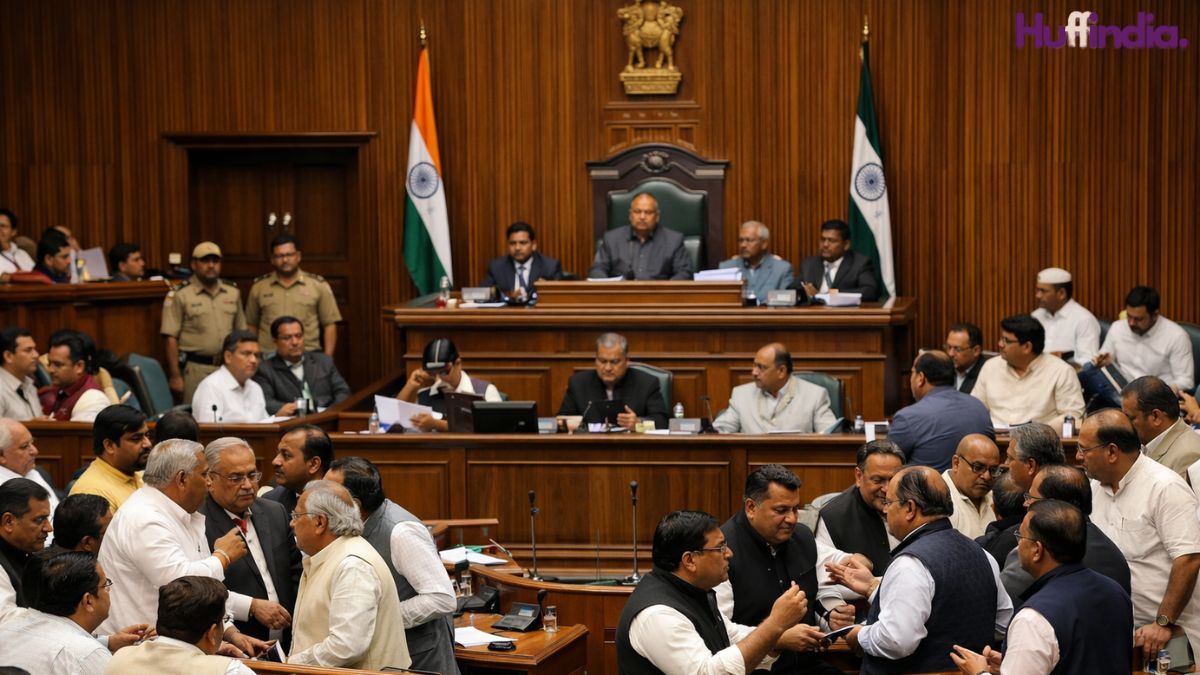



Floor test in state assembly proceedings have moved to the centre of political attention as a key state government prepares to face a crucial trust vote following days of uncertainty and shifting political alignments. The outcome of the vote is expected to determine whether the incumbent administration continues in office or gives way to a new political arrangement.
Political Tensions Rise Ahead of Trust Vote
The floor test was ordered after rival political parties laid competing claims to power, citing changes in legislative support. Acting on constitutional advice, the Governor directed the government to prove its majority on the floor of the House — a step widely viewed as essential to resolving the ongoing political impasse.
Senior leaders from both the ruling coalition and the opposition have been holding meetings with party legislators, projecting confidence while closely monitoring numbers ahead of the decisive vote.
“Acting on constitutional advice, the Governor, according to an official communication cited by the Press Information Bureau, directed the government to prove its majority on the floor of the House.”
What a Floor Test Means for Governance
A floor test is the most transparent constitutional mechanism to determine whether a government enjoys the confidence of the elected members of the legislative assembly. During the process, lawmakers vote openly, allowing the House to clearly establish the strength of the ruling side.
Constitutional experts note that a floor test in state assembly leaves little room for ambiguity, as the numerical outcome directly reflects legislative support and legitimacy.
Governor’s Role and Assembly Proceedings
The Governor’s role in ordering the floor test has attracted attention, with legal experts underlining that such decisions must strictly adhere to constitutional principles and Supreme Court guidelines. The apex court has consistently held that the floor of the House is the appropriate forum to test a government’s majority.
Officials said the assembly session would be conducted under strict procedural rules to ensure transparency, fairness, and order. Security arrangements have also been tightened around the assembly complex to prevent disruptions during the proceedings.
Ruling and Opposition Positions
The ruling camp maintains that it continues to command majority support and has accused the opposition of attempting to destabilise an elected government through political manoeuvring. Opposition leaders, however, argue that recent developments indicate a clear loss of confidence, making the trust vote unavoidable.
Political analysts say the floor test in state assembly could significantly reshape the political landscape of the state, influencing governance priorities, administrative stability, and future alliances.
Legal and Political Implications
If the government fails to secure the required majority during the vote, the Chief Minister may be required to resign. Depending on the situation, the state could see the formation of an alternative government, a caretaker arrangement, or other constitutional measures.
Legal observers add that any dispute over the conduct or timing of the floor test could potentially be challenged in court, though judicial precedent strongly favours floor tests as the fairest method to establish majority.
What Happens After the Vote
Once the trust vote concludes, clarity is expected on the state’s political direction. A successful vote would strengthen the government’s position and provide administrative stability, while an adverse outcome could trigger swift political realignments.
For now, attention remains firmly on the assembly as the floor test in state assembly unfolds, highlighting the decisive role of legislative confidence in India’s parliamentary democracy.
Related: Election Reform India: Fresh Proposal Sparks Political Reactions
Related: Parliament Disruption as Political Tensions Rise Over Key National Issues