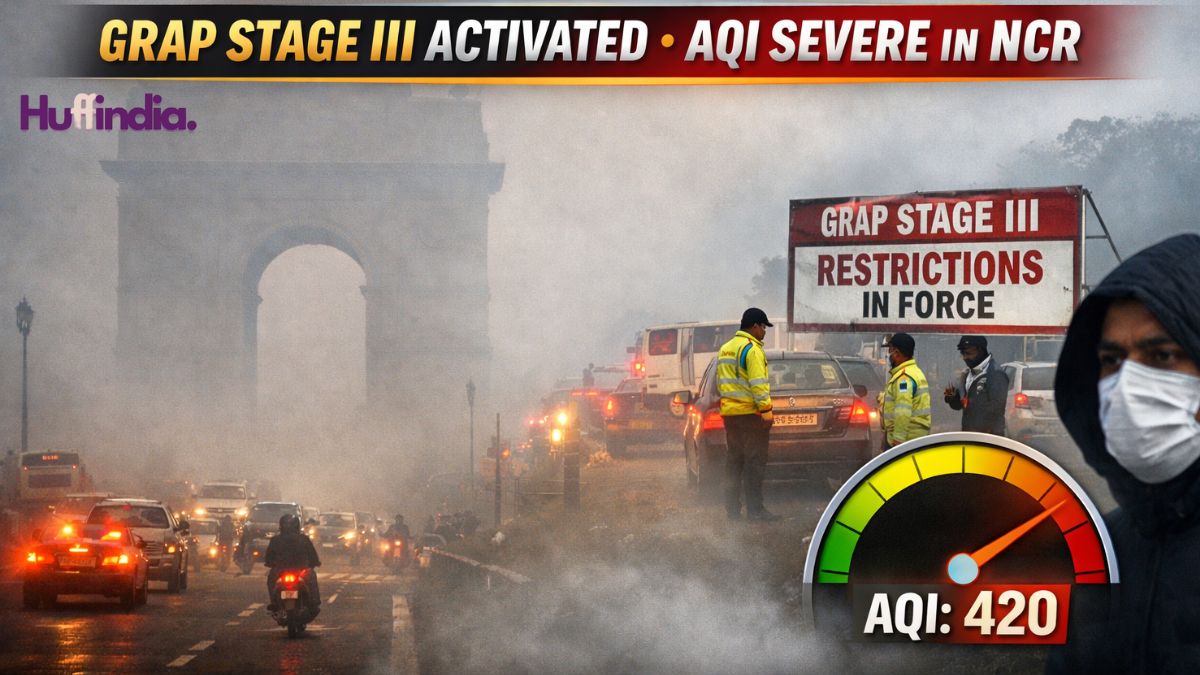



Delhi fog intensified across the National Capital Region (NCR) early Sunday, significantly reducing visibility and pushing air quality into the ‘severe’ category, prompting authorities to re-impose GRAP Stage III restrictions. The move comes amid a combination of low wind speeds, falling temperatures, and persistent emissions that have trapped pollutants over the region.
According to the Central Pollution Control Board (CPCB), Delhi’s average Air Quality Index (AQI) crossed the 400 mark in several monitoring stations, a level classified as ‘severe’. Areas including Anand Vihar, Rohini, and Mundka recorded some of the worst readings, raising concerns over public health, especially for children, the elderly, and people with respiratory conditions.
What GRAP Stage III Means
The Graded Response Action Plan (GRAP) is a set of emergency measures implemented when air pollution reaches critical levels. Under GRAP Stage III, authorities have ordered the suspension of non-essential construction and demolition activities across Delhi-NCR. The use of diesel generator sets is restricted, except for emergency and essential services, while additional curbs have been placed on industrial operations that contribute to particulate emissions.
Vehicles that do not meet prescribed emission standards face stricter enforcement, and state governments have been directed to enhance mechanised road sweeping and water sprinkling to suppress dust. Schools and offices have been advised to limit outdoor activities, while citizens are urged to avoid unnecessary travel during peak pollution hours.
Weather Conditions Behind the Smog
The India Meteorological Department (IMD) has attributed the worsening Delhi fog situation to stable atmospheric conditions and a temperature inversion, a phenomenon common during winter months. In such conditions, cooler air near the ground gets trapped under warmer air above, preventing pollutants from dispersing.
The IMD has also issued a dense fog warning for parts of north India, including Delhi, Haryana, and western Uttar Pradesh, cautioning that low visibility could persist during early morning and late-night hours for the next few days. Calm winds and high moisture levels are expected to continue, limiting any immediate improvement in air quality.
Impact on Transport and Daily Life
The thick fog has disrupted road, rail, and air travel across the NCR. Several flights at Delhi’s Indira Gandhi International Airport reported delays, while trains arriving from northern routes were running behind schedule due to poor visibility. Traffic congestion was reported on major arterial roads as motorists slowed down, increasing commute times.
Health experts warn that prolonged exposure to ‘severe’ AQI levels can lead to aggravated asthma, bronchitis, and other cardiovascular issues. Doctors have advised residents to limit outdoor exposure, use masks where necessary, and keep indoor air as clean as possible.
Government Response and Monitoring
The Commission for Air Quality Management (CAQM) stated that the situation is being monitored on an hourly basis and that restrictions may be further tightened if pollution levels do not improve. Officials emphasised that GRAP measures are temporary but necessary to prevent the situation from deteriorating further.
State agencies have also been directed to intensify checks on construction sites, industrial units, and waste burning hotspots. Public transport services are being encouraged to reduce reliance on private vehicles, one of the major contributors to winter pollution in the capital.
What Lies Ahead
While short-term relief depends largely on changes in weather conditions, such as stronger winds or rainfall, environmental experts stress the need for long-term structural reforms. These include better public transport infrastructure, stricter vehicle emission norms, and effective management of construction dust and waste.
For now, residents are advised to follow official advisories and stay informed through reliable updates. The IMD is expected to issue fresh forecasts over the coming days, which will determine whether NCR restrictions under GRAP Stage III remain in place or are escalated further.
Related: Master India Sudden Weather Changes: Why Multiple States Are on Alert
Related: Dense Fog North India Disrupts Travel as Flights and Trains Face Delays