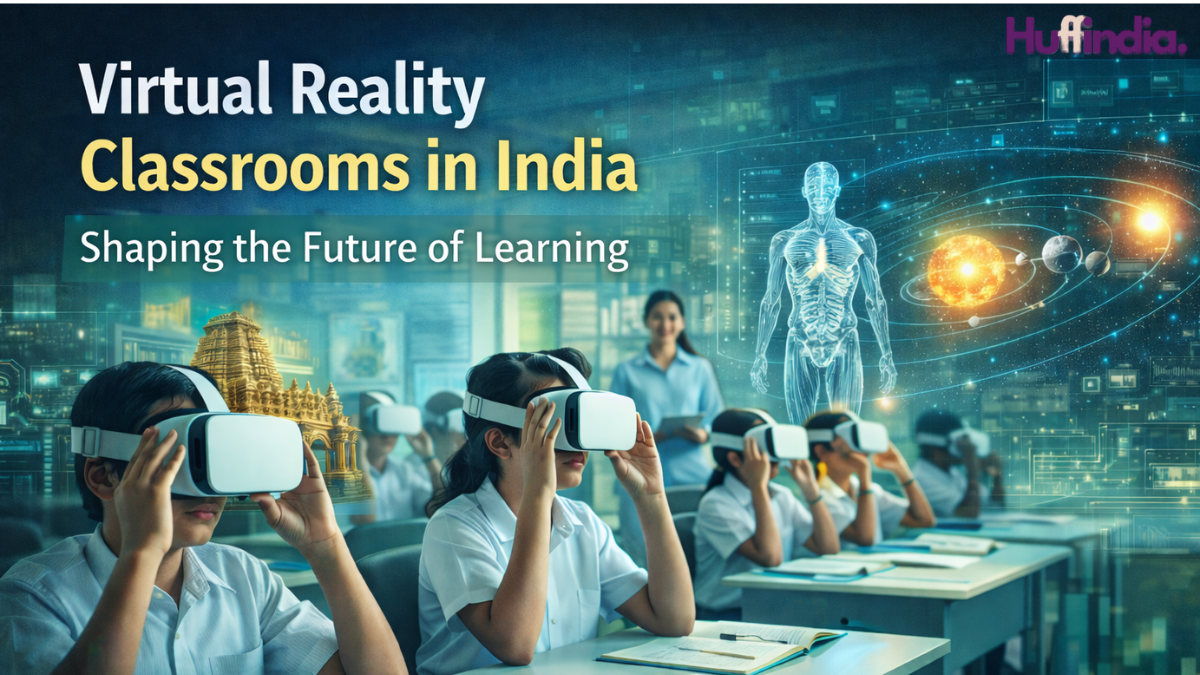



Virtual reality classrooms in India are gradually moving from experimental pilots to serious discussions in education policy and private learning ecosystems. As digital learning evolves beyond screens and video calls, immersive technologies such as virtual reality (VR) are being explored as tools that could redefine how students engage with subjects, teachers, and real-world concepts.
While VR-based education is still in its early stages in India, momentum is building across schools, edtech companies, and teacher training programmes.
What Are Virtual Reality Classrooms?
Virtual reality classrooms use VR headsets and immersive software to simulate three-dimensional learning environments. Instead of reading about historical monuments or scientific processes, students can experience them virtually—walking through ancient cities, exploring the human body, or observing chemical reactions safely.
In the Indian context, virtual reality classrooms in India are being positioned as supplements rather than replacements for traditional teaching methods. Educators view VR as a way to enhance conceptual understanding, particularly for complex or abstract subjects.
Why VR Is Gaining Attention in Indian Education
India’s education system faces challenges related to infrastructure gaps, teacher shortages, and unequal access to quality resources. Immersive learning tools are increasingly being explored as potential solutions to bridge these gaps.
Supporters argue that VR education India could:
- Improve student engagement and retention
- Enable experiential learning without physical constraints
- Provide uniform access to high-quality content across regions
Several pilot projects have already demonstrated improved comprehension levels when students learn through immersive simulations rather than textbooks alone.
Role of EdTech and Private Institutions
India’s edtech sector has played a central role in experimenting with VR-based learning modules. Startups are developing curriculum-aligned VR content for subjects such as science, geography, and vocational training.
Private schools and international curriculum institutions are among the early adopters, testing immersive learning India models in controlled classroom environments. Teacher training remains a key focus, as effective VR use requires pedagogical adaptation rather than simple technology deployment.
Accessibility and Cost Challenges
Despite its potential, VR adoption faces significant barriers. Hardware costs, maintenance, and training requirements limit large-scale implementation, particularly in government schools.
Education experts caution that without inclusive policy planning, VR could widen the digital divide rather than reduce it. Ensuring affordability, shared infrastructure, and multilingual content will be essential for equitable expansion of education technology India.
Some policymakers are exploring public-private partnerships to deploy VR labs at district or cluster levels instead of individual schools.
Impact on Teachers and Learning Outcomes
Contrary to concerns, educators stress that VR is not designed to replace teachers. Instead, it acts as a teaching aid that allows instructors to explain difficult concepts more effectively.
Studies from early adopters indicate higher student participation and improved conceptual clarity when immersive tools are used selectively. However, experts emphasise that learning outcomes depend heavily on content quality and teacher guidance.
Global Perspective and Best Practices
Globally, countries such as South Korea, Finland, and the United States have integrated VR into select areas of school education and vocational training. Their experiences highlight the importance of curriculum integration and ethical use.
For broader insights into how immersive technologies are shaping global education systems, UNESCO provides research and policy frameworks on digital learning innovation:
India’s approach is being closely watched as it balances scale, affordability, and educational integrity.
As India pushes toward digital-first education models, future of education India discussions increasingly include immersive technologies. Policymakers, educators, and technology providers agree that careful implementation will determine long-term impact.
Rather than rapid expansion, phased adoption starting with teacher training, curriculum alignment, and outcome assessment is likely to define India’s VR education journey.
If executed responsibly, virtual reality classrooms could help Indian students move beyond rote learning toward deeper understanding and curiosity-driven education.
Related: AI Jobs in India: How Artificial Intelligence Is Changing Careers and Education
Related: Board Exam Updates Rekindle Student Anxiety as Schools Tighten Schedules