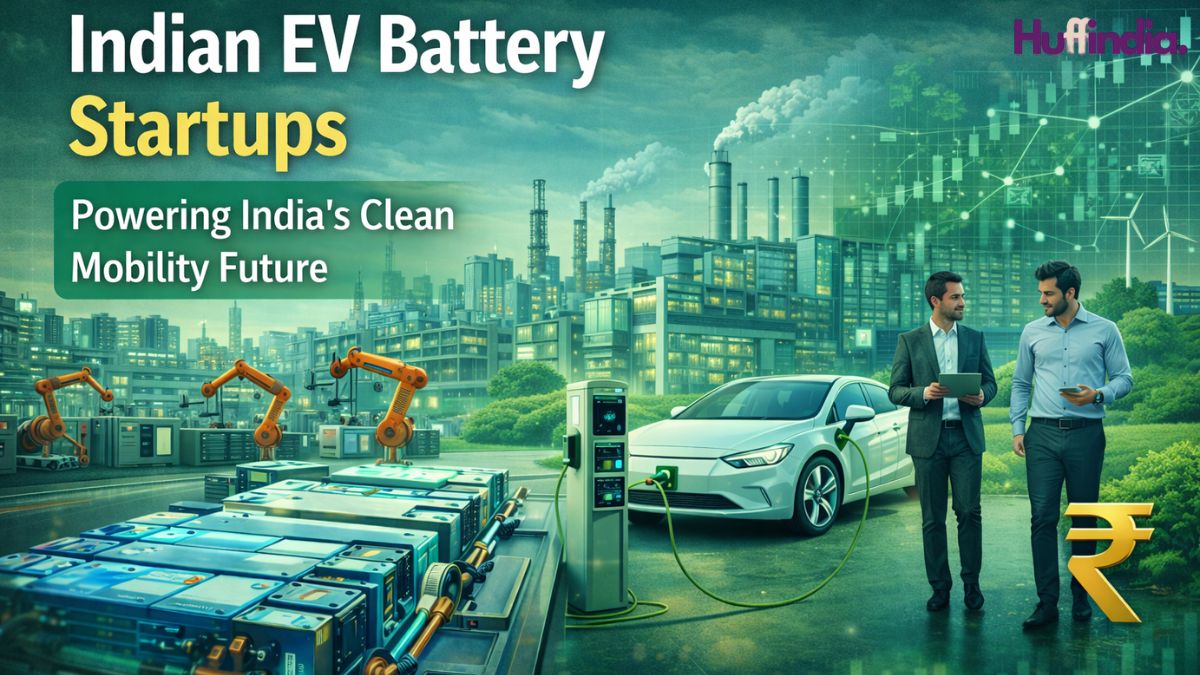



Indian EV battery startups are rapidly emerging as one of the most closely watched segments in the country’s clean mobility ecosystem. As electric vehicle adoption accelerates worldwide, investors are increasingly focusing on battery technology—the most critical and cost-intensive component of EVs. India’s growing ambition to become a global EV manufacturing hub has placed its battery innovators firmly on the international radar.
Why EV Batteries Matter So Much
Batteries account for nearly 40 per cent of an electric vehicle’s total cost. Control over battery technology not only determines vehicle affordability but also defines supply chain independence and long-term competitiveness.
For India, reducing reliance on imported battery cells has become a strategic priority. This has opened significant opportunities for EV battery manufacturing India, particularly across startups working on cell chemistry, battery management systems, and recycling technologies.
What’s Driving Investor Interest
Global capital is flowing into Indian EV battery startups for several reasons. First, India represents one of the world’s largest future EV markets. Second, policy incentives and production-linked schemes have reduced entry barriers for domestic manufacturers. Third, startups are focusing on cost-efficient solutions tailored to Indian conditions rather than copying Western models.
Venture capital firms and strategic investors see long-term value in India’s ability to scale battery production at competitive costs while serving both domestic and export markets.
Government Push and Policy Support
India’s clean mobility push has gained momentum through policy frameworks encouraging local manufacturing and technology development. Incentives aimed at battery storage and advanced chemistry cells are helping startups move from pilot projects to commercial-scale operations.
Industry experts say this policy environment has strengthened EV investment India, particularly in upstream components such as battery cells, modules, and thermal management systems.
At the same time, tighter emission norms and rising fuel costs are accelerating EV adoption, further strengthening demand forecasts.
Technology Innovation at the Core
Indian startups are not just assembling batteries—they are innovating across the value chain. Some are experimenting with alternative chemistries to reduce dependence on lithium imports, while others are building smarter battery management software to extend battery life and improve safety.
Recycling and second-life applications are also gaining traction. As EV adoption grows, managing battery waste responsibly has become essential for sustainable growth in clean mobility India.
Supply Chain Resilience and Global Context
The global EV industry has faced supply chain disruptions in recent years, exposing vulnerabilities in battery sourcing. India’s effort to build local battery capacity is seen as a hedge against such risks.
International manufacturers are exploring partnerships with Indian firms to diversify supply chains. This has positioned India as a potential alternative manufacturing base in the global EV ecosystem.
For a broader overview of global EV battery trends and supply chain challenges, analysis from the International Energy Agency provides useful context:
Challenges That Remain
Despite optimism, challenges persist. High capital requirements, raw material sourcing, and technology scalability remain hurdles for startups. Competition from established global players also adds pressure.
Industry observers note that long-term success will depend on continuous innovation, strong quality standards, and the ability to scale without compromising safety or performance.
As India moves toward its clean mobility goals, Indian EV battery startups are likely to play a defining role in shaping the future of transportation. Their success could determine whether India becomes a net importer of EV technology or a global supplier of affordable, sustainable battery solutions.
For investors, the sector represents both opportunity and risk—but few doubt its strategic importance. As global demand for EVs continues to rise, India’s battery startups may well become the backbone of the country’s electric mobility revolution.
Related: Tata Avinya EV Explained: Design, Platform, Features and Expected Launch
Related: Mahindra Scorpio N Facelift, 7XO Launch in 2026