
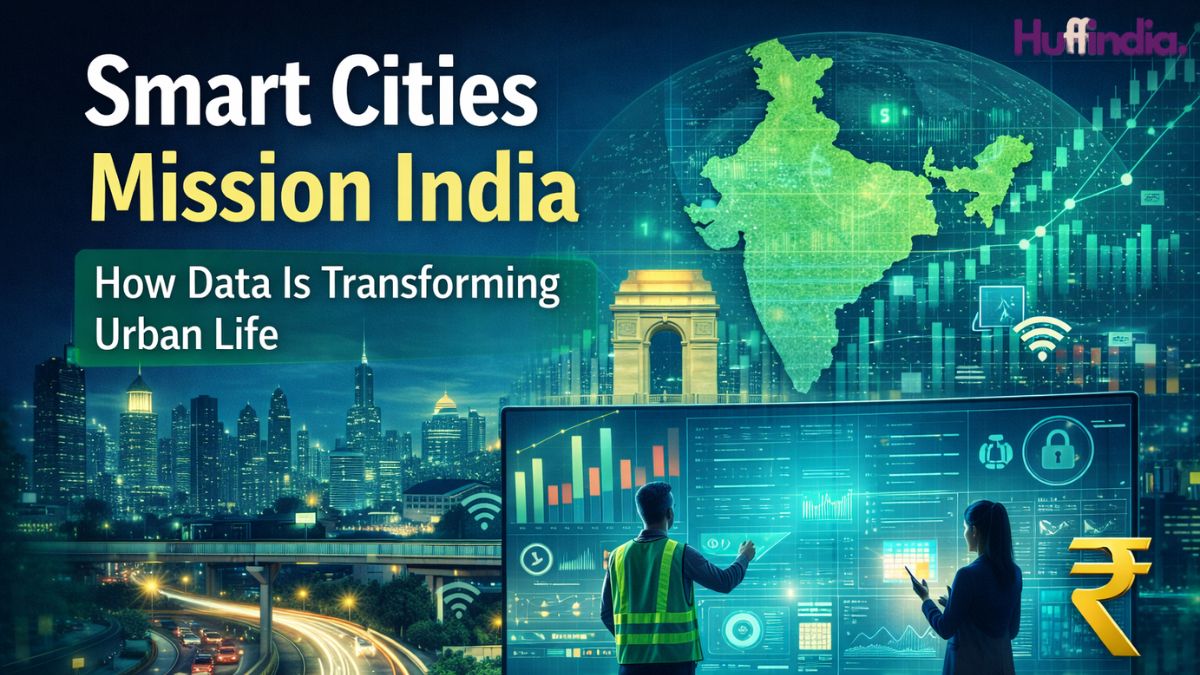



Smart Cities Mission India is no longer just an ambitious government programme—it is becoming a real-world experiment in how data, technology, and governance intersect to improve everyday urban life. Launched to modernise Indian cities, the mission is now entering a phase where outcomes, not announcements, are drawing attention.
Across multiple urban centres, data-driven systems are beginning to shape how cities manage traffic, water supply, waste, safety, and public services—often without residents even noticing the changes.
What Is the Smart Cities Mission?
The Smart Cities Mission was introduced to promote sustainable and citizen-friendly urban development by integrating digital technology into city management. Under the programme, selected cities receive funding and technical support to implement smart solutions tailored to local challenges.
Today, the focus of Smart Cities Mission India has shifted from infrastructure creation to governance efficiency—using data analytics, real-time monitoring, and digital platforms to improve service delivery.
How Data Is Changing Urban Governance
At the core of the mission lies the concept of data-driven governance India. Integrated Command and Control Centres (ICCCs) now operate in several cities, aggregating data from traffic sensors, CCTV networks, weather systems, and public utilities.
These platforms allow city officials to:
- Respond faster to emergencies
- Monitor congestion and pollution levels
- Optimise water and electricity usage
- Improve coordination between departments
Urban planners say such systems reduce decision-making delays and improve accountability—two long-standing challenges in municipal governance.
Everyday Impact on Citizens
While smart governance often sounds abstract, its effects are increasingly visible at street level. Adaptive traffic signals have reduced congestion in select corridors, while smart waste collection systems have improved sanitation efficiency.
In some cities, mobile apps allow residents to report civic issues, track resolutions, and access municipal services digitally. These changes are gradually reshaping the relationship between citizens and local governments.
Experts note that urban development India is entering a phase where service quality—not just expansion—is becoming the benchmark of progress.
The Role of Technology and Private Partnerships
Technology companies, startups, and infrastructure providers play a significant role in implementing smart solutions. Public-private partnerships have enabled cities to adopt innovations without bearing the entire financial burden.
Cloud platforms, AI-based analytics, and Internet of Things (IoT) devices are increasingly embedded in city operations. This ecosystem is positioning digital governance India as a model that other developing nations are beginning to study.
However, specialists caution that technology must remain a tool—not a substitute—for good policy design and administrative capacity.
Challenges and Concerns
Despite progress, challenges persist. Data privacy, cybersecurity, and system interoperability remain key concerns. Civil society groups have raised questions about surveillance safeguards and citizen consent.
Additionally, not all cities have progressed at the same pace. Variations in administrative capacity, funding utilisation, and technical expertise have led to uneven outcomes across regions.
Urban policy analysts argue that the next phase of the mission must prioritise governance reforms and capacity building alongside technological upgrades.
Global Perspective
Globally, smart city models are evolving rapidly. India’s approach—focused on practical problem-solving rather than futuristic concepts—has drawn interest from international urban development agencies.
For a broader understanding of global smart city frameworks and governance principles, resources from UN-Habitat provide comparative insights:
India’s experience could offer lessons for cities facing rapid urbanisation under resource constraints.
What Lies Ahead
As the programme matures, the long-term success of Smart Cities Mission India will depend on measurable outcomes—reduced service delays, improved environmental indicators, and higher citizen satisfaction.
Policy experts believe the mission’s real legacy may lie in changing how Indian cities are governed, rather than in the technology itself. If sustained and scaled effectively, smart governance could become a standard feature of urban administration across the country.
For millions of urban residents, these changes may not always be visible—but they are increasingly shaping how cities function behind the scenes.
Related: India first 40nm chip for Smart Meters Coming in 2026
Related: Amazon $35 Billion Investment in India | Major Boost for AI Jobs